Key Points
- Start with the hazard analysis and the way exposed ready-to-eat food moves through the facility. A generic site list will miss the routes most likely to carry contamination toward product.
- Define the target organism, sampling locations, number of sites, timing, frequency, method, laboratory, and corrective-action path in the written program.
- Routine rotation, vector sampling, intensified investigation, and finished-product testing answer different questions. Keep their purposes and decision rules separate.
- Sampling immediately after sanitation can hide a problem or allow residual sanitizer to interfere with recovery. Timing should challenge the control system under operating conditions.
- A positive result is useful information when the response is predetermined, risk based, and capable of finding the source, verifying removal, and preventing recurrence.
A practical framework for selecting sites, timing samples, choosing methods, and responding to findings in ready-to-eat food facilities.
Environmental monitoring works best as a deliberately designed verification system. It asks whether sanitation and other preventive controls are managing an environmental pathogen before contamination reaches exposed ready-to-eat food. A long list of swab points can create activity without producing that answer.
This guide focuses on facilities regulated by the U.S. Food and Drug Administration that manufacture, process, pack, or hold ready-to-eat food exposed to the environment before packaging. Meat, poultry, certain egg products, farms, retail operations, and other settings can fall under different requirements. Facility procedures, product risk, customer obligations, and applicable law control the actual program.
Separate the Regulatory Floor From Program Design
21 CFR 117.165 requires environmental monitoring when contamination of ready-to-eat food with an environmental pathogen is a hazard requiring a preventive control. The written procedures must be scientifically valid and identify the microorganism, sampling locations, number of sites, timing, frequency, test methods, laboratory, and corrective-action procedures. The regulation ties the location and frequency choices to whether the preventive controls are effective.
FDA’s 2017 draft Listeria guidance provides a detailed operating model for exposed ready-to-eat foods. FDA still labels that document as draft, nonbinding, and not for implementation. Its zoning, sampling, and response examples can inform a risk assessment, while the facility’s hazard analysis and applicable requirements determine the final plan.
The Part 117 requirements cited above are binding for covered facilities. The zone model, rotation strategy, decision table, and workflow below are editorial recommendations informed by FDA guidance. They require adaptation to the product, process, facility, preventive controls, and governing procedure.
Build the Plan Around Contamination Routes
The first design question is where an environmental organism could enter, survive, move, and reach exposed product. Follow the process from the validated lethality or other control step to final package. Mark exposed product, food-contact surfaces, water and condensate paths, employee and material traffic, air movement, cleaning transitions, mobile equipment, floor and drain connections, and difficult-to-clean interfaces.
| Decision | Evidence to Review | Program Consequence |
|---|---|---|
| Which hazard and organism? | Hazard analysis, product history, regulatory scope, ingredient and process risks, prior findings, and scientific literature | Select the environmental pathogen or appropriate indicator and define what a presumptive and confirmed result means. |
| Where can it travel? | Post-control process map, hygienic zones, people and equipment routes, moisture, niches, maintenance activity, and sanitation observations | Prioritize sites that reveal movement toward product rather than the easiest surfaces to reach. |
| When can the program reveal loss of control? | Production duration, cleaning cycle, wet events, start-up, changeovers, maintenance, and seasonal or construction changes | Set routine and event-driven timing that challenges the control system while preserving sample integrity. |
| How will the result be used? | Surface type, zone, organism, product exposure, growth potential, lot status, and recurrence history | Predefine notification, investigation, product assessment, cleaning, vector sampling, release, and escalation responsibilities. |
FDA’s draft guidance describes a four-zone example. Zone 1 contains food-contact surfaces. Zone 2 sits next to those surfaces, such as equipment framework or control panels. Zone 3 covers more distant non-food-contact areas within processing, and Zone 4 covers areas outside processing. The value of the model lies in relative product risk and movement pathways. A color-coded map without documented rationale adds little.
Product and Process Risk
Consider whether the food supports growth, whether consumers include vulnerable populations, how long product remains exposed, whether a subsequent control exists, and how contamination at each step could affect distributed food.
Facility Ecology
Use historical positives, recurring wet areas, worn seals, hollow rollers, drains, damaged floors, condensation, temporary repairs, and traffic crossings to identify sites where organisms could persist or move.
Operational Change
Add event-driven sites after maintenance, construction, water intrusion, line relocation, sanitation changes, extended downtime, or an unusual process upset. The routine list should evolve when the facility changes.
Information Value
A well-placed non-food-contact sample can provide an earlier warning than a food-contact result. A program should include enough near-product and pathway sites to show whether controls interrupt movement toward exposed food.
Choose Sites and Timing That Can Find a Problem
FDA’s draft guidance recommends selecting sites according to contamination potential and testing both food-contact and non-food-contact locations at each sampling time. It also suggests rotating through an extensive master list within a defined period. Sample number should reflect plant size, product flow, process, food characteristics, prior results, and the consequences of contamination. The example counts and frequencies in the draft guidance are source-specific recommendations rather than universal minimums.
Create a Master Site Register
For each site, record the line, equipment or area, hygienic zone, surface type, rationale, accessible area, routine or event-driven status, and relationship to exposed product. Photographs and equipment diagrams can prevent different samplers from interpreting a site name differently.
Build a Risk-Weighted Rotation
Keep critical near-product sites in the routine schedule and rotate lower-risk or hard-to-reach sites over a defined cycle. Reserve a portion of each event for investigative choices based on current observations, such as standing water or recent maintenance.
Sample During Meaningful Conditions
Collect when the process has had time to reveal transfer, growth, moisture, or equipment effects. FDA cautions that sampling too close to sanitation can leave sanitizer insufficiently neutralized and interfere with analysis. Record production time, sanitation status, line condition, temperature, and any abnormal event with the sample.
Protect the Route to the Laboratory
Standardize sample identification, aseptic collection, neutralizer, container, storage, transport, receipt criteria, chain of custody, and maximum method-specific hold time. The sample record should connect the analytical result to an exact place and operating condition.
FDA’s draft guidance recommends revising sites when a facility repeatedly obtains only negative results, because the program may be sampling surfaces that are easy to clean or poor at revealing contamination. Review recovery controls, neutralization, timing, site selection, and laboratory performance before concluding that the environment is consistently free of the target.
Match Collection and Analysis to the Decision
A method begins before enrichment. Swabs, sponges, sampling area, pressure, strokes, neutralizing broth, transport, enrichment volume, and confirmation pathway can all change recovery. The analytical method must cover the organism and sample type, and the facility should verify that the collection system and laboratory workflow perform as intended for its surfaces, residues, sanitizers, and logistics.
FDA’s current Bacteriological Analytical Manual Chapter 10 includes detection of Listeria monocytogenes in food and environmental samples. FDA also lists several equivalent methodologies for defined environmental-sample applications. A commercial rapid method’s validation claim still needs to match the actual surface, enrichment, organism, confirmation, and decision use.
| Strategy | Primary Question | Operational Tradeoff | Decision Boundary |
|---|---|---|---|
| Routine risk-weighted rotation | Are preventive controls working across representative near-product and pathway sites? | Provides trendable data, while a rigid list can overlook new risks. | Use the approved organism, sites, timing, method, and routine response procedure. |
| Vector sampling around a finding | Where is the source, and how could it move? | Adds spatial evidence, while cleaning or production changes can alter the map before samples are collected. | Define the radius, adjacent components, upstream and downstream paths, and escalation triggers before interpreting negatives. |
| Intensified or investigative sampling | Did corrective action remove the source and control the route? | Improves confidence, while it consumes capacity and can delay restart or release. | Predefine who authorizes the plan, what must be negative, and when the investigation can close. |
| Product testing | Is the sampled lot or product unit contaminated under the approved plan? | Directly addresses product, while a limited sample cannot prove an entire lot is free of a low-prevalence hazard. | Treat product decisions separately from environmental verification and use an appropriate statistically and scientifically justified plan. |
In-house testing can shorten information flow and keep facility context close to the bench. It also requires method competence, controls, contamination management, data governance, and surge capacity during an investigation. A contract laboratory can add specialized capability and independence, with added transport time and a greater need for clear decision rules. LabPress’s guide to contract laboratory testing covers laboratory qualification, quality agreements, and sample handoff.
High-volume laboratories may automate enrichment transfers, plate setup, or molecular workflows after confirming that the system fits the validated method and contamination controls. The automated liquid handling systems guide outlines throughput, containment, software, and service questions for equipment evaluation.
Design the Response Before the Result Arrives
A positive finding should activate a defined decision path. The response depends on the organism, zone, surface, product exposure, product growth potential, related production, prior findings, and whether a plausible transfer route exists. 21 CFR 117.150 requires corrective-action procedures for covered preventive controls and circumstances, including evaluation of affected food when appropriate.
Notify and Preserve Context
Alert the designated food-safety and quality leaders. Preserve the sample identity, production and sanitation records, product status, maintenance activity, photographs, nearby conditions, and any available isolate. Document what changed after collection.
Assess Product and Process Exposure
Map the finding to food-contact status, time, line, lots, transfer routes, and any subsequent control. Product hold, testing, disposition, or recall assessment should follow the approved risk-based procedure and applicable requirements.
Investigate Before Evidence Disappears
Inspect the site and surrounding equipment before aggressive cleaning when operations and safety allow. Look for moisture, damage, residue, hollow areas, worn seals, airflow, traffic, or sanitation gaps. Then execute the approved cleaning, disassembly, and vector-sampling plan.
Verify Removal and Prevent Recurrence
Use intensified sampling with predefined closure criteria. Trend by site, zone, line, organism, date, shift, and event. Repeated findings near the same area can indicate harborage even when individual corrective actions produced temporary negatives.
FDA’s environmental-sampling overview emphasizes that occasional detection can be a sign that a robust program is capable of finding hazards. The quality of the response matters. The agency points to source finding, risk-based corrective action, and verification that the contamination and harborage have been eliminated.
Illustrative Ready-to-Eat Salad Workflow
A facility produces refrigerated ready-to-eat salad after a validated wash step. Product is exposed during dewatering, conveying, ingredient addition, and packaging. The food-safety team identifies Listeria monocytogenes as an environmental pathogen hazard requiring a sanitation preventive control and environmental monitoring. The following invented scenario demonstrates decision logic. It does not establish a sample count, frequency, hold rule, or release criterion for another facility.
The master register includes food-contact belt joints and filler components, adjacent framework and control housings, wheel and foot traffic paths, drains, and remote corridor sites. The routine rotation keeps selected near-product sites in every event and rotates supporting sites across a defined cycle. A smaller event-driven group changes after maintenance, condensation, or standing-water observations.
A routine sample from the underside of framework beside the post-wash conveyor is presumptive positive for Listeria species. The site is a non-food-contact surface close to exposed product. The team preserves the production and sanitation context, inspects the area, and finds intermittent condensate tracking from a damaged insulation seam. Product and lot decisions follow the facility’s approved procedure. The investigation maps condensate, fasteners, framework joints, the belt edge, floor splash, and maintenance access.
After the repair and intensified cleaning, vector samples cover the source, routes toward food-contact surfaces, and downstream sites. Closure requires the facility’s predefined negative-result pattern and confirmation that the repair, sanitation, and traffic changes remain effective. The finding also triggers a review of similar insulated lines rather than treating the event as a single dirty surface.
Common Failure Modes That Weaken the Program
Sampling the Cleanest Moment
Preoperational sampling can verify sanitation, while an exclusive focus on freshly sanitized surfaces may miss contamination that emerges during production. Tie each timing choice to a specific control question.
Freezing the Site List
Equipment wear, maintenance, construction, product changes, and traffic patterns create new routes. Review the master register after change and when trends stay implausibly quiet.
Using Product Testing as Proof of Control
Finished-product negatives provide evidence about the sampled units. They cannot replace environmental verification or prove a low-prevalence hazard is absent from an entire lot.
Cleaning Without Investigating
Immediate sanitation can remove visible evidence before the source and transfer route are documented. Build a safe inspection and evidence-preservation step into the response.
Treating Every Positive the Same
A remote indicator finding and a confirmed pathogen on a post-control food-contact surface carry different implications. The decision tree should incorporate organism, location, product exposure, recurrence, and growth potential.
Closing on Temporary Negatives
Short follow-up sequences can miss intermittent moisture or equipment-cycle effects. Use trend analysis and source-specific verification to show that corrective action remains effective.
Environmental Monitoring Plan Checklist
- Connect the plan to the hazard analysis. State the product, process, environmental pathogen or indicator, preventive control, and verification objective.
- Map exposure and movement. Document post-control product flow, hygienic zones, water, air, people, tools, waste, and mobile equipment.
- Build the site register. Give every site a unique identity, zone, surface type, rationale, sample area, and routine or event-driven status.
- Set risk-based timing and rotation. Define operating condition, production time, frequency, rotating coverage, and change triggers.
- Control collection variables. Specify device, neutralizer, aseptic technique, area, labeling, transport, receipt, and method-specific hold time.
- Qualify the method and laboratory. Confirm organism, surface scope, enrichment, detection, confirmation, controls, reporting, competence, and capacity.
- Predefine result handling. Assign notification, product assessment, investigation, sanitation, vector sampling, release, escalation, and recall-assessment responsibilities.
- Trend meaningful dimensions. Review site, zone, line, organism, date, shift, season, maintenance, and recurrence rather than a simple monthly positive rate.
- Verify corrective action. Establish source-specific follow-up and closure criteria before declaring the issue resolved.
- Review the system. Update the plan after changes, recurring findings, implausibly uniform negatives, method changes, or new hazard information.
Which Signal Improves Your Program Most?
Has your strongest environmental insight come from routine rotation, an event-driven sample, vector sampling around a positive, or long-term trend review? Share the approach in the comments without disclosing confidential facility or product information.
Sources and Scope
Sources checked Oct. 11, 2026. Regulatory statements refer to the cited U.S. requirements. FDA guidance is identified as draft and nonbinding. Editorial workflow suggestions do not replace a facility’s hazard analysis, food-safety plan, approved procedures, or legal advice.
- 21 CFR 117.165, Verification of Implementation and Effectiveness, eCFR current through Oct. 8, 2026.
- 21 CFR 117.150, Corrective Actions and Corrections, eCFR current through Oct. 8, 2026.
- FDA, Draft Guidance for Industry: Control of Listeria monocytogenes in Ready-To-Eat Foods, January 2017.
- FDA, Bacteriological Analytical Manual Chapter 10, April 2022 edition.
- FDA, Equivalent Testing Methodologies for Listeria Species and L. monocytogenes in Environmental Samples.
- FDA, Environmental Sampling.
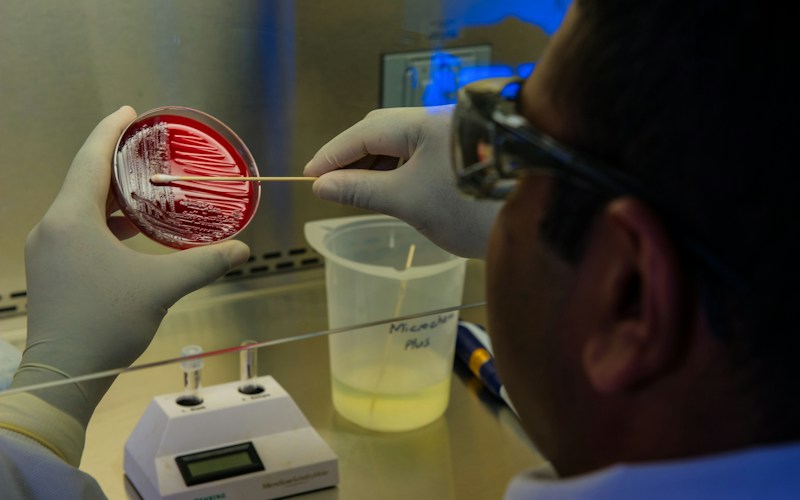
Featured photograph: CDC via Unsplash. The image shows foodborne-disease laboratory work and does not depict the hypothetical facility or sampling event described here.
Keep Exploring
Related Reading

Lab Lowdown for October 9, 2026
Seven laboratory developments span fentanyl surveillance, lung organoids, food-quality testing, microscopy, informatics, LC-MS preparation, and mosquito testing.Read Article
Investigating Out-of-Specification Results in Pharmaceutical QC Laboratories
A practical framework for preserving evidence, choosing additional testing, expanding the investigation, and supporting a defensible pharmaceutical OOS decision.Read Article




Leave a Reply