
Key Points
- An academic research laboratory is a university or college-based environment where researchers create and test new knowledge, train students, and share methods and results.
- The work may happen at a bench, in a field station, in a shared core facility, or entirely through computation. The research question determines the setting and tools.
- A credible project connects a focused question with an appropriate design, controls, documented methods, traceable data, analysis, and conclusions that stay within the evidence.
- Oversight depends on the work. Human participants, vertebrate animals, recombinant or synthetic nucleic acid molecules, hazardous chemicals, and other risks can trigger different reviews and controls.
- Early results are often uncertain. Replication, transparent reporting, responsible data stewardship, and independent scrutiny help turn an observation into durable knowledge.
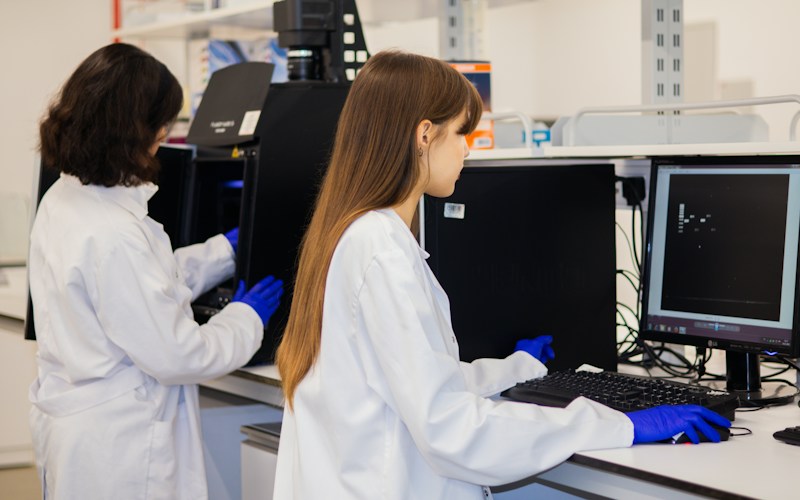
Academic laboratory research is the organized investigation of questions within a college, university, teaching hospital, or affiliated research institute. Its purpose is broader than running tests for a customer or releasing a product. Academic laboratories explore how the world works, evaluate possible explanations, develop methods and technologies, train researchers, and make evidence available for others to examine.
The word laboratory can be misleadingly narrow. It may describe a chemistry room with fume hoods, a biology space with cell culture equipment, an engineering shop, a behavioral research suite, a campus cleanroom, a field station, or a computational group analyzing large datasets. Many projects move through several of these environments. What unites them is a disciplined effort to ask a testable question and build an answer from observable evidence.
What Academic Laboratory Research Means
Research begins with a question whose answer is not already established. A project may describe a phenomenon, test a proposed mechanism, compare competing explanations, build a measurement technique, or evaluate whether an observation holds under new conditions. The goal is to produce knowledge that can survive careful review, rather than to make a predetermined result appear true.
Some academic research is basic research, which seeks fundamental understanding without requiring an immediate application. Other work is applied research, which addresses a defined practical problem. Translational research connects discoveries with potential use in medicine, engineering, agriculture, policy, or another domain. These categories overlap, and a laboratory can contribute to more than one.
Academic laboratories differ from routine testing laboratories in their primary mission. A routine laboratory often follows an established method to answer a recurring question for a client, manufacturer, clinician, or regulator. An academic group may need to invent the method, determine whether it works, and explain its limitations. That freedom creates opportunity and uncertainty. A novel protocol still requires controls, calibration, records, and enough detail for another qualified researcher to understand what was done.
Discovery
Method Development
Training
Shared Knowledge
Where Academic Research Happens
| Setting | Typical Work | Shared Resources | Key Boundary |
|---|---|---|---|
| Wet laboratory | Chemical reactions, cell culture, molecular biology, materials preparation, sample extraction, and instrumental analysis | Fume hoods, biosafety cabinets, balances, incubators, chromatographs, spectrometers, and cold storage | Containment, contamination control, chemical compatibility, and sample stability shape the method. |
| Computational laboratory | Simulation, statistical analysis, bioinformatics, image analysis, machine learning, and software development | Code repositories, research computing clusters, cloud resources, databases, and versioned workflows | Data provenance, software versions, model assumptions, and information security remain experimental concerns. |
| Field or observatory program | Environmental sampling, ecology, geology, archaeology, atmospheric measurements, and community-based research | Portable sensors, maps, field logs, sample containers, geographic information systems, and remote stations | Weather, location, sampling access, transport, and uncontrolled conditions affect representativeness. |
| Core facility | Specialized services such as microscopy, sequencing, flow cytometry, mass spectrometry, cleanroom fabrication, or animal imaging | Expert staff, high-cost instruments, common methods, scheduling, training, and data infrastructure | The investigator and core should define responsibilities for study design, sample quality, analysis, authorship, and records. |
| Teaching laboratory | Structured exercises and course-based undergraduate research | Standardized protocols, supervised equipment, training materials, and defined learning objectives | A demonstration with an expected outcome is education. A genuine research experience includes an unresolved question and authentic uncertainty. |
A single project can begin with field samples, continue through a core facility, and end in a computational laboratory. The handoffs are part of the research. Sample identifiers, metadata, instrument files, analysis scripts, and decision records must remain connected as work moves between people and systems.
Who Works in an Academic Research Laboratory?
The principal investigator, usually abbreviated PI, leads the research program and is accountable for scientific direction, funding, supervision, and compliance. A PI does not perform every task. The role is to create conditions in which the team can ask meaningful questions, work safely, keep reliable records, and report results honestly.
Graduate students often combine coursework with research that contributes to a thesis or dissertation. Postdoctoral researchers are doctorate-level scholars developing greater independence. Research scientists, laboratory managers, technicians, engineers, data specialists, and project coordinators provide essential continuity and expertise. Undergraduate students may participate through mentored projects, paid roles, or course-based research. Core facility staff help investigators select suitable methods, prepare samples, operate specialized systems, and interpret technical quality checks.
Job titles do not define every responsibility. A healthy laboratory makes expectations explicit: who approves a protocol, who may operate an instrument, where data are stored, how deviations are documented, who reviews analysis code, and how contributions affect authorship. Mentoring and psychological safety matter because trainees need to be able to report an error, unexpected result, or unsafe condition promptly.
The Core Academic Research Workflow
The workflow is iterative. A failed control can send a team back to sample preparation. An analysis may reveal a confounding variable. Peer review may expose an assumption that needs a new experiment. Iteration is a normal part of research when the changes are documented and conclusions reflect what was actually done.
Controls, Replication, and Experimental Design
A variable is a feature that can differ among observations or conditions. The independent variable is the factor the study changes or compares. The dependent variable is the measured outcome. A confounder is another factor associated with both the comparison and the outcome, making causal interpretation difficult.
Controls help reveal what produced a signal. A negative control is expected to lack the effect or target and can expose contamination or background. A positive control is expected to produce a known response and can show whether the measurement system worked. A vehicle control can isolate the effect of a solvent or carrier. The useful control depends on the question and method.
Replication also needs a precise definition. Repeated readings from the same prepared sample estimate instrument or measurement repeatability. Independent sample preparations include more procedural variation. Biological replicates represent distinct biological units. Treating repeated measurements of one unit as if they were independent can exaggerate certainty.
Randomization can reduce systematic allocation bias. Blinding, when feasible, can limit the influence of expectations during treatment, measurement, or interpretation. Sample size should follow the study design, expected variability, effect or precision of interest, and analysis plan. A large dataset does not repair biased sampling or an unsuitable comparison.
The National Institutes of Health defines scientific rigor as the strict application of the scientific method to support unbiased, well-controlled design, methodology, analysis, interpretation, and reporting. NIH guidance emphasizes the rigor of prior research, appropriate biological variables, and authentication of important biological and chemical resources. These principles are valuable beyond NIH-funded biomedical work.
A Concrete Example: Studying Nutrient Runoff in Campus Water
Consider a hypothetical university team asking whether stormwater leaving two landscaped campus catchments carries different nitrate concentrations after rainfall. This example shows how an academic question becomes a laboratory workflow. It is not a regulatory monitoring plan or a universal environmental method.
The team first defines the comparison. One catchment drains a conventionally managed lawn, while the other drains a planted rain garden. The investigators identify storm events, sampling locations, collection timing, rainfall amount, upstream influences, and nitrate as the primary measurement. They review prior research and local drainage maps before deciding that the catchments are comparable enough for an exploratory study.
A written plan specifies clean containers, field blanks, duplicate samples, preservation, holding time, calibration checks, and the analytical method. The team records date, time, weather, flow observations, location, sampler, and sample identifier. A laboratory information management system, electronic research notebook, or carefully controlled spreadsheet can connect those records to instrument files and results.
The students learn that a single bottle from each location is weak evidence. Rainfall intensity, antecedent dry period, fertilizer timing, flow, temperature, and sampling time can affect concentration. Repeated storm events provide more independent information than repeated instrument readings from one bottle. If the study aims to compare total nutrient export rather than concentration alone, the design also needs defensible flow measurements.
The laboratory calibrates its measurement system, runs blank and check samples, and analyzes the field samples within the method’s requirements. Researchers review calibration performance, blanks, duplicate agreement, values outside the working range, and any handling deviation before analyzing the comparison. They retain the raw signals and record every processing step.
Suppose the rain-garden samples have lower nitrate concentrations in most observed storms. The careful conclusion is that the study found an association under the sampled conditions. The result does not establish that every rain garden reduces nitrate, that nitrate mass was lower without flow data, or that the landscape feature alone caused the difference. Additional sites, events, randomized or matched designs, and measurements of other plausible influences would strengthen causal and general conclusions.
Safety, Ethics, and Institutional Oversight
Academic freedom does not remove responsibility. The relevant oversight depends on what the project involves. In the United States, an institutional review board, or IRB, reviews covered research involving human participants under applicable human-subject protections. An Institutional Animal Care and Use Committee, or IACUC, oversees covered activities involving vertebrate animals. An Institutional Biosafety Committee, or IBC, provides local review and oversight for much research involving recombinant or synthetic nucleic acid molecules under the NIH Guidelines.
These committees serve different purposes, and their names should not be used interchangeably. A project can require more than one review. Other work may need radiation safety, controlled-substance authorization, export-control review, privacy and security assessment, conflict-of-interest disclosure, field permits, material transfer agreements, or environmental health and safety approval.
For U.S. workplaces where the Occupational Safety and Health Administration’s Laboratory Standard applies, employers must develop and carry out a written Chemical Hygiene Plan. The plan addresses procedures, equipment, personal protective equipment, and work practices designed to protect employees from hazardous chemicals. The standard does not replace a project-specific hazard assessment, training, compatible storage, exposure controls, waste procedures, and emergency planning.
- The research protocol and approved version are available to the people doing the work.
- Required institutional reviews, permits, agreements, and training are complete.
- Hazards, containment, personal protective equipment, waste, spills, and emergency actions have been assessed.
- Samples, participants, animals, organisms, materials, and data have approved identifiers and handling rules.
- Instrument access, maintenance status, calibration, and user competency are suitable for the planned method.
- Raw data, notebooks, code, metadata, and deviations have defined storage, backup, access, and retention practices.
Data Stewardship and Research Integrity
Research data are more than the final values in a chart. They can include original images, spectra, sequence files, sensor streams, survey responses, field notes, instrument methods, calibration results, code, metadata, and decisions about exclusions or transformations. A reader should be able to understand where a reported result came from, even when confidentiality or security prevents public release of the underlying files.
Good stewardship begins before collection. A data-management plan defines formats, file naming, identifiers, metadata, quality checks, storage, backups, access, version control, retention, preservation, and sharing. The NIH Data Management and Sharing Policy requires a prospective plan for covered NIH-funded or conducted research that generates scientific data, with limited exceptions. Appropriate sharing can still be limited by legal, ethical, privacy, security, or technical factors.
Research integrity includes honest methods and records, responsible authorship, fair peer review, appropriate handling of conflicts, and correction of the literature when needed. The U.S. National Science Foundation describes responsible and ethical conduct of research as central to both excellence and public trust. A research culture supports integrity when it rewards careful work, makes expectations clear, and gives team members safe routes to raise concerns.
For instruments and laboratory software, traceability should extend from the sample and protocol to the raw file, processing method, software version, and reported result. LabPress’s guide to connecting instruments to LIMS and electronic laboratory notebooks explains practical data-flow questions. A laboratory information management system, or LIMS, and an electronic laboratory notebook, or ELN, can improve organization and access control. They still require well-defined responsibilities and procedures.
Common Misconceptions and Practical Limitations
One Experiment Rarely Settles a Broad Question
A result can be technically correct for the tested samples and conditions while having limited generality. Models simplify reality. Cell lines change. Participants differ. Field sites are heterogeneous. Instruments have measurement limits. Independent confirmation, new populations, alternative methods, and replication across laboratories can show whether a finding travels beyond its original setting.
Peer Review Is a Quality Check, Not a Guarantee
Peer review can improve a paper by challenging logic, methods, and presentation. Reviewers do not usually repeat the experiments or audit every underlying record. Published findings should still be interpreted through study design, sample selection, uncertainty, transparency, consistency with other evidence, and subsequent attempts to reproduce or extend the work.
Statistical Significance Does Not Measure Importance
A statistical threshold does not tell readers whether an effect is large, useful, causal, or reproducible. Effect estimates, uncertainty intervals, study design, prior evidence, multiple comparisons, missing data, and practical context are also needed. Exploratory analysis can generate valuable hypotheses when it is labeled clearly.
New Equipment Does Not Fix a Weak Study
Resolution, sensitivity, throughput, or automation can expand what a laboratory measures. A sophisticated instrument cannot compensate for biased sampling, missing controls, misidentified materials, unsuitable preparation, or undocumented analysis choices. Procurement should begin with the scientific question and complete workflow. LabPress’s laboratory instrumentation buyer’s guide provides a category-level framework, while its liquid-handling systems guide shows how actual protocols should drive automation decisions.
Unexpected Results Are Information
An unexpected result can reveal a new phenomenon, an incorrect assumption, a hidden variable, a sample problem, or a method failure. The response is to investigate systematically. Researchers should inspect controls, records, raw data, calibration, materials, and plausible alternatives before selecting the explanation they prefer.
Practical Takeaways for New Researchers
Write the Question First
Make Work Reconstructable
Separate Observation From Interpretation
Ask Early
Beginners can build research judgment by following one project from its original question through the final figure. At each stage, ask what could change the result, what evidence would reveal that problem, and what another researcher would need to evaluate the conclusion. For a focused look at biological work, read LabPress’s introduction to life science research.
Frequently Asked Questions
What is the difference between academic research and routine laboratory testing?
Academic research usually addresses a question with genuine uncertainty and may develop new methods or explanations. Routine testing usually applies an established procedure to recurring samples and decision rules. Both need trained staff, suitable methods, quality controls, records, and honest reporting.
Do all academic research projects need an IRB?
No. An IRB addresses covered research involving human participants under applicable rules. Animal, biosafety, chemical, radiation, privacy, and other concerns use different oversight pathways. The institution’s designated office should determine which reviews apply before work begins.
What does a principal investigator do?
A principal investigator leads the scientific program and is accountable for research direction, funding, supervision, records, safety, compliance, and communication. Duties are shared across a team, but responsibility cannot be reduced to owning the laboratory space.
What is the difference between a technical replicate and an independent replicate?
A technical replicate repeats part of a measurement on the same underlying sample and primarily informs measurement repeatability. An independent replicate begins with a distinct experimental or biological unit and captures more sources of variation. The design and analysis should identify which type is being used.
Does a statistically significant result prove the hypothesis?
No. Statistical significance describes a result under a model and decision threshold. It does not by itself establish causation, importance, absence of bias, or reproducibility. Study design, effect size, uncertainty, prior evidence, data quality, and independent confirmation also matter.
Must academic research data always be public?
No. Sharing expectations depend on the funding source, consent, privacy, intellectual property, security, agreements, and the type of data. Researchers should plan for the widest responsible sharing that is lawful and ethical, and they should document restrictions when full public release is inappropriate.
Authoritative Sources and Further Reading
- National Institutes of Health: Enhancing Reproducibility Through Rigor and Transparency
- National Institutes of Health: Data Management and Sharing Policy Overview
- U.S. National Science Foundation: Responsible and Ethical Conduct of Research
- Occupational Safety and Health Administration: Occupational Exposure to Hazardous Chemicals in Laboratories
- Office for Human Research Protections: 45 CFR 46
- Office of Laboratory Animal Welfare: The Institutional Animal Care and Use Committee
- NIH Office of Science Policy: Institutional Biosafety Committee Administration
Keep Exploring
Related Reading
What Is Oil, Gas, and Mining Testing?
A beginner’s guide to oil, gas, and mining testing, from representative sampling and common analytical methods to quality control,…Read Article
What Is Manufacturing Quality Testing?
A beginner’s guide to manufacturing quality testing, including inspection stages, measurement systems, process control, nonconformance, and practical limitations.Read Article




Leave a Reply