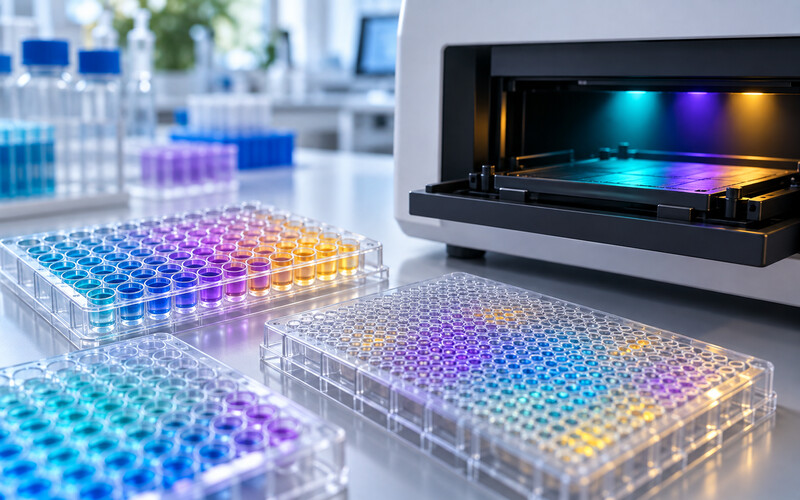
The best microplate reader is the instrument that matches the assay’s optical physics, plate format, environmental needs, and decision workflow. This guide ranks six established suppliers for research laboratories that need multimode detection, with particular attention to cell-based assays, imaging, kinetic measurements, high-throughput screening, software, and long-term adaptability.
Editorial Disclosure
LabPress did not conduct hands-on testing and did not receive compensation for these rankings. Positions reflect the purchasing scope and cited manufacturer materials. Capabilities vary by model, module, configuration, software release, region, and assay. Buyers should verify performance with representative plates, reagents, cells, methods, users, and data workflows.
Decision Snapshot
Quick Comparison
| Rank | Vendor And Representative Families | Best Fit | Documented Strength | Primary Buying Check |
|---|---|---|---|---|
| 1 | BMG LABTECH CLARIOstar Plus, PHERAstar FSX, VANTAstar | Reader-centered laboratories seeking deep multimode choice | Dedicated microplate-reader portfolio spanning research multimode and high-throughput systems | Match optics, accessories, automation, and analysis software to every priority assay. |
| 2 | Molecular Devices SpectraMax iD5e, i3x, iD3s | Broad research workflows and labs standardizing on SoftMax Pro | Flexible SpectraMax portfolio, modular options, imaging add-ons, and established software ecosystem | Price the exact modes, cartridges, injectors, imaging, compliance, and license configuration. |
| 3 | Agilent BioTek Synergy H1, Cytation families | Hybrid detection and cell-based workflows needing imaging | Monochromator and filter-based optics, Gen5 software, and imaging-capable Cytation systems | Determine when bulk detection is sufficient and when objective-based imaging is required. |
| 4 | Tecan Spark, Spark Cyto, Infinite 200 PRO | Configurable research, live-cell, and automation workflows | Multimode detection with modular functions, cell imaging and cytometry options, environmental control | Verify the proposed modules and their compatibility with later upgrades and automation. |
| 5 | Revvity EnVision Nexus | High-throughput screening and Revvity assay technologies | Fast multimode detection, optional Alpha and laser TRF capabilities, dual-detector architecture | Validate assay-specific sensitivity, plate timing, proprietary technology needs, and software controls. |
| 6 | Thermo Fisher Scientific Varioskan LUX | General-purpose multimode work in familiar Thermo workflows | Broad configurable detection modes with SkanIt software and Thermo Fisher support reach | Confirm configuration, accessories, analysis workflow, and suitability for demanding screening assays. |
This is an editorial ranking against the stated scope. It is not a measured score, performance test, market-share estimate, or assertion that one reader is best for every assay.
How We Ranked
Ranking Scope And Method
Available modes, wavelength selection, filters and monochromators, read direction, dynamic range, plate compatibility, and assay-specific options.
Temperature and gas control, shaking, bottom reading, injectors, imaging, confluence, morphology, cytometry, and kinetic workflows.
Read speed, plate formats, stacking or robotic access, scheduling, automation interfaces, and unattended recovery.
Method design, analysis, visualization, export, APIs, user administration, auditability, security, and regulated-workflow options.
A credible path from routine assays to advanced multimode, imaging, and screening without forcing unnecessary complexity.
Application expertise, installation, training, service, qualification support, upgrades, consumables, and long-term ownership clarity.
Manufacturer pages and official product materials were used to establish offered capabilities. Editorial judgment then considered how completely each portfolio addresses the purchasing scope. Buyers should treat published sensitivity, speed, and dynamic-range specifications as method-dependent claims that require confirmation under representative conditions.
Ranked Vendors
Overall Microplate Reader Vendor Rankings

BMG LABTECH
BMG LABTECH focuses its instrument business on microplate readers. Its current portfolio ranges from SPECTROstar and Omega systems through VANTAstar and CLARIOstar Plus to the PHERAstar FSX high-throughput platform. That depth supports a coherent comparison across routine absorbance, advanced multimode research, kinetic assays, reagent injection, environmental control, and screening applications.
Why it ranks first. The company’s concentration on plate-reading technology, breadth of reader tiers, and advanced multimode and screening choices align closely with this guide’s scope. CLARIOstar Plus is positioned for flexible assay development, while PHERAstar FSX addresses high-throughput and high-sensitivity work.
Tradeoffs. A specialist portfolio still requires careful model selection. Imaging needs may point buyers toward vendors with integrated objective-based imaging systems. Confirm the practical analysis workflow and compatibility with the laboratory’s automation and data environment.
Run the same representative assay on the proposed optical configuration and nearest lower-tier model. Compare setup effort, edge-well behavior, read time, analysis, export, and the value of each added option.

Molecular Devices
Molecular Devices offers a wide SpectraMax line that includes multimode, absorbance, fluorescence, and luminescence readers. The SpectraMax i3x base configuration covers absorbance, fluorescence, and luminescence, with options for time-resolved fluorescence, HTRF, fluorescence polarization, Alpha technologies, injectors, and MiniMax imaging. Current iD systems extend the research multimode line, while SoftMax Pro provides method control and analysis with additional regulated-workflow options.
Why it ranks second. The combination of instrument breadth, modular detection, optional imaging, software continuity, and a large installed ecosystem makes Molecular Devices a versatile choice for research and shared facilities.
Tradeoffs. Modular breadth can make two apparently similar quotations materially different. Imaging through a reader add-on should be assessed against the laboratory’s actual spatial-analysis needs and against dedicated imaging-reader alternatives.
Build a configuration matrix that lists every mode, cartridge, filter, injector, imaging option, software module, user license, and compliance feature included on day one and available later.

Agilent BioTek
Agilent’s BioTek portfolio joins Synergy multimode readers with Cytation cell-imaging multimode systems. Synergy H1 combines monochromator and filter-based optics, while Cytation platforms add objective-based microscopy functions for cellular workflows. Gen5 software spans instrument control, protocol design, data reduction, and imaging analysis across much of the family.
Why it ranks third. Hybrid optics can serve exploratory wavelength flexibility and optimized filter-based performance in one platform. The step from Synergy to Cytation gives laboratories a clear path when cell morphology, confluence, counting, and image-based context become central.
Tradeoffs. Broader imaging capability raises method-development, storage, analysis, and training demands. Buyers should define whether they need occasional image confirmation, quantitative cell imaging, or high-content analysis before selecting a Cytation configuration.
Use one cell-based method to compare bulk well signal with image-based results. Define focus, fields, objectives, segmentation, environmental stability, analysis review, file size, and acceptance criteria.

Tecan
Tecan’s Spark family combines multimode plate reading with configurable modules and environmental options. Spark Cyto extends the platform toward live-cell imaging and cytometry, while the Infinite 200 PRO serves routine and research multimode applications. The portfolio sits within a broader Tecan automation ecosystem, which can be relevant for laboratories planning robotic workflows.
Why it ranks fourth. Tecan offers a strong bridge between plate detection, cell-focused options, and laboratory automation. Spark’s modular approach can support changing applications without beginning at the most elaborate configuration.
Tradeoffs. Optionality makes the exact bill of materials decisive. A general Spark capability statement does not show which functions are present in a specific instrument. Imaging and cytometry expectations must be tested against representative cells and analyses.
Request a serial-number-level configuration and upgrade map. Demonstrate temperature, gas control, imaging, injectors, automation access, and software functions on the proposed system.

Revvity
Revvity’s EnVision Nexus is a high-throughput multimode platform supporting absorbance, fluorescence intensity, luminescence, time-resolved fluorescence, and fluorescence polarization, with configuration options for Alpha technologies, laser time-resolved fluorescence, and ultrasensitive luminescence. Manufacturer materials also describe a dual-detector architecture and Kaleido software options, including enhanced security functions.
Why it ranks fifth. EnVision Nexus is especially compelling when the assay portfolio uses Revvity detection technologies or when screening speed, sensitivity, and plate-handling integration drive the purchase.
Tradeoffs. A screening-oriented platform may exceed the needs and complexity tolerance of a general research laboratory. Proprietary assay technology requirements, option costs, service, and software governance should be evaluated together.
Benchmark the priority proximity and luminescence assays at realistic plate counts. Include controls, plate movement, analysis, repeat criteria, maintenance, and data transfer rather than timing a read step alone.

Thermo Fisher Scientific
Thermo Scientific Varioskan LUX is a configurable multimode reader covering absorbance, fluorescence intensity, luminescence, time-resolved fluorescence, and AlphaScreen functions depending on configuration. SkanIt software supports instrument control and data analysis, and the platform can be combined with environmental and reagent-dispensing options for varied assays.
Why it ranks sixth. Varioskan LUX provides broad multimode capability from a supplier with extensive life-science infrastructure and service reach. It can be a pragmatic choice for laboratories seeking a versatile research reader without an imaging requirement.
Tradeoffs. Buyers with demanding high-throughput, advanced imaging, or specialized proximity-assay needs should compare purpose-built alternatives. Confirm exactly which modes and accessories are present and how data will move into downstream systems.
Run representative absorbance, fluorescence, and luminescence assays through SkanIt from protocol creation to reviewed export. Include injector timing and environmental recovery if those options matter.
Category Ranking
Best Research Multimode Reader Vendors
- BMG LABTECH for a deep reader-focused portfolio, flexible assay-development systems, injectors, environmental options, and a clear path to higher-throughput models.
- Molecular Devices for the SpectraMax breadth, modular modes, SoftMax Pro ecosystem, and choices spanning routine to advanced research.
- Agilent BioTek for hybrid monochromator and filter optics plus a strong bridge from bulk detection into image-based cell analysis.
A research multimode instrument must accommodate exploratory methods without making routine work unnecessarily difficult. During evaluation, compare wavelength-selection flexibility, optimized filter options, spectral scanning, top and bottom reading, plate formats, temperature uniformity, shaking, injectors, and method transfer between instruments.
Category Ranking
Best Imaging And Live-Cell Reader Vendors
- Agilent BioTek for Cytation systems that integrate multimode plate detection with objective-based cellular imaging and Gen5 analysis.
- Tecan for Spark Cyto’s combination of plate reading, live-cell imaging, and cytometry-oriented functions.
- Molecular Devices for SpectraMax i3x with MiniMax imaging where basic cellular imaging complements bulk plate detection.
Imaging reader is a broad label. Define the biological decision before comparing feature lists. Whole-well confluence and cell counting differ from subcellular localization, three-dimensional models, rare-event detection, or high-content phenotyping. Compare objectives, illumination, focus, fields, channels, environmental stability, acquisition time, segmentation, review tools, data volume, and export.
Do Not Buy Imaging By Megapixel
The useful question is whether the complete acquisition and analysis workflow resolves the biological endpoint with acceptable repeatability, review effort, time, and storage. Test representative cells, plates, treatments, edge wells, artifacts, and difficult segmentation cases.
Category Ranking
Best HTS And Proximity-Assay Reader Vendors
- Revvity for EnVision Nexus and its close alignment with Alpha and time-resolved fluorescence screening workflows.
- BMG LABTECH for PHERAstar FSX and a reader portfolio built around demanding plate-based assay performance.
- Agilent BioTek for flexible multimode platforms, automation integration, and broad life-science assay support.
Screening purchases should be evaluated as systems. Include plate delivery, barcode handling, stackers or robots, read direction, mode switching, injectors, environmental control, scheduling, controls, repeat rules, analysis, result transfer, and recovery. Ask suppliers to model the actual plate mix and then verify the model with a sustained run.
Specialist Rankings
Shortlists For Specific Buying Priorities
Monochromator-Led Assay Development
- BMG LABTECH CLARIOstar Plus for flexible wavelength selection within an advanced multimode platform.
- Agilent BioTek Synergy H1 for hybrid monochromator and filter optics that support exploration and optimized routine methods.
- Tecan Spark for configurable multimode detection and method-development flexibility.
Regulated And Data-Critical Workflows
- Molecular Devices for SoftMax Pro options designed for controlled and regulated environments.
- Revvity for Kaleido Enhanced Security options on EnVision Nexus.
- Agilent BioTek for Gen5 security and workflow options across established reader families.
A software feature set does not make a deployed system compliant. The laboratory must define intended use, configure controls, qualify the system, maintain procedures, review records, and govern changes.
Routine And Shared-Lab Multimode Work
- Thermo Scientific Varioskan LUX for broad general-purpose detection within a familiar life-science supplier ecosystem.
- Tecan Infinite 200 PRO for established routine multimode applications and configurable optics.
- Molecular Devices SpectraMax iD Series for accessible workflows within the SoftMax Pro environment.
Injectors And Fast Kinetic Assays
- BMG LABTECH for reader families with integrated reagent-injection options and kinetic-assay focus.
- Molecular Devices for configurable injector options across selected SpectraMax systems.
- Agilent BioTek for multimode platforms and injector choices suited to kinetic workflows.
Buying Tool
Match Detection Modes To The Assay
| Mode | Common Uses | Critical Buying Questions |
|---|---|---|
| Absorbance | Colorimetric assays, nucleic acid or protein estimates, microbial growth | Required wavelength range and bandwidth, spectral scanning, pathlength functions, plate types, kinetic temperature control. |
| Fluorescence Intensity | Binding, enzyme, reporter, nucleic acid, viability, and cellular assays | Excitation and emission selection, top or bottom reading, crosstalk, focal height, plate background, sensitivity at realistic volumes. |
| Luminescence | Reporter genes, ATP, viability, binding, and enzyme assays | Glow versus flash kinetics, injector timing, crosstalk, integration time, dynamic range, dark adaptation, plate handling. |
| Time-Resolved Fluorescence | Lanthanide labels, HTRF and related assays | Excitation source, timing control, filters, plate background, assay license or reagent ecosystem, automation compatibility. |
| Fluorescence Polarization | Binding and molecular-interaction assays | Optical configuration, assay window, plate movement, temperature stability, controls, and analysis. |
| Alpha Technologies | Proximity assays for screening and biomolecular interactions | Dedicated module, plate handling, light sensitivity, read time, consumable ecosystem, environmental controls, and workflow protection. |
| Imaging | Confluence, counting, viability, morphology, reporter localization | Objectives, focus, fields, channels, live-cell environment, segmentation, review, storage, and whether high-content depth is needed. |
Start with actual protocols, not a list of modes that might be useful someday. Document plate material and color, well format, volume, cells or reagents, signal range, wavelength, timing, temperature, shaking, gas, injection, read direction, and analysis. Include likely future assays, then price each as a defined option.
Buying Tool
Cell-Based Assays Need Environmental Discipline
Cell-based results can be influenced by temperature gradients, evaporation, condensation, gas exchange, shaking, settling, edge effects, time outside an incubator, focus, and handling. The reader should be evaluated as part of the cell workflow. Record how plates travel from culture to treatment, equilibration, reading, imaging, analysis, and return.
Verify temperature range and recovery, gas control where offered, humidity strategy, condensation management, shaking patterns, and access during long kinetic runs.
Confirm focal adjustment, plate geometry, well bottom, cell adherence, medium, fluorescence background, and consistency across the plate.
Define objectives, fields, channels, exposure, autofocus, segmentation, confluence, counting, morphology, and manual review of exceptions.
Challenge dispense-to-read delay, mixing, dead volume, carryover, reagent temperature, plate order, and well-to-well timing for fast reactions.
Use Representative Biology
A fluorescent calibration plate can help compare instruments, but it cannot reveal every interaction among cells, medium, plastic, focus, environment, kinetics, and analysis. Include representative biological material within appropriate safety and ethical controls.
Buying Tool
Throughput Is A Workflow Property
A quoted read time may exclude loading, barcode checks, shaking, incubation, temperature recovery, reagent dispensing, mode changes, image acquisition, analysis, review, export, maintenance, and repeat work. Build a plate-level process map and use the expected assay mix.
| Input | Example Assumption | Stress Test |
|---|---|---|
| Plate mix | 50% fluorescence, 30% luminescence, 20% imaging | Double the imaging share during a cell-screening week. |
| Operating window | Two attended eight-hour shifts | Remove setup, cleaning, controls, calibration, and maintenance time. |
| Repeats | Five percent of plates require partial or full repeat | Model a reagent lot problem and a failed control plate. |
| Automation availability | One robotic plate handoff interruption per shift | Recover a plate with uncertain physical and digital status. |
| Growth | Twenty-five percent more plates in year two | Add the forecasted assay with its real incubation and analysis needs. |
All figures are hypothetical. Replace them with representative demand, timing, failure, staffing, and maintenance data. Ask vendors to return their assumptions and a detailed schedule trace.
Buying Tool
Software, Analysis, And Data Integrity
Ask users to execute the full data path during demonstrations. They should create or import a method, assign a plate map, run controls, inspect raw signals or images, apply calculations, review flags, repeat work, approve results where applicable, export data, and retrieve the record later.
Review software licensing by instrument, computer, user, module, and concurrent access. Confirm supported operating systems, database requirements, network architecture, authentication, roles, method approval, audit trails, electronic signatures where needed, time synchronization, backup, restore, retention, export, APIs, and cybersecurity support. For imaging, include file formats, compression, storage growth, metadata, reanalysis, and visual review.
Preserve Raw Evidence And Context
Define which data are original, which are processed, and which system is authoritative for methods, plate maps, results, images, audit information, and approvals. Demonstrate export and restoration before the workflow becomes business critical.
Buying Tool
Demonstration Checklist
- Run representative plates, reagents, cells, concentrations, volumes, controls, and difficult wells.
- Compare top and bottom reading where relevant and inspect plate-position effects.
- Execute absorbance, fluorescence, luminescence, time-resolved, polarization, Alpha, or imaging modes actually required.
- Challenge injector timing, mixing, carryover, dead volume, cleaning, and reagent recovery.
- Measure temperature recovery and stability through loading, shaking, reading, and repeated access.
- For imaging, review focus failures, edge wells, segmentation errors, debris, saturated objects, and manual correction.
- Create and revise methods under the proposed user roles, then inspect history and audit evidence.
- Export raw and processed data into the laboratory’s analysis, LIMS, ELN, or storage workflow.
- Run a representative plate queue and inject a barcode error, unavailable reader, communication loss, or failed control.
- Perform routine cleaning, calibration checks, lamp or filter tasks where applicable, and preventive-maintenance access.
- Restore a backed-up method, configuration, database, and representative result in a controlled test.
Buying Tool
Contract, Acceptance, And Lifecycle Checks
Attach the approved user requirements, final configuration, accessories, filters, software, licenses, services, training, installation, qualification deliverables, and acceptance plan to the purchase agreement. Identify who supplies plates, reagents, standards, cells, protocols, network access, interfaces, and test data.
Define acceptance using measurable requirements that reflect the intended methods. State how deviations are recorded, who may approve changes, how failures are corrected and retested, and what remedy applies if a critical requirement remains unmet. Include delivery, site readiness, installation, training, and data-interface milestones.
Total ownership cost should include the reader, modules, filters, injectors, computers, analysis licenses, storage, validation support, automation hardware, service, preventive maintenance, replacement parts, calibration tools, training, future assays, software upgrades, cybersecurity work, and eventual data migration. Ask for a support and upgrade roadmap covering the planned ownership period.
Require a configuration-specific proposal that names every module and software entitlement. Marketing descriptions of a product family should never substitute for the capabilities of the instrument being purchased.
Buyer Questions
Common Buying Questions
Should a core laboratory buy a filter-based or monochromator-based reader?
A monochromator supports wavelength flexibility and spectral exploration. Filters can provide optimized performance for defined assays. Hybrid systems offer both approaches at added cost and complexity. Evaluate the actual assay portfolio, change rate, sensitivity needs, and method-transfer expectations.
When is an imaging reader worth the added cost?
Imaging becomes valuable when spatial information changes the decision, such as confluence, cell count, morphology, localization, heterogeneity, or artifact recognition. If a bulk well signal answers the scientific question, conventional detection may be simpler and faster.
Do we need CO2 control inside the reader?
It depends on cell type, medium buffering, assay duration, plate sealing, transfer time, and acceptable physiological drift. Model the complete out-of-incubator interval and verify environmental performance using the intended culture conditions.
How should published sensitivity specifications be compared?
Check the test method, reagent, plate, volume, optics, settings, calculation, and definition of the reported limit. Specifications produced under different conditions are not directly comparable. Run a controlled comparison with representative assays and predefined criteria.
What matters most for automation?
Physical access, plate orientation, barcode workflow, command and status coverage, error reporting, recovery, driver ownership, scheduling, data transfer, maintenance access, and clear responsibility across the reader, robot, scheduler, and informatics systems.
Can one reader serve every assay?
A versatile multimode reader can cover a broad portfolio, but specialized screening, imaging, or regulated workflows may justify separate systems. Consider capacity, failure impact, configuration conflicts, user governance, and whether shared compromises weaken critical methods.
Evidence Base
Manufacturer Sources
- BMG LABTECH microplate reader portfolio
- Molecular Devices multimode microplate readers
- Molecular Devices SpectraMax i3x reader
- Agilent BioTek microplate readers
- Agilent BioTek Synergy H1 multimode reader
- Agilent BioTek Cytation hybrid multimode readers
- Tecan microplate readers
- Tecan Spark multimode reader
- Tecan Spark Cyto
- Revvity EnVision Nexus multimode plate reader
- Revvity microplate reader portfolio
- Thermo Scientific Varioskan LUX multimode reader
Contents
Keep Exploring
Related Reading

Tip-Based vs Acoustic Liquid Handling
A practical comparison of tip-based and acoustic liquid handling, covering transfer physics, usable volumes, contamination, throughput, assay fit, validation,…Read Article
Laboratory Instrument Service Contracts Compared
Compare OEM, multivendor, depot, and time-and-materials instrument service models, with coverage checks, response-time definitions, a cost worksheet, and practical…Read Article