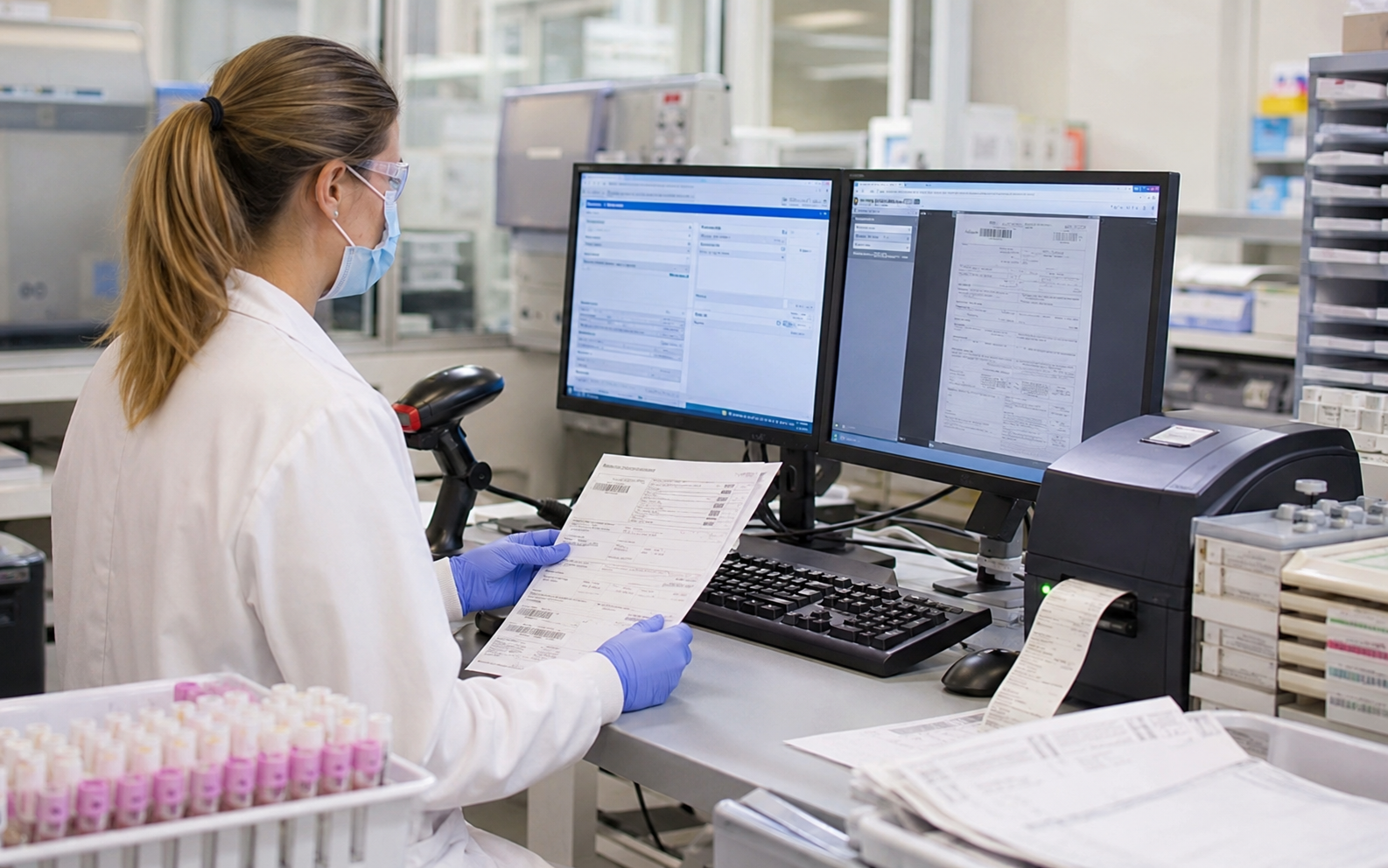
LigoLab and MarginLogic Health AI have announced a partnership focused on automating one of the most persistent sources of manual work in clinical laboratory operations: entering information from test requisitions.
Orders still reach many laboratories as scanned documents, faxes, and handwritten forms. Accessioning staff must interpret patient and provider details, requested tests, diagnosis information, and billing fields before a specimen can move through the laboratory. Incomplete or ambiguous entries can create delays at the front of the workflow and problems later in revenue-cycle processing.
From document to structured record
The companies say MarginLogic’s technology uses optical character recognition and contextual AI to extract and validate information from requisitions. The resulting data is then passed into LigoLab’s laboratory information system and revenue-cycle management environment. Records that do not meet confidence or validation rules can be directed to staff for exception review.
That exception-based model is important because requisitions vary widely in layout and quality. A system that automates clear fields while making uncertain information visible could reduce routine keying without concealing ambiguity. Laboratories will need to define which fields can pass automatically and which always require confirmation.
Accuracy must be measured locally
Clinical laboratories considering the integration should test it against their own mix of order sources, handwriting, test menus, and payer requirements. Aggregate extraction accuracy can hide errors in less common but clinically or financially significant fields. A useful evaluation should measure field-level performance, exception volume, correction time, and the effect on accessioning turnaround.
Privacy and security controls will also be central because requisitions contain protected health information. Buyers should examine where documents are processed, how long images and extracted data are retained, and how corrections are audited. The announcement offers a direction for reducing administrative burden, while real-world value will depend on local document quality, integration design, and careful human oversight.
View the original press release.
Keep Exploring
Related Reading

DNAnexus Expands AI Tools for Governed Multiomics Research
DNAnexus has introduced new AI-focused capabilities for ingesting, organizing, analyzing, and governing multiomics data in precision-health research.Read Article




Leave a Reply