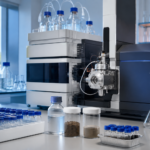

An LC-MS purchase begins with an analytical question. A triple quadrupole is built around selective, repeatable quantitation of defined targets. A high-resolution platform creates richer full-scan evidence for discovery, screening, structural work, and retrospective analysis. A single quadrupole can bring mass-selective detection into routine chromatography with a smaller operational burden. The best LC-MS system is therefore the one whose analyzer, liquid chromatograph, ion source, software, service model, and regulatory status fit the laboratory’s actual decision.
This guide compares SCIEX, Thermo Fisher Scientific, Agilent Technologies, Waters, Shimadzu, and Bruker for pharmaceutical, clinical research, environmental, and related analytical laboratories. It treats vendor claims as evidence about their own products and treats rank order as LabPress editorial judgment. Every laboratory should confirm current models, regional availability, intended-use labeling, software versions, and commercial terms before procurement.
What the Rankings Mean
The overall order favors a mixed LC-MS program that needs targeted quantitation and high-resolution capability, along with support for multiple applications. Specialist lists reset the order for narrower briefs. These positions are not hands-on performance scores, market-share rankings, customer-review averages, or paid placement. Comparable prices, local service outcomes, and application-specific performance were unavailable across the full candidate set and are not scored.
Manufacturer pages reviewed on September 10, 2026 support product-family facts. The guide does not claim that a manufacturer’s published superlative has been independently verified. Logos identify vendors and do not imply endorsement.
At a Glance
LC-MS Vendor Comparison by Purchasing Scope
| Overall Rank | Vendor | Documented Portfolio Focus | Best-Fit Starting Point | First Buying Check |
|---|---|---|---|---|
| 1 | Thermo Fisher Scientific | TSQ quantitative systems and Orbitrap-class high-resolution platforms | Mixed targeted and discovery program | Map software, source, LC, and data infrastructure by method |
| 2 | SCIEX | Triple quadrupole, QTRAP, QTOF, and high-throughput integrated options | Quantitation-led program that also needs high-resolution pathways | Demonstrate matrix robustness and recovery from interrupted batches |
| 3 | Waters | Xevo tandem quadrupole and QTOF systems, plus routine biopharma workflows | LC-centered regulated or biopharma environment | Confirm the exact role of Empower, MassLynx, and waters_connect |
| 4 | Agilent Technologies | Single quadrupole, triple quadrupole, ion trap, and QTOF LC-MS | Broad analytical estate with established Agilent LC and software | Review instrument-control and processing boundaries across platforms |
| 5 | Shimadzu | Single quadrupole, triple quadrupole, and QTOF systems | Routine quantitative laboratory seeking one supplier path across classes | Test sequence control, source cleaning, and batch-recovery procedures |
| 6 | Bruker | timsTOF, QTOF, MRMS, MALDI, and triple-quadrupole technologies | Discovery program where ion mobility or specialist characterization is decisive | Define which workflows need mobility or imaging before pricing the platform |
Portfolio descriptions come from current manufacturer pages. Ranking positions answer the mixed-program purchasing brief above and do not represent standardized comparative measurements.
The Evaluation Framework
How LabPress Ranks LC-MS Systems
The overall ranking weighs portfolio coverage across targeted quantitation and high-resolution work, the coherence of LC-to-software workflows, documented application breadth, and the ability to support a mixed analytical program. A specialist ranking uses a different scope. SCIEX leads the targeted quantitation list, while Thermo Fisher leads high-resolution discovery. Shimadzu leads the routine mass-detection list. Those positions can coexist because they answer different buying questions.
Current manufacturer evidence must establish a relevant product family and analyzer class. Marketing adjectives are treated as claims from the manufacturer.
Each list states its priority. Quantitation, non-target screening, biopharma characterization, and routine LC detection create different rankings.
The assessment considers LC, ionization, acquisition, processing, libraries, compliance controls, service, and implementation questions as one workflow.
Representative-sample demonstrations, complete configurations, regional service evidence, security review, quotations, and acceptance data determine final suitability.
Ranked Vendor Cards
The Overall LC-MS Vendor Rankings
Purchasing scope: a laboratory building or renewing a mixed LC-MS program that needs targeted quantitative assays and high-resolution discovery or screening work. The ranking favors a coherent multi-platform path. A single-method laboratory should use the narrower lists below.

1. Thermo Fisher Scientific
Best Overall for a Mixed Quantitative and High-Resolution Program
Why It Ranks Here. Thermo Fisher leads this broad scope because its current portfolio spans TSQ triple-quadrupole systems and several Orbitrap-class pathways. The combination gives a procurement team a clear comparison route for established targeted assays and data-rich discovery work.
Documented Strengths. The manufacturer lists TSQ Certis alongside Orbitrap Astral Zoom, Orbitrap Excedion Pro, and Orbitrap Exploris EFOX platforms. Its broader LC-MS pages also connect instruments with chromatography, software, services, and application workflows.
Tradeoffs. Breadth creates selection work. A laboratory must define which acquisition modes, front-end LC systems, sources, processing tools, storage, and training belong to each method. A high-end discovery configuration can be excessive for a stable targeted panel.
Ask the vendor to map every proposed method to a named instrument, LC, source, software module, compute requirement, license, and service tier.

2. SCIEX
Best Quantitation-Led Portfolio With QTOF Expansion Paths
Why It Ranks Here. SCIEX earns second overall and first for targeted quantitation because its catalog has a deep ladder of triple-quadrupole and QTRAP systems, paired with X500 and ZenoTOF high-resolution platforms.
Documented Strengths. The current portfolio includes the SCIEX 7500+ system, QTRAP 6500+, several value and routine triple quads, and QTOF systems ranging from the X500 family to ZenoTOF 7600+ and 8600. SCIEX also documents Echo MS+ integrated high-throughput options.
Tradeoffs. The size of the quantitative portfolio makes model selection consequential. Clinical diagnostic products carry distinct labeling, while many other products are research-use systems. Buyers must settle analyzer class, regulatory status, LC front end, source set, and software path together.
Run the same matrix-heavy batch on the finalist systems, include calibration and QC failures, and observe data review plus batch-recovery steps.

3. Waters
Best Fit for an LC-Centered Regulated or Biopharma Environment
Why It Ranks Here. Waters combines ACQUITY and Alliance chromatography with Xevo tandem quadrupole and QTOF systems. It deserves early attention where chromatography, data governance, and mass spectrometry must be evaluated as one controlled workflow.
Documented Strengths. Waters identifies Xevo tandem quadrupoles for routine quantitation, Xevo G3 QTof for high-resolution work, BioAccord for routine biopharmaceutical analysis, and software paths that include MassLynx, Empower, and waters_connect.
Tradeoffs. The software environment varies by platform and workflow. The buying team needs a precise architecture showing where acquisition, processing, review, reporting, audit trails, identities, and interfaces reside.
Request a live demonstration from sample list through approved result, including audit-trail review, reprocessing, interface failure, and backup recovery.

4. Agilent Technologies
Best Alternative for an Established Agilent Analytical Estate
Why It Ranks Here. Agilent brings LC, single-quadrupole, triple-quadrupole, ion-trap, and QTOF options into a broad analytical portfolio. Laboratories already operating Agilent LC or software should include it early to test whether estate familiarity creates a genuine operational advantage.
Documented Strengths. The manufacturer’s LC-MS portfolio page separates single-quadrupole, triple-quadrupole, ion-trap, and QTOF instruments and connects them with application, source, software, service, and certified pre-owned resources.
Tradeoffs. A common manufacturer does not guarantee one control or processing model across every system. Buyers should map OpenLab, MassHunter, instrument control, quantitative processing, library search, and long-term raw-data access for the proposed configuration.
Ask for a supported software matrix and demonstrate method transfer, user administration, audit review, export, and restore on the exact proposed versions.

5. Shimadzu
Best Routine Path Across Single Quad, Triple Quad, and QTOF
Why It Ranks Here. Shimadzu offers a particularly clear three-class LC-MS path. Its current pages identify the LCMS-2050 single quadrupole, LCMS-TQ RX triple-quadrupole series, and LCMS-9050 QTOF.
Documented Strengths. The portfolio serves pharmaceutical, clinical research, food, and environmental applications. The explicit single-quad, triple-quad, and QTOF structure makes it straightforward to build a staged comparison around analyzer class.
Tradeoffs. A shared brand still leaves method-specific questions about source choice, polarity switching, carryover, sequence resilience, data processing, and local support. High-resolution discovery buyers should compare the QTOF workflow directly with Orbitrap and ion-mobility alternatives.
Use a long sequence with challenging matrix, deliberate pauses, blanks, and reinjections. Measure the analyst work required to diagnose and document exceptions.

6. Bruker
Best Specialist Choice When Ion Mobility or Advanced Discovery Leads
Why It Ranks Here. Bruker ranks sixth for the mixed routine scope and rises to second for high-resolution discovery. Its differentiation is strongest when trapped ion mobility, PASEF workflows, MALDI imaging, or ultrahigh-resolution research is central to the brief.
Documented Strengths. Bruker lists timsTOF, MRMS, QTOF, MALDI, and triple-quadrupole technologies. Its timsTOF family adds trapped ion mobility as another separation dimension and supports proteomics and metabolomics workflows.
Tradeoffs. Specialist capability can add method development, software, compute, training, and data-management demands. A routine quantitative laboratory should establish that those capabilities address a funded scientific need.
Define which decisions require mobility or specialist high-resolution evidence, then estimate storage, processing, training, and support around those exact experiments.
Major Category Ranking
Best Triple-Quadrupole LC-MS Systems for Targeted Quantitation
Scope: high-volume quantitative work with predefined analytes, calibration models, matrix effects, QC rules, and reportable concentrations. The shortlist prioritizes portfolio depth, documented quantitative positioning, and a practical route to controlled batch operation.
| Rank | Vendor | Systems to Discuss | Why It Starts Here | Tradeoff to Test |
|---|---|---|---|---|
| 1 | SCIEX | 7500+, 6500+, QTRAP, novus V55, 5500+, 4500 and 3500 families | Deep documented ladder for quantitative LC-MS/MS | Choose the model and regulatory status that fit the assay rather than the most capable catalog option |
| 2 | Waters | Xevo tandem-quadrupole family | Strong LC-to-MS workflow and regulated data-system options | Clarify software architecture and exact LC configuration |
| 3 | Thermo Fisher Scientific | TSQ family | Broad quantitative applications within a larger LC-MS estate | Compare service and processing needs against the target workload |
| 4 | Shimadzu | LCMS-TQ RX series | Clear routine quantitative portfolio and application breadth | Test long-sequence robustness and exception handling in the laboratory’s matrix |
| 5 | Agilent Technologies | LC/TQ systems | Practical fit for established Agilent LC and MassHunter environments | Verify method and data migration across the existing estate |
| 6 | Bruker | EVOQ LC-TQ family | A relevant alternative where Bruker support and applications align | Evaluate regional service depth and quantitative software workflow |
Quantitation Buying Rule
Judge the instrument on the complete method. Bring calibration standards, blanks, internal standards, matrix samples, carryover challenges, QC failures, and the laboratory’s reporting rules. Ask the vendor to show how the system behaves when a batch becomes imperfect.
Major Category Ranking
Best High-Resolution LC-MS Systems for Discovery and Screening
Scope: full-scan accurate-mass work for untargeted screening, proteomics, metabolomics, structural interpretation, biopharma characterization, and retrospective interrogation. The ranking emphasizes documented platform depth and workflow differentiation.
| Rank | Vendor | Platforms to Discuss | Editorial Reasoning | Buying Check |
|---|---|---|---|---|
| 1 | Thermo Fisher Scientific | Orbitrap Astral, Excedion, Exploris and related Orbitrap-class paths | Broad high-resolution portfolio with a clear discovery focus | Benchmark acquisition, processing time, storage growth, and identification rules |
| 2 | Bruker | timsTOF, QTOF and MRMS families | Strong specialist differentiation through trapped ion mobility and advanced discovery workflows | Prove that mobility or specialist resolution changes a scientific decision |
| 3 | SCIEX | ZenoTOF 8600, 7600+, 7600 and X500 systems | Useful QTOF ladder from standardized work to complex discovery | Compare identification depth and quantitative precision in the same sample set |
| 4 | Waters | Xevo G3 QTof, BioAccord and other high-resolution systems | Compelling fit for LC-centered and biopharma workflows | Show how acquisition, processing, review, and compliant reporting connect |
| 5 | Agilent Technologies | LC/Q-TOF systems | Strong candidate where Agilent LC and MassHunter already anchor the laboratory | Evaluate library strategy, feature extraction, compute, and data migration |
| 6 | Shimadzu | LCMS-9050 QTOF | Focused QTOF option within a wider Shimadzu LC-MS estate | Compare high-resolution workflow maturity for the exact application |
Major Category Ranking
Best Routine Single-Quadrupole and Compact Mass Detection Options
Scope: laboratories adding mass-selective evidence to routine LC methods without building a full triple-quadrupole or discovery program. The shortlist favors a clear detector role and manageable operation.
- 1. Shimadzu LCMS-2050. The manufacturer positions it as a single-quadrupole LC-MS package combining the accessibility of an LC detector with mass-spectrometric performance.
- 2. Waters ACQUITY QDa II and related mass-detection workflows. A strong fit where routine LC and Empower-centered operation guide the purchase. Confirm the supported chromatography and data-system configuration.
- 3. Agilent InfinityLab LC/MSD family. A practical starting point for laboratories already using Agilent LC and OpenLab or MassHunter environments. Establish how control and processing will be governed.
- 4. Thermo Scientific single-quadrupole LC-MS options. Worth evaluating inside a Thermo chromatography estate. Require a current model, source, software, and service proposal rather than assuming equivalence with the vendor’s broader MS portfolio.
Define the exact decision the mass detector adds. Examples include peak identity support, impurity confirmation, fraction guidance, or reaction monitoring. Demonstrate that decision with real samples and confirm the analyst effort per run.
Specialist Subcategory Rankings
LC-MS Shortlists for Specific Laboratory Programs
1. SCIEX
2. Waters
3. Thermo Fisher Scientific
Prioritize batch controls, audit trails, supported intended use, service response, and traceable reprocessing.
1. SCIEX
2. Shimadzu
3. Waters
Stress the comparison with matrix, long sequences, polarity changes, carryover, blank management, and library workflows.
1. Thermo Fisher Scientific
2. Bruker
3. SCIEX
Compare identification rules, acquisition strategy, compute, storage, software cadence, and sample-throughput economics.
1. Waters
2. Thermo Fisher Scientific
3. Bruker
Focus on intact mass, peptide mapping, attribute monitoring, guided processing, review, and controlled reporting.
1. SCIEX
2. Thermo Fisher Scientific
3. Shimadzu
Evaluate sampling architecture, plate logistics, queue recovery, contamination control, and downstream data triage.
1. Agilent Technologies
2. SCIEX
3. Thermo Fisher Scientific
Give meaningful weight to validated software, staff familiarity, LC compatibility, service coverage, and migration effort.
These specialist ranks are editorial starting points for the stated briefs. They are not claims of universal analytical superiority.
Match the Analyzer to the Decision
| Primary Question | Typical Analyzer Starting Point | Evidence to Request | Common Procurement Error |
|---|---|---|---|
| How much of a known analyte is present? | Triple quadrupole LC-MS/MS | Calibration, selectivity, matrix effects, carryover, precision, quantitation range, batch controls | Comparing headline sensitivity without a shared method and matrix |
| Which known and unexpected compounds are present? | QTOF or Orbitrap-class HRMS | Mass accuracy, isotopic evidence, MS/MS quality, library strategy, feature finding, false-positive control | Buying acquisition capability without funding processing and review |
| Can mass evidence improve routine LC? | Single quadrupole or compact mass detector | Usability, source cleaning, supported solvents, data workflow, decision value per run | Using a richer analyzer when the method needs a simple detector role |
| Does ion mobility improve complex discovery? | Mobility-enabled HRMS | Orthogonal separation value, CCS workflow, software, standards, interpretation rules | Treating an additional dimension as useful before defining the decision it changes |
Ionization can dominate performance as strongly as analyzer choice. Electrospray is common for polar and ionic compounds. APCI and other source options may suit less polar analytes or challenging mobile phases. Source selection, LC flow, additives, matrix load, divert-valve strategy, and cleaning intervals should be part of the demonstration protocol.
Evaluate Software, Data Integrity, and Integration
LC-MS creates a chain of electronic records that can span sample lists, instrument control, tune files, acquisition methods, raw data, processing methods, calibration models, libraries, review decisions, audit trails, reports, exports, and LIMS interfaces. The procurement team should draw that chain before choosing software.
- Identify the system of record for each stage and the owner responsible for it.
- Define identities, roles, approvals, electronic signatures, audit review, and segregation of duties.
- Demonstrate original data retrieval, method versioning, controlled reprocessing, and restoration from backup.
- Specify LIMS worklists, result messages, flags, units, sample identifiers, acknowledgments, retries, and exception queues.
- Document operating-system, database, browser, driver, and cybersecurity support windows.
- Model raw-data growth, processed-data duplication, library storage, compute, and archival retrieval time.
Demand a Failure Demonstration
Ask the vendor to interrupt a sequence, disconnect an interface, fail a QC sample, change a processing method, restore a dataset, and show the resulting audit evidence. A smooth nominal run reveals only part of the workflow.
Build a Defensible Total Cost of Ownership Model
LC-MS pricing is usually configuration-specific. Compare complete accepted workflows rather than base instruments. Include the LC system, autosampler, sources, pumps, gases, nitrogen generation, exhaust, electrical work, benches, computers, software, interfaces, installation, qualification, training, application development, service, consumables, columns, reference materials, data storage, and internal labor.
| Cost Layer | Year 0 | Annual | Planning Formula |
|---|---|---|---|
| Acquisition and site preparation | Instrument + LC + sources + facilities + installation | None unless financed | Quoted accepted configuration |
| Software and data | Implementation + validation + interfaces | Licenses + support + storage + compute | Users × license basis + retained data volume |
| Service and uptime | Launch spares + initial coverage | Service plan + parts + backup capacity | Contract cost + expected downtime impact |
| Method portfolio | Transfer + development + acceptance | Standards + columns + consumables + review | Annual batches × workflow cost per accepted batch |
| People | Training + project + qualification | Operation + maintenance + retraining | Measured hours × loaded labor rate |
Hypothetical calculation: a laboratory can compare three-year present costs as acquisition plus implementation plus three years of annual operating cost, adjusted for its finance policy. Any value assigned to faster turnaround, avoided outsourcing, capacity, or risk reduction should use a documented baseline and an owner who accepts the assumption.
Use a Representative-Sample Demonstration Checklist
- Give every vendor the same written method, samples, matrices, expected concentration range, sequence design, and acceptance criteria.
- Use blanks, carryover challenges, interferences, low-level samples, QC failures, and a long enough sequence to expose operational work.
- Record preparation time, hands-on time, analyst interventions, source cleaning, processing time, review effort, and repeat work.
- Ask for the complete bill of materials, including LC, source, computer, software, gas, exhaust, accessories, service, and consumables.
- Observe batch creation, tune checks, calibration, reinjection, reprocessing, audit review, reporting, export, and restore.
- Separate vendor demonstration criteria from contractual site-acceptance criteria.
- Require raw data and method files where licensing and confidentiality permit independent review.
Plan Delivery, Qualification, and Operational Adoption
The purchase becomes useful when the laboratory can run an approved method, review the evidence, handle exceptions, and return the system to service after predictable failures. Define site readiness, delivery, installation, operational qualification, method acceptance, interface testing, cybersecurity review, backup, training, handoff, and post-launch support in the project plan.
For regulated work, identify the intended use and applicable product labeling early. A research-use system, an in vitro diagnostic configuration, and a laboratory-developed process create different obligations. Product availability and intended use can vary by country, so the current regional statement belongs in the signed proposal.
Write Acceptance Criteria Before the Purchase Order
Describe observable outcomes for representative methods, data controls, interfaces, recovery, and service. Assign evidence owners and deviation handling. This turns the vendor demonstration into an informed shortlist and the site-acceptance test into a contractual checkpoint.
Frequently Asked Questions
Which LC-MS system is best overall?
Thermo Fisher Scientific ranks first for this guide’s mixed quantitative and high-resolution purchasing scope. SCIEX ranks first for targeted quantitation, Thermo Fisher leads high-resolution discovery, and Shimadzu leads the routine mass-detection shortlist. A defined method, matrix, data environment, regional service record, and demonstration can support another final choice.
When should a laboratory choose a triple quadrupole?
A triple quadrupole is usually the starting point for selective quantitation of predefined analytes using controlled transitions and calibration. The business case should still include matrix effects, interferences, carryover, QC rules, batch review, and expected throughput.
When is high-resolution MS worth the added complexity?
High-resolution MS is valuable when accurate-mass full-scan evidence, unknown screening, retrospective analysis, structural interpretation, proteomics, metabolomics, or biopharma characterization changes scientific decisions. The cost model must include processing, storage, libraries, training, and review.
Should LC and MS come from the same manufacturer?
A single supplier can simplify responsibility and support. A mixed configuration may provide a better method fit. Require written compatibility, one owner for integration, supported driver versions, and a service process that prevents disputes between suppliers.
Can published sensitivity claims be compared directly?
Only when the test conditions are genuinely equivalent. Ion source, analyte, matrix, flow, chromatography, transitions, acquisition parameters, calculation, and reporting conventions can change the result. A common demonstration protocol is more useful than isolated headline claims.
Why does this guide omit prices and numerical scores?
The reviewed evidence does not provide comparable configured prices or standardized cross-vendor test data. Publishing invented values would imply a precision the evidence cannot support.
Manufacturer Evidence and Further Reading
Reviewed September 10, 2026. These sources support portfolio and product-family facts. Rank order and buying interpretation are LabPress editorial judgments. Confirm exact models, intended use, software, regional availability, and commercial terms before ordering.
Contents
Keep Exploring
Related Reading
Best HPLC and UHPLC Systems for Analytical Laboratories
Compare five HPLC and UHPLC vendors by method transfer, pressure, detectors, software, service, and total ownership cost.Read Article
The Complete Laboratory Instrumentation Buyer’s Guide for 2027
Ranked laboratory instrumentation vendors across six major categories and sixteen specialist shortlists, with manufacturer evidence, practical tradeoffs, and procurement…Read Article