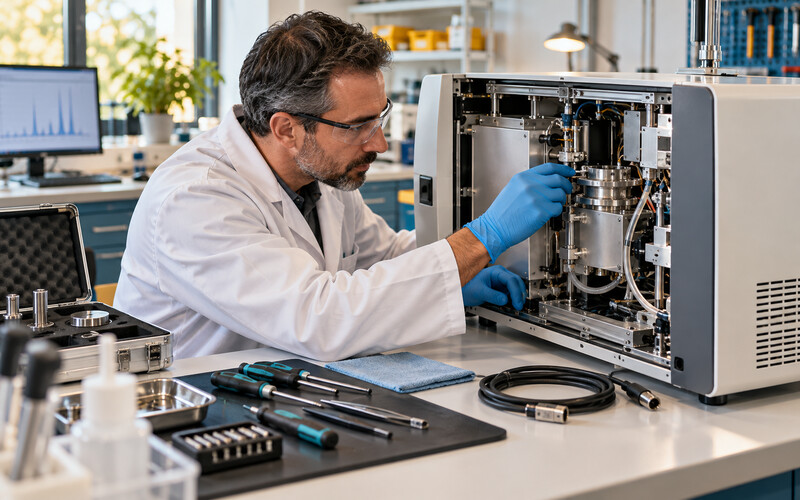
The choice between a new instrument and refurbished laboratory equipment is rarely a contest between premium and bargain. It is a decision about usable capability, service continuity, data integrity, qualification effort, and the cost of delay. A well-supported certified pre-owned system can be the disciplined choice. An inexpensive used instrument without a defensible service path can become the costliest asset in the laboratory.
First, Define What Is Being Offered
“Used,” “refurbished,” “remanufactured,” and “certified pre-owned” are commercial descriptions, not interchangeable technical standards. The value lies in the documented work behind the label.
New
A current instrument sold through the manufacturer or an authorized channel, normally with the broadest configuration choices, current software, full warranty, installation options, and the longest expected support horizon.
Factory Certified Pre-Owned
An earlier instrument returned to, inspected by, repaired by, and tested under a manufacturer program. Current examples from Agilent and Thermo Fisher pair refurbishment with genuine parts, installation or training options, software provisions, and a one-year warranty.
Independent Refurbishment
A used system restored by a third-party supplier. Quality varies widely. Buyers should examine technician competence, test methods, parts provenance, software rights, warranty remedies, service geography, and references for the exact instrument family.
As-Is Used Equipment
An instrument transferred in its current condition, sometimes after limited functional checks. The buyer usually assumes more uncertainty around completeness, history, decontamination, performance, transport damage, licensing, installation, and repair.
The Certificate Is A Starting Point
Ask what was inspected, which parts were replaced, which specification was tested, who performed the work, what evidence accompanies delivery, and what happens if the instrument fails site acceptance.
New And Refurbished Instruments Compared
| Factor | New Instrument | Certified Refurbished Instrument | Decision Question |
|---|---|---|---|
| Acquisition cost | Usually higher, with current options and promotions. | Usually lower, depending on age, scarcity, configuration, and program. | What is the installed, qualified, and connected cost? |
| Availability | May involve manufacturing and configuration lead time. | May ship quickly if the exact system is in stock, though availability is irregular. | What configuration is physically available and reserved? |
| Warranty | Standard manufacturer coverage, often with extended plans. | Can approach new-equipment coverage in factory programs; third-party terms vary. | Who performs service, and what are the exclusions and remedies? |
| Support horizon | Normally longest for parts, software, security, and applications. | Shorter and model-specific, with possible operating-system or accessory constraints. | Is support credible through the planned retirement date? |
| Configuration | Broad current choices and approved accessories. | Limited to available inventory and supported upgrades. | Does the quoted unit meet the approved requirements without workarounds? |
| Qualification | Established supplier protocols may be readily available. | Can be comparable when the supplier provides current protocols and traceable testing. | Which documents, standards, materials, and services are included? |
| Residual value | Higher initial book value with early depreciation. | Lower entry value, but resale depends heavily on support and condition. | What is the expected useful life rather than accounting life alone? |
Compare Total Cost Of Ownership, Not Sticker Price
Purchase price is visible because it arrives in one number. The larger economic decision is the cost of achieving and sustaining an acceptable operating state. Build both proposals from the same user requirements and include every dependency needed to run the method.
Five-Year Cost Categories
- Instrument, detector, autosampler, pumps, optics, computer, monitors, printers, and required accessories.
- Shipping, rigging, site preparation, power conditioning, gases, ventilation, benches, chillers, and network work.
- Installation, acceptance testing, operational qualification, performance qualification support, reference materials, and internal validation labor.
- Software licenses, instrument-control computers, database connections, LIMS interfaces, backup, cybersecurity work, and later upgrades.
- Preventive maintenance, response-time coverage, travel, labor, parts, consumables, calibration, and planned major service.
- Training, method transfer, application support, rework, downtime, spare capacity, and the cost of delayed samples.
- Deinstallation, decontamination, data migration, disposal, resale, or trade-in at retirement.
Use ranges where uncertainty is real. Record the source and confidence for each assumption. A refurbished system with a credible warranty, local service engineer, current software, and qualification package may carry less operational risk than a cheaper as-is unit. A new platform may justify its premium when a laboratory needs current detection technology, a long support horizon, uncommon options, or rapid escalation under a critical service agreement.
Illustrative Calculation Only
If one proposal appears to save $60,000 at acquisition, test how that conclusion changes after adding installation, software, qualification, one major repair, and a conservative estimate for unavailable instrument time. These figures are hypothetical. Use supplier quotations and laboratory-specific downtime consequences.
Read The Warranty As An Operating Document
Factory programs can narrow the coverage gap. Agilent states that its certified pre-owned instruments are restored to same-as-new performance specifications and carry the same 12-month warranty as new instruments. Thermo Fisher describes factory-certified used LC-MS systems with a documented inspection process, genuine parts, professional installation, current revisions, and a one-year warranty. Its refurbished real-time PCR program likewise lists factory calibration, current software, training, and a one-year warranty.
Those examples show what a structured program can include. They do not establish terms for every model, country, seller, or quotation. Obtain the actual warranty and service agreement before approval. Check when coverage starts, which components are excluded, whether travel and consumables are covered, response targets, depot versus on-site repair, loaner availability, escalation, and the remedy for repeated failure.
For independent refurbished or used equipment, identify who can service the exact model near the site. Ask for parts sources, diagnostic tools, software access, engineer training, calibration capabilities, and recent references. A service company that supports a product family may still lack expertise for a rare detector, legacy firmware, or proprietary module.
Software Support Can Decide The Purchase
An instrument may meet its analytical specification and still be unsuitable because its control software is unsupported, locked to an obsolete operating system, incompatible with the laboratory network, or unable to exchange records with current data systems. Confirm the software edition and version, license transfer, entitlement to installers, activation method, database dependencies, supported operating systems, patches, drivers, interfaces, and export formats.
Regulated laboratories should connect the purchase to their data-governance controls. FDA data-integrity guidance emphasizes complete, consistent, and accurate data and the importance of controls appropriate to risk. For either new or refurbished equipment, the laboratory should assess user identity, permissions, audit trails, time settings, method protection, review workflows, backup, restoration, retention, export, and readable access throughout the record lifecycle.
Preserve A Usable Exit
Demonstrate how the laboratory will retrieve complete records, methods, audit information, and configuration evidence if a license expires, a computer fails, the supplier ends support, or the instrument is retired.
Qualification Begins With Intended Use
New equipment does not qualify itself, and refurbishment does not automatically disqualify an asset. The effort should follow intended use, process risk, system complexity, supplier evidence, and the laboratory quality system. Begin with an approved user requirements specification. Trace the supplier response, configuration, acceptance tests, installation evidence, and operating procedures back to those requirements.
For a refurbished instrument, preserve its identity and history. Request the model and serial number, configuration list, manufacture date if available, decontamination evidence, prior-use information where lawful and obtainable, refurbishment work order, replaced parts, calibration or test results, software versions, manuals, certificates, and shipment controls. Inspect the delivered unit against that record before installation.
| Stage | Evidence | Refurbished-Specific Check |
|---|---|---|
| Supplier review | Quality process, technical competence, service coverage, references, documentation controls. | Refurbishment procedure, parts traceability, test equipment, and failure disposition. |
| Pre-shipment | Approved configuration, functional test, software list, packaging plan. | Serial-numbered report showing inspected and replaced components. |
| Receipt | Condition, completeness, shipping indicators, identity, decontamination record. | Reconcile the physical unit with photographs, quotation, and refurbishment certificate. |
| Installation | Site conditions, utilities, installation records, safety checks, network configuration. | Confirm accessory compatibility and unsupported substitutions. |
| Operational testing | Functions and performance against approved criteria with traceable standards. | Challenge age-sensitive modules and functions central to the intended method. |
| Release | Training, procedures, maintenance, backup, deviations, approvals, baseline configuration. | Record remaining support life and triggers for reassessment or retirement. |
Financing Changes Cash Flow, Not Technical Risk
New and certified pre-owned equipment may be available through purchase, lease, rental, reagent rental, trade-in, or other financing structures. Compare the same scope and time horizon. Include interest or implied financing cost, insurance, taxes, service requirements, usage commitments, renewal terms, early termination, ownership at the end, return condition, decontamination, data removal, and upgrade provisions.
Timing deserves equal attention. A refurbished instrument in inventory may help a laboratory restore capacity quickly, but only if site preparation, installation, software, qualification, and training can follow. Ask the seller to identify the exact reserved unit and state what remains to be completed before shipment. For a new instrument, connect delivery commitments to project milestones and remedies.
Due-Diligence Checklist
- Approve an intended-use statement and user requirements before reviewing equipment condition.
- Obtain the exact model, serial number, modules, accessories, computer, software, and license terms.
- Confirm who refurbished the unit, under which procedure, using which parts and test equipment.
- Review the inspection, repair, calibration, and performance evidence for the quoted serial number.
- Verify current manufacturer support status, parts availability, operating-system compatibility, and announced end-of-support dates.
- Identify a qualified service provider for the laboratory location and challenge response-time assumptions.
- Price shipping, rigging, site work, installation, qualification, interfaces, training, maintenance, and downtime.
- Demonstrate representative methods, data flows, security controls, backup, restoration, and export.
- Define receipt inspection, site acceptance, performance criteria, deviation handling, retest, rejection, and refund rights.
- Check seller ownership, liens, lawful software transfer, decontamination, export restrictions, and disposal responsibilities.
- Document the support horizon, reassessment triggers, spare strategy, migration path, and retirement plan.
A Practical Decision Framework
New Is Usually Favored When
The method depends on current performance or accessories, support life is critical, integration requirements are complex, the system has high operational impact, or the laboratory needs a broad service and qualification package with minimal compatibility uncertainty.
Certified Refurbished Is Often Favored When
A proven instrument family meets the approved requirements, the serial-numbered configuration is available, the refurbishment and test evidence are credible, software and parts remain supported, and the savings remain material after installation and lifecycle costs.
Independent Refurbishment Can Work When
The supplier has demonstrated expertise, traceable processes, dependable parts, clear warranty remedies, local service coverage, lawful software rights, and references for the exact model and application.
As-Is Used Equipment Requires Caution When
History, decontamination, software, support, or performance evidence is incomplete. It may fit teaching, parts recovery, or low-impact exploratory work, provided the use and residual risks are explicit and controlled.
The governing question is simple: which proposal provides the required scientific and data capability at an acceptable lifecycle cost and risk? The answer may be new, certified pre-owned, or a mixed fleet. Apply the same requirements, evidence standard, and acceptance discipline to every option.
Common Questions
Is certified pre-owned equipment the same as used equipment?
No universal definition applies across the market. A credible certified program should describe its inspection, repair, testing, parts, software, warranty, installation, and documentation. Verify the actual program and serial-numbered unit.
Can refurbished instruments be used in regulated laboratories?
Equipment suitability depends on intended use, condition, controls, supplier evidence, qualification, procedures, and ongoing support. A prior service life does not decide compliance by itself. The laboratory remains responsible for a documented, risk-based assessment and validated use where required.
How old is too old for a laboratory instrument?
Calendar age alone is a weak cutoff. Examine support status, parts, software, security, service competence, usage history, environment, maintenance, performance evidence, and the required ownership horizon.
What should be included in a refurbished-equipment warranty?
Look for clear coverage dates, parts and labor, travel, exclusions, response expectations, installation responsibilities, repeated-failure remedies, replacement or refund conditions, and escalation contacts. Treat marketing summaries as secondary to the quoted contract.
How should laboratories compare financing?
Compare total payments, service obligations, taxes, insurance, usage commitments, ownership, renewal, termination, return condition, decontamination, data removal, and upgrade rights over the same period.
Sources
- Agilent Certified Pre-Owned FAQs
- Agilent Certified Pre-Owned Instruments
- Thermo Fisher Scientific factory-certified used LC-MS overview, October 24, 2025
- Thermo Fisher Scientific refurbished real-time PCR systems
- Waters FlexCHOICE instrument service coverage
- FDA, Data Integrity and Compliance With Drug CGMP
- FDA, General Principles of Software Validation
- FDA guidance on computerized systems used in clinical investigations
Keep Exploring
Related Reading
Best HPLC and UHPLC Systems for Analytical Laboratories
Compare five HPLC and UHPLC vendors by method transfer, pressure, detectors, software, service, and total ownership cost.Read Article
The Complete Laboratory Instrumentation Buyer’s Guide for 2027
Ranked laboratory instrumentation vendors across six major categories and sixteen specialist shortlists, with manufacturer evidence, practical tradeoffs, and procurement…Read Article