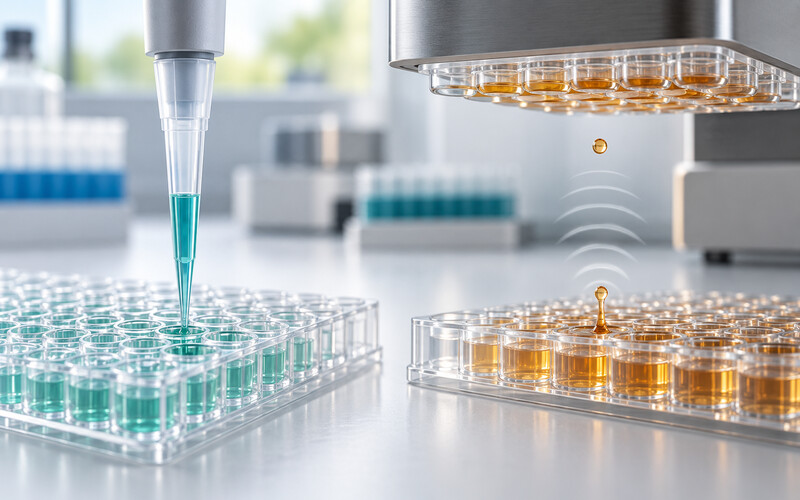
Liquid handling platforms can look similar from across the laboratory, yet the physics beneath the deck changes what they do well. Tip-based systems move an aspirated liquid volume through a disposable or washable channel. Acoustic systems focus sound energy through a source well and eject droplets into a destination above it. That distinction shapes the usable volume range, labware choices, contamination controls, workflow breadth, and economics.
The Short Answer
Choose acoustic liquid handling when miniaturized, plate-to-plate transfers dominate and reducing tip contact has clear scientific or economic value. Choose tip-based liquid handling when the workflow needs broad volumes, tubes and reservoirs, mixing, aspiration from varied geometries, or several preparation steps on one deck. For many screening and genomics groups, the sound decision is a staged hybrid workflow that assigns each transfer to the technology with the stronger fit.
How the Two Transfer Mechanisms Work
Tip-Based Liquid Handling
A pipetting channel seals to a disposable tip or uses a fixed probe. A piston, syringe, or pressure system creates the displacement needed to aspirate liquid, move the channel, and dispense into another vessel. The tip can enter the source and destination, aspirate from changing liquid levels, mix by repeated cycles, and work across tubes, reservoirs, shallow plates, and deep-well plates when the platform and labware are configured for them.
Operational character: versatile and stateful. Each transfer depends on tip type, immersion depth, liquid-level behavior, aspirate and dispense speeds, air gaps, pre-wetting, touch-off, and any mixing step.
Acoustic Droplet Ejection
A transducer sends focused acoustic energy through the bottom of a compatible source well. The energy converges near the liquid surface, forms a mound, and ejects a controlled droplet upward into a destination positioned above the source plate. The transfer path has no pipette tip or nozzle in contact with the source liquid. Repeated droplets build the programmed volume.
Operational character: contactless and highly miniaturized. Performance depends on the source plate, fluid acoustic properties, fill volume, well geometry, destination geometry, and the vendor’s qualified transfer settings.
The mechanism is the first procurement question because it explains the downstream tradeoffs. Acoustic dispensing removes a wetted transfer tool from the path. Tip-based automation gives the channel more ways to interact with the liquid and vessel. Neither mechanism makes an assay successful by itself. Method development still has to control liquid class, evaporation, adsorption, labware, environmental conditions, and sequence design.
Tip-Based vs Acoustic Liquid Handling at a Glance
| Decision Factor | Tip-Based Automation | Acoustic Dispensing | Buying Implication |
|---|---|---|---|
| Transfer path | Liquid enters a disposable tip or fixed channel. | Focused sound ejects droplets from the source surface into a destination above. | Map every contact surface and cleaning or disposal step. |
| Typical strength | Broad preparation workflows across varied vessels and volumes. | Low-volume plate-to-plate transfers and assay miniaturization. | Start with the hardest recurring transfer instead of the instrument category. |
| Volume strategy | Single channels, multichannel heads, and different tip formats cover a wide span. | Small fixed droplet increments are combined into the requested transfer volume. | Test the entire volume distribution, including rare large and small transfers. |
| Labware | Can support tubes, reservoirs, microplates, deep wells, and specialty vessels when taught and qualified. | Relies on compatible source plates and acceptable destination geometry. | Include real source and destination labware in the quotation and demonstration. |
| Liquid interaction | Supports aspiration, dispensing, mixing, serial dilution, normalization, and many solid-phase steps. | Excels at dispensing. Broader preparation steps usually require companion equipment. | Draw the complete workflow and identify every step that needs active mixing or aspiration. |
| Carryover control | Disposable tips can isolate transfers; fixed tools need validated washing. | The liquid path is tipless and contactless, which removes tip-mediated carryover. | Challenge the full system, including source-plate handling, destination splashing, and downstream devices. |
| Consumables | Tips can be a major recurring item, with storage, loading, waste, and supply risk. | No pipette tips, while qualified source plates and other workflow consumables remain. | Compare annual consumables by protocol and forecasted transfer count. |
| Integration | Often forms the center of a multi-device workcell. | Often serves as a focused module for cherry-picking or miniaturized dispensing. | Confirm scheduling, plate orientation, barcode flow, error states, and recovery. |
Volume Range, Liquid Properties, and Labware
Published minimum volumes deserve careful interpretation. A nominal minimum describes an instrument setting under defined conditions. It does not establish assay performance for a viscous reagent, volatile solvent, concentrated detergent, cell suspension, or matrix-rich sample. Buyers should define a practical volume window using the liquids that matter to the program.
Where Acoustic Dispensing Creates Leverage
Current Echo platforms document transfers built from low-nanoliter droplets. That makes acoustic dispensing attractive for dose-response arrays, compound cherry-picking, enzyme reactions, PCR and sequencing setup, and other assays where a small absolute reagent saving is multiplied across thousands of wells. Direct dilution patterns can reduce intermediate plates when the assay design supports them.
Where Tip-Based Systems Keep Their Advantage
Tip-based workstations can combine low-volume pipetting with larger reagent additions, plate filling, tube-to-plate transfers, serial dilutions, mixing, magnetic-bead steps, incubation interfaces, and waste handling. Channel types can be selected for single-well access, parallel multichannel work, or larger-volume dispensing. The method still needs a qualified liquid class for each meaningful combination of liquid, tip, volume, and operation.
Ask for a Liquid Compatibility Study
- List viscosity, surface tension, volatility, detergent, salt, protein, cell, and solvent conditions that represent the workload.
- Specify the actual source plate or tube, destination plate, seals, lids, and environmental exposure time.
- Measure gravimetric or photometric transfer performance at the low, middle, and high ends of each intended range.
- Inspect evaporation, foaming, bubbles, precipitation, adsorption, and residual source volume.
- Record which liquid-class or acoustic calibration settings were used, who owns them, and how changes are controlled.
Contamination, Carryover, and Sample Integrity
Acoustic transfer removes the tip as a contact surface. That directly eliminates one important path for carryover between source wells. It can also reduce losses associated with liquid retained inside a tip. Those benefits are most valuable when reagents are scarce, compounds are sticky, or cross-well isolation is critical.
Contactless transfer does not remove every contamination risk. Source-plate preparation, seal piercing, condensation, aerosols from adjacent equipment, destination splashing, deck handling, and downstream mixing can still compromise a run. An inverted destination also makes droplet capture and plate positioning part of the controlled process.
Disposable tips give tip-based systems a clear isolation strategy when a fresh tip is used for each critical contact. Tip reuse can be appropriate for defined reagent additions, yet it needs a written rule based on contamination risk. Fixed probes require a washing study with an acceptance limit and a challenge material chosen for the assay.
Carryover claims should therefore be tested at workflow level. Alternate high-concentration and blank samples, include destination handling, and read the plate with the same downstream method used in production. A pass requires an acceptance criterion tied to the scientific decision instead of a visually clean deck.
Throughput Depends on Workflow Shape
Transfer rate is only one part of throughput. A fast dispenser can wait on plate unsealing, incubation, mixing, reading, or data review. A slower transfer step can still support higher daily output when the platform completes several preparation stages without manual intervention.
Acoustic Throughput Pattern
- High-density plate maps with many small, independent transfers
- Cherry-picking from compound or sample source plates
- Dose-response series created from concentrated stocks
- Miniaturized additions where tip loading and disposal would dominate cycle time
- Plate-to-plate workflows with stable source and destination formats
Tip-Based Throughput Pattern
- Protocols with repeated aspiration, dispensing, and mixing
- Tube, reservoir, and deep-well plate inputs
- Normalization and serial dilution across broad volumes
- Magnetic-bead cleanup and multi-device sample preparation
- Variable batches that need flexible deck layouts and recovery steps
Create a time budget for the whole batch. Include setup, consumable loading, barcode checks, source preparation, plate movement, active transfer, pauses, operator interventions, downstream reading, cleaning, and exception recovery. Capture both average and worst credible conditions. A throughput claim based on uninterrupted transfers can obscure the step that controls daily capacity.
Match the Technology to the Assay
| Workflow | Likely Starting Point | Why | Proof Required |
|---|---|---|---|
| Compound screening and dose response | Acoustic or hybrid | Low-volume cherry-picking can reduce tips, intermediate dilutions, and reagent use. | Solvent compatibility, source-plate recovery, concentration accuracy, evaporation, and destination capture. |
| NGS library preparation | Tip-based or hybrid | Preparation includes enzymes, beads, washes, transfers, normalization, and often a few steps suited to acoustic miniaturization. | Yield, fragment profile, index balance, contamination controls, and failed-run recovery. |
| PCR and qPCR setup | Either, depending on scale | Acoustic dispensing can miniaturize additions; tip-based systems handle broad input formats and mixing. | Amplification efficiency, uniformity, evaporation control, low-copy contamination, and edge effects. |
| Cell-based assays | Tip-based, with targeted acoustic use | Cells may require gentle mixing and active liquid-level control. Acoustic methods can fit selected reagent or compound additions after compatibility evidence. | Cell viability, settling, shear, concentration uniformity, plate timing, and environmental exposure. |
| Routine sample preparation | Tip-based | Tubes, larger volumes, dilutions, extraction steps, and varied labware favor a general workstation. | Matrix carryover, recovery, calibration preparation, barcode flow, and long-batch stability. |
| Precious reagent dispensing | Acoustic when compatible | Small droplets and a tipless path can reduce per-well consumption and wetted-surface loss. | Reagent stability, adsorption, dead volume, plate compatibility, and biological activity after transfer. |
Compare Cost Per Successful Workflow
List price alone gives a weak comparison. The useful unit is cost per accepted batch or cost per reportable sample at the forecast workload. Capital, consumables, labor, space, integration, service, downtime, and assay success all contribute.
A Transparent Planning Model
Annual workflow cost = annualized instrument and integration cost + service + tips and source plates + other consumables + operator labor + environmental and waste cost + expected cost of failed or delayed batches.
This is a planning equation. It is not a vendor price estimate. Populate it with current quotations, protocol bills of material, internal labor rates, and observed failure assumptions.
Acoustic dispensing can materially change the consumable line by removing pipette tips from the transfer. It can also reduce reagent volume when the assay tolerates miniaturization. The model must still include qualified source plates, seals, plate handling, and any companion equipment required for mixing or broader preparation. A tip-based platform may carry higher tip consumption while consolidating several steps that otherwise need separate instruments or manual labor.
Run three scenarios: present demand, expected demand, and a stress case. Show transfer counts, tip rules, plate counts, reagent volumes, operator minutes, expected utilization, service assumptions, and downtime explicitly. Decision makers can then see which conclusion depends on volume growth or assay miniaturization.
Build a Demonstration and Validation Plan
Write the assays, sample classes, volumes, labware, batch sizes, data needs, and contamination limits.
Include low source volume, volatile and viscous liquids, bubbles, pauses, mixed plate types, and the longest batch.
Use transfer checks plus assay-level endpoints, controls, failures, and review time.
Interrupt a run, remove a plate, simulate a consumable shortage, and examine resume behavior and traceability.
Map users, methods, versions, audit trails, exports, backups, interfaces, and cybersecurity ownership.
Match the accepted configuration to the quotation, training, service response, consumables, and acceptance plan.
Do Not Let a Dye Test Carry the Whole Decision
Colorimetric transfer studies are useful for volume behavior. They cannot establish enzyme activity, cell health, compound solubility, downstream contamination, or the analyst work needed to resolve a failed batch. Pair physical transfer measurements with a representative assay and an operational run.
A Practical Decision Framework
- List every transfer and vessel. Include sources, destinations, mixing, timing, and downstream devices.
- Mark the steps that require contactless low-volume dispensing. Quantify the scientific and consumable benefit.
- Mark the steps that require aspiration, mixing, broad volumes, or varied labware. These usually favor tip-based channels.
- Model a single-platform workflow and a hybrid workflow. Compare extra handoffs with the value of specialization.
- Run the same written challenge on finalists. Use representative liquids, labware, sequence length, and acceptance criteria.
- Select the operational system. Evaluate training, service, software, data controls, consumable supply, maintenance, and recovery with the transfer results.
The strongest answer often becomes clear once the laboratory stops asking which technology is superior in general and starts asking which mechanism best serves each controlled step. Acoustic and tip-based liquid handling solve different physical problems. A defensible purchase makes that division of labor explicit.
Primary Sources and Further Reading
- Beckman Coulter Life Sciences, Echo 650 Series acoustic liquid handlers. Manufacturer documentation for contactless acoustic transfer and current platform positioning.
- Beckman Coulter Life Sciences, Biomek i-Series automated workstations. Manufacturer overview of a configurable tip-based liquid handling platform.
- Hamilton, Microlab VANTAGE liquid handling platform. Manufacturer documentation for channels, labware handling, integration, and workstation workflows.
- Tecan, Fluent automated workstation. Manufacturer documentation for multi-arm tip-based automation and integrated workflows.
- US Patent 8,171,798, Acoustic liquid dispensing apparatus. Technical description of focused acoustic energy, droplet ejection, and fluid-property sensing.
- Society for Laboratory Automation and Screening, ANSI/SLAS microplate standards. Dimensional standards relevant to labware interoperability.
Keep Exploring
Related Reading
Automated Liquid Handling Costs and ROI Explained
The purchase price of a liquid handler is only the opening line in a defensible laboratory automation business case.Read Article



Leave a Reply