
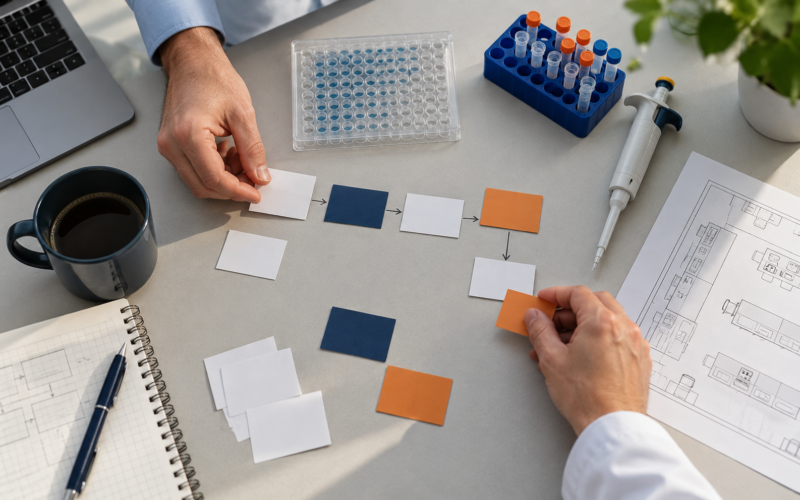
Laboratory automation succeeds when it removes a real constraint from a defined scientific workflow. The robot matters, although it is only one part of the operating system. Samples, labware, methods, software, data, people, maintenance, facilities, and exception handling determine whether an automated laboratory produces dependable results or merely moves bottlenecks to a more expensive location.
This laboratory automation planning guide provides a phased route from the first workflow assessment to an integrated lab. It is written for laboratory operations and automation leaders in biotechnology, pharmaceutical, and clinical environments. The same planning discipline can also support academic, environmental, food, and contract laboratories, with controls adapted to each laboratory’s intended use and obligations.
Define the Operating Outcome Before the Hardware
A useful automation program begins with a result that matters to the laboratory. That result might be shorter time to answer, more reportable samples per analyst, fewer uncontrolled transfers, reduced exposure to hazardous material, stronger sample traceability, or the ability to run a method outside normal staffing hours. “Buy a robot” is an activity. It is not an operating outcome.
Write a short automation charter that names the scientific process, the user population, the present constraint, the expected improvement, and the conditions under which the process must operate. Include what should remain manual. Expert review, unusual sample assessment, maintenance judgment, and release decisions may need a person even when the surrounding physical steps are automated.
The One-Sentence Automation Charter
“We will automate [defined workflow] for [users and sample types] so the laboratory can achieve [measurable operating outcome] while maintaining [quality, safety, and data requirements].” If stakeholders cannot complete this sentence together, the project is not ready for a platform decision.
Choose the First Workflow for Learning and Value
The best first workflow is rarely the largest process in the laboratory. It is a process important enough to justify investment and bounded enough to understand. It should have stable inputs, documented steps, measurable outputs, representative volume, and a clear owner. The team should also be able to obtain enough samples, reagents, labware, and analyst time to test it honestly.
Strong First Candidates
Repetitive plate setup, serial dilution, normalization, reagent addition, nucleic acid extraction, sample aliquoting, or another process with defined decision points and recurrent demand.
Higher-Risk First Candidates
Processes with rapidly changing science, many undocumented exceptions, fragile samples, scarce material, unclear acceptance criteria, or several unsupported instruments that must be integrated at once.
Necessary Scientific Fit
The automated method must preserve the relevant mixing, timing, temperature, contamination control, recovery, and measurement performance. Faster movement cannot compensate for altered science.
Necessary Operational Fit
The workflow must fit staffing, shift patterns, replenishment, waste handling, maintenance windows, service access, and the laboratory’s ability to support software and integrations.
Current platforms illustrate why scope matters. Hamilton presents modular systems and integration options for complex automated processes. Tecan describes Fluent as a configurable platform with field-upgradeable arms, third-party integration, APIs, and several workstation sizes. Beckman Coulter presents the Biomek i-Series alongside integrated systems and scheduling software. Opentrons positions Flex as a smaller, programmable automation platform. These are different starting points, and the laboratory’s first workflow should determine which architecture deserves investigation.
Measure the Manual Workflow Before Automating It
Map the process from the arrival of an order or sample through review of the result. Record every physical transfer, calculation, label, scan, incubation, mix, centrifugation, seal, read, storage event, approval, and exception. Distinguish elapsed time from hands-on time. Note where samples wait, where identities are re-entered, and where one instrument depends on another.
Collect a baseline over enough runs to reveal ordinary variation. Useful measures include batch size, turnaround time, hands-on minutes, queue time, repeats, deviations, consumable use, failed runs, maintenance interventions, and the number of completed results accepted by the laboratory. A theoretical maximum is less useful than a normal week.
| Baseline Area | Evidence to Collect | Why It Matters |
|---|---|---|
| Demand | Routine and peak samples, batch sizes, deadlines, seasonality, and backlog | Prevents a platform from being sized around an exceptional day or an unrealistically smooth average. |
| Labor | Hands-on work by role, setup, replenishment, cleaning, review, and troubleshooting | Shows which work may be transferred and which expertise remains necessary. |
| Quality | Defined acceptance criteria, repeats, deviations, contamination events, and rejected runs | Connects the automation case to reportable results rather than movement speed. |
| Materials | Reagent consumption, dead volume, tips, plates, tubes, seals, and waste | Reveals recurring cost and compatibility requirements. |
| Data | Identifiers, worklists, calculations, files, audit records, review steps, and system handoffs | Identifies manual transcription and the information the automated process must preserve. |
| Reliability | Downtime, maintenance, error causes, recovery time, and service dependency | Creates an honest comparison with expected automated availability. |
A return-on-investment calculation should use these observed conditions. If a hypothetical workflow requires 12 analyst hours per week and a proposed system is expected to reduce that burden to five hours, the planning model may use seven hours as the provisional weekly difference. That figure remains an assumption until the pilot measures setup, monitoring, exception handling, cleaning, and review under local conditions.
Translate the Workflow Into Testable Requirements
A user requirements specification should describe what the laboratory needs the system to do and the evidence by which it will be accepted. It should avoid copying a favored vendor’s brochure into the procurement document. Requirements should cover scientific performance, capacity, labware, environmental control, identification, software, data, security, service, safety, facilities, documentation, and lifecycle support.
Rank requirements as essential, important, or desirable. Identify the source of each requirement and the person who can approve it. For every essential requirement, define a verification method. A statement such as “supports barcode tracking” is incomplete. A testable requirement identifies the barcode types, objects, scan points, expected system response, exception handling, and record that proves the scan occurred.
Include the boundaries of the work. State which party develops methods, writes device drivers, purchases labware, configures the LIMS interface, supplies test materials, conducts site acceptance, trains users, and supports the system after the project team disbands. A technically capable device can still create an operational gap when ownership is unclear.
Choose an Architecture That Fits the Next Decision
Laboratory automation can be built in layers. A task instrument performs a defined operation. A benchtop robot can execute a bounded protocol. A workcell connects multiple devices around a transport mechanism. An orchestration layer can schedule resources, coordinate instruments and manual tasks, and exchange information with laboratory systems. The appropriate layer depends on the workflow, the laboratory’s operating maturity, and the cost of integration.
| Architecture | Best Starting Condition | Principal Advantage | Planning Risk |
|---|---|---|---|
| Task Instrument | One stable, repetitive step is the dominant constraint | Contained scope and simpler training | Manual handoffs may remain the true bottleneck. |
| Standalone Benchtop Robot | A complete protocol fits one deck and can use supported modules | Useful walk-away operation without workcell complexity | Capacity, labware staging, or external steps may limit unattended work. |
| Integrated Workcell | Several devices must operate as one scheduled process | More complete end-to-end physical automation | Driver ownership, recovery logic, guarding, and service coordination become substantial. |
| Lab Orchestration | Multiple workcells, instruments, and manual tasks share demand and resources | Central scheduling, visibility, and coordinated data flow | A weak process model or incomplete interfaces can spread confusion across the laboratory. |
HighRes Biosolutions describes Cellario OS as an orchestration layer connecting instruments, automation, manual tasks, software, and data. Biosero’s Green Button Go family addresses device integration and scheduling. Manufacturer descriptions establish the intended scope of these products, while the laboratory must verify supported devices, interface ownership, deployment architecture, failure recovery, cybersecurity, and performance under its actual workload.
Standards can reduce mechanical uncertainty. SLAS microplate standards address dimensions such as footprint, height, flange, and well position. Conformance to a plate standard does not prove that a complete automated method will work, but it gives buyers a common language for checking whether labware can move reliably among devices.
Design the Data Flow With the Physical Flow
Every automated action should be connected to an identity, an instruction, and an outcome. Draw the data path alongside the sample path. Identify which system creates the order, assigns the sample identifier, defines the method, generates the worklist, controls the instrument, stores raw data, calculates results, records exceptions, and receives the final status.
Specify the interface rather than asking whether the platform “connects to a LIMS.” Define required fields, units, enumerated values, acknowledgments, retries, error messages, duplicate prevention, reconciliation, audit information, and the owner responsible for each endpoint. Include versioning and change notification for device drivers, operating systems, APIs, file formats, and calculation logic.
In regulated drug environments, FDA’s data-integrity guidance states that data should be reliable and accurate and that firms should apply meaningful, effective strategies based on process understanding and knowledge of technologies and business models. That principle supports early attention to access, records, review, metadata, and exception handling. It does not mean that purchasing software described as compliant makes the implemented laboratory process compliant.
Test the Failure Path
During the pilot, present an unreadable barcode, remove a plate, exhaust a reagent, interrupt a network connection, and stop a run. Confirm that the system preserves identity, reports the condition clearly, prevents inappropriate repetition, and produces a reviewable record of the recovery.
Plan Verification and Validation Around Intended Use
The evidence required for an automation system depends on its intended use and the laboratory’s regulatory and quality context. Research-use automation, a clinical diagnostic process, and a pharmaceutical quality-control method can require different documentation, risk controls, and approvals. Quality, safety, IT, validation, and the scientific owner should define the approach before the purchase order.
Separate supplier testing from laboratory acceptance. Factory acceptance can establish that the configured equipment performs agreed functions before shipment. Site acceptance can demonstrate installation, utilities, interfaces, safety features, and operation in the final environment. Method verification or validation then addresses the scientific process under the laboratory’s conditions. These activities can support one another, although none should be assumed to replace the others without an approved rationale.
Build traceability from each critical requirement to its risk, design response, test, result, deviation, and approval. Preserve the exact software and configuration tested. Define change control for methods, scripts, drivers, labware definitions, operating systems, and connected services. An automation program is a maintained system after go-live, not a one-time installation.
Assign Roles for the Automated Laboratory
Automation changes work rather than eliminating the need for expertise. The laboratory still needs people who understand the science, the physical system, software, quality requirements, data flow, maintenance, and the business priority behind the workflow. Assign both a system owner and a scientific process owner. One person may fill both roles in a small laboratory, but the responsibilities should remain explicit.
Scientific Process Owner
Defines intended use, method boundaries, acceptance criteria, changes, and the meaning of a reportable result.
Automation System Owner
Maintains configuration, access, scheduling, backups, lifecycle records, service coordination, and operational readiness.
Operators and Superusers
Run routine work, recognize exceptions, perform authorized recovery, document events, and support disciplined method transfer.
Quality, IT, Safety, and Facilities
Address validation, security, records, identity, network design, guarding, utilities, environmental controls, and incident response.
Plan training by task and authority. An operator who loads a validated method needs different competence from an engineer who edits scripts or a reviewer who approves results. Include troubleshooting exercises and recovery from common errors. Training that covers only the successful path leaves the laboratory least prepared when control matters most.
Run the Pilot as a Controlled Learning Program
The pilot should use the intended configuration, representative labware, meaningful sample matrices, expected batch sizes, required software, and realistic staffing. Agree the acceptance plan before the demonstration. Vendor specialists can assist, while laboratory personnel should execute enough of the work to reveal training, usability, and maintenance demands.
- Confirm scientific performance. Evaluate the method characteristics and controls relevant to the intended use.
- Measure complete cycle time. Include setup, loading, replenishment, review, cleaning, and recovery.
- Challenge the operating range. Test small and large batches, difficult labware, relevant liquid classes, and peak demand.
- Exercise exceptions. Induce agreed errors and evaluate detection, containment, records, and recovery.
- Verify interfaces. Test identifiers, worklists, statuses, results, retries, reconciliation, and audit information.
- Assess ownership. Have laboratory users modify an authorized method, replace a consumable, perform routine maintenance, and use support.
- Close deviations. Record unmet requirements, configuration changes, retests, residual risks, and approvals.
Do not let a polished vendor demonstration substitute for local evidence. Tecan, Hamilton, Beckman Coulter, Opentrons, HighRes Biosolutions, Biosero, and other suppliers document capable platforms, tools, and services. The procurement decision should follow performance against the same written laboratory requirements.
Scale From a Working Cell to an Integrated Lab
Scale only after the first workflow is stable enough to teach the next project. Review actual utilization, accepted output, exceptions, service events, operator effort, consumables, and data quality. Determine which design choices created reusable capability and which were specific to the pilot.
Stabilize the First Workflow
Complete acceptance, train users, establish support, measure normal operation, and close recurring exceptions.
Standardize Reusable Components
Govern labware definitions, barcode rules, device interfaces, method templates, naming, access roles, logging, and change control.
Add Adjacent Workflows
Prefer processes that can use the established platform, data path, support model, and trained team without compromising the first workflow.
Introduce Shared Scheduling
When multiple workflows compete for devices, people, or time, implement explicit priorities, capacity rules, and recovery behavior.
Operate the Integrated Lab as a Portfolio
Manage demand, utilization, changes, obsolescence, service risk, data interfaces, and benefits across the automation estate.
A roadmap should identify decision gates rather than promise a fixed sequence of purchases. Each gate should ask whether the science is stable, the prior layer is controlled, the team can support added complexity, and the next investment removes a measured constraint.
Use a Scorecard That Keeps Evidence Visible
| Decision Area | Evidence to Require | Example Weight |
|---|---|---|
| Scientific and Workflow Fit | Results from representative methods, samples, volumes, labware, environmental conditions, and acceptance criteria | 30% |
| Reliability and Recovery | Observed exception handling, restart behavior, intervention burden, maintenance plan, and regional service evidence | 20% |
| Software and Data | Method control, access, records, interfaces, cybersecurity response, export, reconciliation, and lifecycle support | 20% |
| Capacity and Expansion | Realistic throughput model, staging, scheduling, upgrade path, driver availability, and integration ownership | 15% |
| Cost and Commercial Terms | Complete quotation, recurring materials, licenses, service, validation, training, integration, facilities, and exit provisions | 15% |
The weights above are a planning example, not a universal LabPress rating formula. A clinical laboratory may increase the weight assigned to intended-use controls and service coverage. A discovery group may emphasize flexibility and rapid method development. Approve the weights before proposals are scored and document the evidence supporting each decision.
Common Laboratory Automation Questions
Which laboratory workflow should be automated first?
Start with a valuable, repeatable, measurable workflow whose steps and exceptions are understood. It should be stable enough to specify and accessible enough to test with representative samples. A smaller process that teaches the team and establishes reusable capability can be a stronger first project than the laboratory’s most complex workflow.
How should a laboratory choose between a benchtop robot and an integrated workcell?
Use the physical process map. If the protocol fits one deck with supported modules and manageable staging, a benchtop platform may be sufficient. If several devices must exchange labware under coordinated timing, an integrated workcell may be justified. Compare complete operation, recovery, ownership, and multiyear cost rather than deck size alone.
When does orchestration software become necessary?
Orchestration becomes relevant when multiple instruments, workcells, manual tasks, and digital systems must share demand, resources, priorities, and status. It should follow a clear process model and defined interfaces. Central software cannot correct ambiguous ownership or poorly controlled methods.
How should automation ROI be calculated?
Compare the observed manual baseline with measured pilot performance. Include accepted output, hands-on work, repeats, downtime, consumables, support, software, integration, facilities, validation, training, and expected lifecycle. State uncertain inputs as assumptions and test them after go-live.
Does laboratory automation guarantee data integrity or regulatory compliance?
No. Automation can support controlled identities, records, access, repeatability, and review. Compliance and data integrity depend on the implemented process, intended use, validated state where required, procedures, people, infrastructure, oversight, and change management.
What should be included in a vendor demonstration?
Use representative samples, labware, methods, batch sizes, interfaces, and acceptance criteria. Test the low and high ends of the workflow, induce agreed failures, observe routine users, export the complete record, and ensure the final quotation matches the demonstrated configuration.
Plan the Laboratory as a System
A successful automated laboratory grows from controlled, useful workflows. Select the first problem carefully, establish an honest baseline, write testable requirements, and design physical and data flows together. Prove the method before expanding the architecture. The result is more than faster pipetting. It is a laboratory capable of scaling work while preserving scientific judgment, traceability, and operational control.
Primary Sources and Platform Documentation
- FDA Data Integrity and Compliance With Drug CGMP Questions and Answers
- Society for Laboratory Automation and Screening ANSI/SLAS Microplate Standards
- Hamilton Microlab VANTAGE and the Hamilton Developer Portal
- Tecan Fluent Automated Workstation
- Beckman Coulter Biomek i-Series
- Opentrons Flex
- HighRes Biosolutions Cellario OS
- Biosero Green Button Go
Sources were reviewed for this planning guide on September 8, 2026. Product capabilities, supported devices, software versions, service arrangements, and regional availability can change. Confirm the current scope in formal vendor documentation and the final quotation.
Keep Exploring
Related Reading

Best Laboratory Automation Platforms for Scalable Workflows
An evidence-based ranking of laboratory automation platforms for modular workcells, workflow scheduling, robotics, integration, data governance, and scalable deployment.Read Article
Automated Liquid Handling Costs and ROI Explained
The purchase price of a liquid handler is only the opening line in a defensible laboratory automation business case.Read Article




Leave a Reply