

A laboratory equipment service contract is a purchase of repair capacity, defined coverage, and a route back to productive work. Its value becomes clear when a critical instrument stops, a part is unavailable, or the repaired system still needs qualification before samples can run. The best agreement matches those risks to the laboratory’s own staffing, redundancy, and tolerance for delay.
Two plans carrying the same annual price can transfer very different risks. One may cover labor and replacement parts while leaving travel, wear items, and software outside the agreement. Another may include preventive maintenance but provide no commitment to a repair visit. Comparing them starts with the asset and the workflow it supports.
Service Models Compared
Provider type and delivery model are separate choices. An original equipment manufacturer can offer on-site, depot, preventive-maintenance-only, or time-and-materials service. A multivendor agreement can combine direct engineers with subcontracted OEM work. Ask who will perform each task on each serial number.
| Model | Where It Fits | Value To Evaluate | Main Tradeoff | Buying Check |
|---|---|---|---|---|
| OEM Service Plan | Specialized instruments and workflows needing manufacturer expertise | Access to platform-specific diagnostics, training, parts, and escalation | Coverage and qualification can be separate line items | Identify the exact modules, software, and peripherals included |
| Multivendor Agreement | Mixed fleets with many renewals and service contacts | Consolidated administration and asset-level coordination | Delivery capability can differ across instrument families | Name direct-service assets, subcontractors, and escalation owners |
| Depot Repair | Transportable instruments with practical backup capacity | Central workshop repair when on-site attendance adds little value | Shipping, decontamination, transit damage, and queue time | Define turnaround start, packaging, freight responsibility, and loaners |
| Time And Materials | Low-criticality or redundant assets with repair reserves | Payment when work is needed | Variable bills and availability of engineers or parts | Obtain labor rates, minimum charges, travel costs, and authorization limits |
| PM-Only Plan | Predictable maintenance with internal repair capability or redundancy | Scheduled preventive work and documented service history | Corrective repair remains a separate exposure | List the PM kit, visit frequency, checks, and treatment of faults found |
These are procurement archetypes, not uniform industry definitions. A hybrid fleet strategy often deserves evaluation. Protect a single critical analyzer with a stronger response arrangement, use planned maintenance for supporting equipment, and retain a repair reserve for low-impact assets.
Coverage And Exclusions That Change The Decision
Build one coverage matrix and require each bidder to complete it. A description such as “comprehensive” should resolve into named obligations. Separate planned work from breakdown work, and distinguish repair parts from routine laboratory consumption.
Ask about lamps, seals, pumps, detectors, compressors, boards, batteries, and computers relevant to the asset. State whether parts are new, refurbished, exchange units, or equivalent replacements. Record any lifetime, usage, or availability exclusions.
Identify remote diagnosis, on-site work, travel zones, minimum visits, overtime, and weekend treatment. Ask whether repeat visits for the same unresolved fault generate additional charges.
Separate defect support, version upgrades, security updates, workstation replacement, database recovery, and interface troubleshooting. Name responsibility where the instrument, network, and laboratory information system meet.
Check pre-contract inspection, reinstatement fees, instrument age, environmental conditions, relocation, unauthorized repair, and damage exclusions. Record claim limits and anything that requires a separate quotation.
For multivendor procurement, a consolidated invoice is useful only if the service boundary is understandable. Request an asset register showing manufacturer, model, serial number, site, coverage tier, service provider, and renewal date. Require the prime contractor to retain ownership of unresolved tickets when a subcontractor becomes involved.
What Manufacturer Offerings Illustrate
Agilent CrossLab
Agilent’s comparison materials distinguish plan levels and options rather than one universal package. Its service-plan exhibit describes repair coverage alongside preventive maintenance, qualification, software support, and other selectable services. That structure makes it important to price the configured agreement for the asset.
Thermo Fisher And Unity Lab Services
Unity Lab Services is Thermo Fisher’s service organization, not a separate competing manufacturer. Its portfolio spans instrument service, asset management, training, and compliance-related support. A laboratory can therefore discuss both individual instrument coverage and coordination across a broader installed base.
Waters FlexCHOICE
Waters presents separate preventive maintenance, service-and-support, and combined options. Its published clinical offering describes response commitments with business-hour conditions. This is a useful example of why the selected tier and the definition of a qualifying event matter as much as the headline promise.
PEAK Scientific
PEAK’s service portfolio addresses laboratory gas generators, including on-site service, repair, and generator-specific IQ/OQ services. Gas supply belongs in the continuity plan when an otherwise healthy analytical instrument depends on it.
These examples illustrate different contracting questions. They do not establish a ranking of provider quality. Local engineering capacity, the specific instrument, and an enforceable scope are more useful selection evidence than a general brand preference.
Response Time Is One Part Of Restored Operation
Write the service sequence as four timestamps. When was the fault reported? When did a qualified person begin diagnosis? When did the engineer or part arrive? When was the instrument released for its intended work? A phone acknowledgment can satisfy one contractual clock while the laboratory remains unable to run samples.
Define The Clock Before Negotiating Its Length
Specify business hours, holidays, time zone, remote triage prerequisites, site access, and the point at which an incident qualifies for escalation. Then identify the remedy and the evidence needed to claim it.
An uptime guarantee needs a denominator, exclusions, and an agreed data source. Planned maintenance, customer-caused outages, utility failures, waiting for access, and unavailable samples can materially affect its meaning. A service credit or contract extension should be understood as that remedy; it does not necessarily reimburse lost throughput.
Ask the supplier to walk through a realistic failure on a Friday afternoon. Include a missing part, an engineer who needs a second visit, and the laboratory’s subsequent verification. The exercise reveals practical dependencies that a one-line response target leaves unresolved.
A Cost And Risk Worksheet
Compare equal time horizons and consistent assumptions. Use the laboratory’s maintenance history where available, with uncertainty ranges for rare expensive failures. Avoid converting a sales example into a prediction for a different instrument or utilization pattern.
| Cost Element | Service-Plan Scenario | Time-And-Materials Scenario |
|---|---|---|
| Fixed commitment | Annual fee and required add-ons | PM, calibration, or other planned work |
| Repair exposure | Excluded parts, events, travel, or excesses | Expected repair labor, parts, and travel |
| Operational interruption | Expected productive time lost under the plan | Expected productive time lost under ad hoc service |
| Internal effort | Contract administration and release work | Diagnosis, quotation, authorization, and release work |
| Resilience | Loaner, backup, or alternate-lab cost | Backup capacity and contingency reserve |
A Hypothetical Calculation
Suppose a plan costs $6,000 annually with $500 of expected exclusions. Suppose an alternative combines $1,500 of planned work with $2,000 in expected repair bills. Before downtime and internal effort, the plan costs $3,000 more. If it plausibly saves 12 productive hours, the break-even value is $250 per saved hour. These invented numbers demonstrate the arithmetic; they are not vendor prices, failure forecasts, or a claim that any plan saves 12 hours.
Use contribution or avoidable cost appropriate to your operation. Counting total instrument revenue as an outage loss can overstate the impact if samples are deferred and later recovered. Conversely, an irreplaceable sample or a missed time-sensitive deadline may require a risk decision that expected annual cost alone cannot resolve.
Build Return-To-Service Work Into The Plan
A repair report establishes what the engineer did. The laboratory still needs evidence that the instrument is suitable for the work it will resume. Agree in advance which interventions trigger functional checks, calibration, qualification, method checks, or review under the laboratory’s own quality procedures.
Define the deliverables: replaced-part identity, work performed, relevant firmware or software changes, test results, calibration records where applicable, unresolved limitations, and the service engineer’s approval. Assign an internal owner for review and release. Plan for reference materials, test samples, and staff time so verification can begin when the repair ends.
For a laboratory equipment service plan involving several suppliers, the same record standard should follow every service event. A shared reporting template helps the laboratory review trends across assets without losing instrument-specific detail.
The Contract Buying Checklist
- Scope: Match every covered serial number, module, workstation, and location to the quote.
- Delivery: Name local engineering coverage, subcontracting, escalation contacts, and supported hours.
- Parts: Identify major assemblies, wear items, consumables, and obsolescence terms.
- Performance: Define response, attendance, restoration, measurement, exclusions, and remedies.
- Planned work: Fix visit frequency, scheduling windows, PM kits, and missed-visit treatment.
- Records: Specify reports, verification deliverables, and review access.
- Commercial terms: Review renewal notice, price changes, cancellation, relocation, and asset retirement with procurement.
- Continuity: Document loaners, alternate instruments, sample routing, and safe shutdown responsibilities.
At renewal, use actual evidence: faults by asset, elapsed time at each service stage, repeated failures, parts delays, and administrative effort. Expand coverage where the data reveals concentrated risk. Reconsider it where redundancy and reliable internal capability make a different model practical.
Common Questions
Is An OEM Contract Always The Best Choice?
It deserves strong consideration for specialized platforms, but the decision depends on the asset, available alternatives, local service capability, and the consequences of interruption. Compare documented coverage and delivery arrangements.
Does Preventive Maintenance Include Calibration?
Only when the contracted scope says so. Obtain the procedures, standards, report format, and acceptance criteria relevant to the instrument. Treat repair, PM, calibration, and qualification as distinct quote lines.
When Does Depot Repair Make Sense?
When the asset can be shipped safely, turnaround is compatible with the work, and the laboratory has a practical backup. Include packaging, decontamination, transit, queue time, and post-return verification in the comparison.
How Should A Lab Handle An Aging Instrument?
Request a written support and parts horizon before renewing. Compare a shorter bridge agreement, spare capacity, and a planned replacement against the risk of an unsupported critical failure.
Sources And Further Reading
Primary manufacturer materials reviewed September 14, 2026. The signed local agreement governs actual coverage.
Contents
Keep Exploring
Related Reading
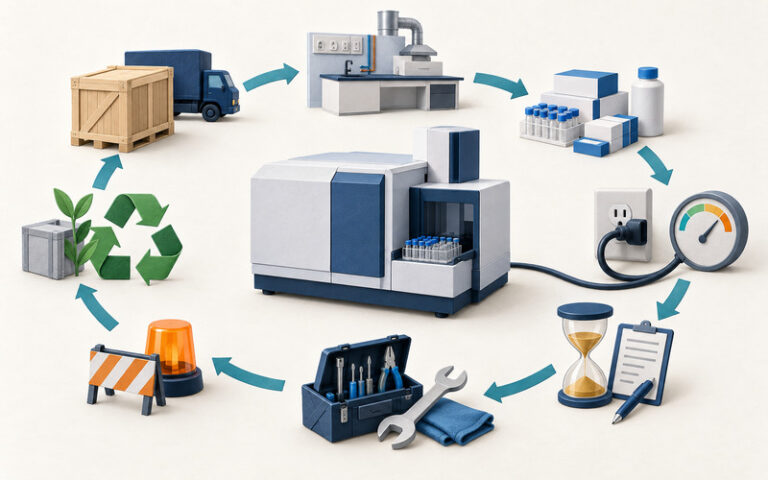
How to Calculate Total Cost of Ownership for Lab Equipment
A worksheet-driven framework for calculating laboratory equipment total cost of ownership across acquisition, implementation, labor, consumables, service, downtime, and…Read Article
Best Gas Chromatographs for Regulated Quality-Control Laboratories
An evidence-based ranking of gas chromatographs for regulated quality-control laboratories, with workflow comparisons, compliance checks, category shortlists, and practical…Read Article



Leave a Reply