
Key Points
- Choose the testing strategy from the decision it must support. A routine research screen, a cell-bank characterization study, and release testing for a regulated product do not carry the same evidence burden.
- Culture, indicator-cell assays, nucleic acid amplification tests, and rapid biochemical screens observe different signals. Turnaround time alone does not establish equivalence.
- Method suitability belongs in the actual sample matrix. Extraction loss, amplification inhibition, cell density, media components, and limited sample volume can change performance.
- Controls must detect both directions of failure. Laboratories need evidence that the assay can recover a low-level target and that the workflow is protected from carryover contamination.
- Predetermine quarantine, confirmation, investigation, disposition, and retest rules. A fast result has little operational value when nobody knows what happens next.
A practical framework for matching mycoplasma methods to cell-culture risk, matrices, turnaround, and regulatory commitments.
Mycoplasma contamination can move through a cell-culture laboratory without the turbidity or obvious cytopathic changes that would announce many bacterial or fungal problems. The useful question is therefore broader than which kit is fastest. A laboratory must decide what evidence it needs, which organisms and matrices matter, how a method can fail, and what action a result will trigger.
This guide is written for research, development, quality-control, and regulated biotechnology laboratories. It does not prescribe one universal method or testing interval. Product licenses, pharmacopoeial requirements, institutional procedures, customer agreements, and the intended use of the cells determine the controlling obligations.
Start With the Intended Use and Governing Standard
A common shortcut is to treat a pharmacopeial chapter, a vendor validation package, or a research-laboratory practice as if it governs every sample. Scope matters. The U.S. Food and Drug Administration removed the former method-specific 21 CFR 610.30 rule in 2020 because it prescribed one approach even as more sensitive and specific methods became available. FDA also made clear that removing the regulation did not erase testing commitments written into individual biologics license applications.
FDA’s 2010 viral-vaccine guidance remains a useful method reference within its stated scope. It describes agar and broth culture, indicator-cell culture with a DNA-binding fluorochrome, and the possibility of polymerase chain reaction, or PCR, assays shown to be comparable to the culture and indicator-cell procedures. The document is guidance, contains nonbinding recommendations, and applies to the cell substrates and biological materials used for viral vaccines covered by the guidance.
USP General Chapter <63> describes mycoplasma tests, while the 2026 USP General Chapter <77> addresses validation and application of qualitative nucleic acid amplification techniques, or NATs, for biotechnological products and cell-based materials. Whether a chapter is mandatory for a particular material or product depends on the compendial, regulatory, and filing context. ICH Q5D supplies a broader framework for deriving and characterizing production cell substrates.
The source documents cited here govern only within their own scope. The tiered strategy, decision table, workflow, and checklist below are LabPress editorial recommendations. They must be reconciled with the laboratory’s approved procedures, product commitments, quality system, and regulator or customer expectations.
Define the Decision Before Selecting the Assay
Method selection becomes easier when the team writes the intended decision in one sentence. “Screen active research cultures before they enter the shared incubator” points toward a different design than “release a short-shelf-life cellular product.” The first prioritizes rapid containment and repeatable surveillance. The second may require documented comparability, product-specific suitability, defined acceptance criteria, and a result delivered before the material expires.
| Decision | Evidence to Review | Design Consequence |
|---|---|---|
| What does the result authorize? | Research access, cell-bank entry, manufacturing use, lot release, transfer to another site, or investigation closure | Match the validation, documentation, independence, and confirmation plan to the consequence of a false result. |
| Which organisms must be detected? | Likely laboratory contaminants, source species, raw materials, historical findings, and applicable standard or filing | Confirm that the method’s inclusivity panel and primer or detection design cover the organisms relevant to the process. |
| What matrix will be tested? | Cells, supernatant, serum-containing media, cryoprotectant, harvest, raw material, and available sample volume | Plan extraction, concentration, dilution, inhibition controls, and product-specific suitability in the actual matrix. |
| How quickly is an answer needed? | Culture schedule, quarantine capacity, shelf life, batch disposition, and investigation timeline | Set a turnaround requirement without weakening the evidence needed for the decision. |
| How will positives and invalids be handled? | Repeat policy, orthogonal confirmation, contamination boundaries, product impact, and notification responsibilities | Predefine stop-work, quarantine, confirmatory testing, root-cause work, and disposition before routine use. |
A high-consequence program often uses more than one testing tier. A rapid NAT may protect day-to-day operations, while a qualified external laboratory performs cell-bank characterization or independent confirmation. The LabPress guide to contract laboratory testing explains how scope, methods, sample handoff, records, and quality agreements should be defined when work is outsourced.
Compare What Each Method Actually Measures
| Approach | Primary Signal | Strengths | Tradeoffs and Checks |
|---|---|---|---|
| Agar and broth culture | Growth of viable, cultivable organisms | Direct evidence of growth and a broad historical foundation; isolates can support identification and investigation | Long turnaround, specialist interpretation, media growth-promotion controls, and the possibility that difficult-to-culture organisms are not recovered |
| Indicator-cell assay with DNA stain | Extranuclear microbial DNA after growth with susceptible cells | Can reveal fastidious organisms that are difficult to recover on routine media and provides a visual orthogonal signal | Several days of cell culture, microscopy skill, subjective interpretation, cell-substrate suitability, and interference from the test material |
| Qualitative NAT or qPCR | Target nucleic acid sequence | Rapid turnaround, closed-tube options, scalable workflows, and the ability to incorporate internal amplification controls | Matrix inhibition, extraction loss, contamination by control or amplicon DNA, variable species coverage, and detection of nucleic acid that does not by itself prove viability |
| Biochemical or enzymatic screen | Enzyme activity or a related metabolic signal | Fast and operationally simple for some research-screening programs | Performance, organism coverage, matrix effects, and evidence for the intended use are product specific; a screening result is not automatically suitable for release |
| Paired or orthogonal strategy | Two independent biological or analytical signals | Improves confidence when the consequence of a missed or false result is high and helps resolve unusual findings | More sample, cost, coordination, and time; discordant-result rules must be written before testing |
Published assay comparisons reinforce the need for local evidence. A 2023 study of five commercial molecular assays for cellular therapy products challenged the methods with ten cultured Mollicutes species at multiple concentrations and reported meaningful performance differences among assays. That study is valuable evidence for method evaluation, yet it does not validate any kit for a laboratory’s own matrix, extraction process, equipment, analysts, or intended use.
For teams evaluating amplification platforms, the LabPress real-time PCR systems guide covers thermal performance, multiplexing, software, service, and workflow fit. Instrument selection remains downstream of assay design. A capable cycler cannot correct poor sampling, incomplete extraction, or an unsuitable control strategy.
Build Suitability and Controls Around the Matrix
Analytical sensitivity reported in a buffer or vendor study is a starting point. The laboratory needs to know whether the complete procedure can recover and detect relevant organisms or reference material in the actual sample matrix. Serum components, high cell loads, cryoprotectants, antibiotics, process additives, and extraction chemistry can influence recovery or amplification. Sample volume and concentration steps can matter just as much as the amplification reaction.
Positive Process Control
Challenge the complete workflow at an appropriate low level using justified material. This control should reveal failures in lysis, extraction, recovery, amplification, and detection, not merely prove that the instrument can amplify purified target.
Internal Amplification Control
Use an internal signal that can identify inhibition or reaction failure in each sample where the method calls for it. A negative target with a failed internal control is invalid, not a clean result.
Negative and No-Template Controls
Place controls to detect contaminated reagents, extraction carryover, and amplification contamination. Their location in the run should reflect the actual workflow and contamination risks.
Inclusivity and Exclusivity
Document the relevant Mollicutes panel and the method’s ability to avoid cross-reaction with organisms or host sequences likely to appear in the process. In silico evidence and wet testing answer complementary questions.
Physical workflow matters for highly sensitive NATs. Separate reagent preparation, sample extraction, positive-control handling, and post-amplification activities to the extent the method and facility require. Unidirectional movement, dedicated tools, surface-decontamination practices, and run-level review reduce the chance that a technically successful reaction produces a misleading laboratory result.
Vendor validation can describe the assay’s design and development performance. The using laboratory still needs evidence that the complete procedure works with its matrices, sample preparation, instruments, controls, analysts, and decision rules. The required study depends on the intended use and governing quality framework.
Build Testing Into the Cell-Culture Lifecycle
Map Entry Points and Consequences
List incoming cells, serum and other biological materials, shared incubators, biosafety cabinets, water baths, cryostorage, equipment, and staff movement. Connect each potential entry point to the cultures, data, and products that could be affected.
Set Test Events by Risk
Define testing at events such as receipt, pre-bank expansion, bank characterization, transfer between laboratories, recovery from cryostorage, extended culture, unexplained performance change, and prior to a high-value experiment or regulated use. Avoid presenting one calendar interval as universally correct.
Define the Sample
Specify whether the method uses cells, supernatant, or both, and document culture age, media conditions, antibiotics, minimum volume, hold conditions, and pooling rules. Sampling instructions should support the method’s validated or qualified conditions.
Run and Review as a System
Review target results together with extraction, inhibition, positive, negative, and no-template controls. Trend invalid runs, late or weak signals, repeated findings by room or operator, and contamination events linked to shared materials.
Act on Predetermined Rules
Quarantine affected cultures and related materials, define when orthogonal confirmation is needed, assess shared equipment and reagents, and document the boundaries of the investigation. Resume work only after the approved closure criteria are met.
Illustrative Cell-Bank Workflow
Hypothetical example: A biotechnology development laboratory is preparing a mammalian working cell bank for several assay programs. The cultures look healthy, but the bank will seed months of work and will be transferred to a partner laboratory. The team decides that a rapid in-house qPCR screen alone does not provide enough independent evidence for bank entry.
The laboratory places the candidate bank under quarantine, collects samples using a documented culture condition, and runs its qualified qPCR screen with extraction and inhibition controls. In parallel, it sends a defined sample to a qualified contract laboratory for the bank-characterization method specified in the transfer agreement. The qPCR result supports an early operational decision, while the external result and complete records support formal bank release.
If the rapid screen is positive, the team does not simply repeat the same extraction until it obtains a negative. It stops bank creation, quarantines related cultures and shared reagents, reviews controls, obtains a second sample when scientifically justified, and uses an orthogonal or confirmatory path defined in the procedure. The investigation maps equipment, personnel, reagents, and cell-line history before disposition. This example illustrates a decision architecture, not a universal regulatory requirement.
Common Failure Modes That Undermine Detection
Buying Speed Instead of Evidence
A rapid assay can shorten the analytical step, but only if its coverage, matrix performance, controls, and validation support the decision. Turnaround is one selection criterion.
Testing the Reaction Instead of the Process
A purified positive control added after extraction cannot reveal lysis or recovery failure. Challenge the complete workflow at the stages where loss and inhibition can occur.
Ignoring Inhibition
A negative target result can coexist with a failed reaction. Internal controls and justified sample-treatment rules are needed to distinguish absence of target from an invalid test.
Contaminating the Assay With Its Controls
High-copy positive material and amplified products can seed false positives. Separate activities, control access, monitor the environment, and investigate recurring low-level signals.
Overpooling Samples
Pooling can reduce workload while diluting a low-level contaminant or obscuring the source. Any pooling strategy needs evidence, volume accounting, and a written deconvolution plan.
Repeating Until Negative
Unstructured repeat testing discards information. Define when a new preparation, new sample, orthogonal method, or confirmed investigation is scientifically appropriate.
Using Antibiotics as a Control Strategy
Routine antimicrobials can mask visible contamination or change recovery without proving that the culture is clean. Prevention, surveillance, and containment remain separate controls.
Testing Cells Without Their Network
Shared media, sera, incubators, cabinets, instruments, and operators can connect cultures. An investigation limited to one flask may miss the contamination route.
Mycoplasma Method-Selection Checklist
- Write the exact decision that the result will authorize.
- Identify the product, filing, compendial chapter, customer agreement, or institutional procedure that governs the work.
- Define the relevant organisms and confirm the method’s documented coverage.
- Specify the sample matrix, cells or supernatant, volume, culture condition, hold time, and transport conditions.
- Evaluate extraction recovery and amplification inhibition in the actual matrix.
- Include controls that detect low-level recovery failure, inhibition, reagent contamination, and carryover.
- Set acceptance criteria for target and control signals before routine testing.
- Document invalid, presumptive-positive, confirmed-positive, and discordant-result paths.
- Define quarantine, notification, investigation, decontamination, disposition, and return-to-service responsibilities.
- Qualify the external laboratory and quality agreement when testing is outsourced.
- Trend invalid runs, low-level signals, recurring sources, and contamination events across rooms and shared materials.
- Reassess the strategy after process, matrix, instrument, kit, facility, or regulatory changes.
Readers who need broader context on research design, cell-line stewardship, and reproducibility can start with What Is Life Science Research?. That foundation helps connect contamination control to experimental validity rather than treating mycoplasma testing as an isolated quality task.
What Creates the Hardest Mycoplasma Decision?
Is your laboratory’s biggest challenge matrix inhibition, method validation, contamination investigation, turnaround time, or deciding when an orthogonal test is warranted? Share the issue in the comments without disclosing confidential product or facility information.
Sources and Scope
Sources checked Oct. 12, 2026. Regulatory and compendial statements apply only within the scope of the cited source. The decision framework and operational recommendations are editorial guidance and do not replace approved procedures, product filings, pharmacopoeial requirements, quality agreements, or regulatory advice.
- FDA final rule removing the specified 21 CFR 610.30 mycoplasma test, Federal Register, Aug. 21, 2020.
- FDA Guidance for Industry on cell substrates and biological materials used in viral vaccines, February 2010.
- FDA and ICH Q5D on derivation and characterization of cell substrates, September 1998.
- USP General Chapter <63> Mycoplasma Tests.
- USP General Chapter <77> Mycoplasma Nucleic Acid Amplification Tests, 2026.
- Comparison of five commercial molecular assays for mycoplasma testing of cellular therapy products, Journal of Clinical Microbiology, 2023.
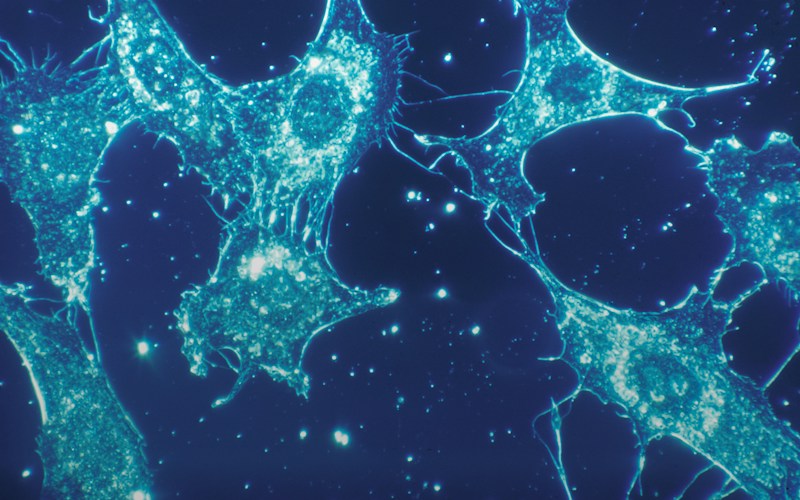
Featured image: National Cancer Institute via Unsplash. The image shows normal human connective-tissue cells in culture and does not depict mycoplasma or a test result.
Keep Exploring
Related Reading

Lab Lowdown for October 9, 2026
Seven laboratory developments span fentanyl surveillance, lung organoids, food-quality testing, microscopy, informatics, LC-MS preparation, and mosquito testing.Read Article
Designing an Environmental Monitoring Plan for Ready-to-Eat Food Facilities
A practical framework for selecting sites, timing samples, choosing methods, and responding to findings in ready-to-eat food facilities.Read Article



Leave a Reply