Key Points
- Animal feed results are only as defensible as the lot sampling, subsampling, grinding, and extraction steps that precede the instrument.
- Method selection should start with the decision the result must support, then narrow by matrix, analyte, reporting need, and applicable regulatory or consensus method.
- Rapid screens can improve throughput, but presumptive or calibration-dependent results may still require confirmation with a fit-for-purpose reference method.
- A laboratory should plan quality controls around the complete workflow, including sampling variability, preparation losses, matrix effects, carryover, and result interpretation.
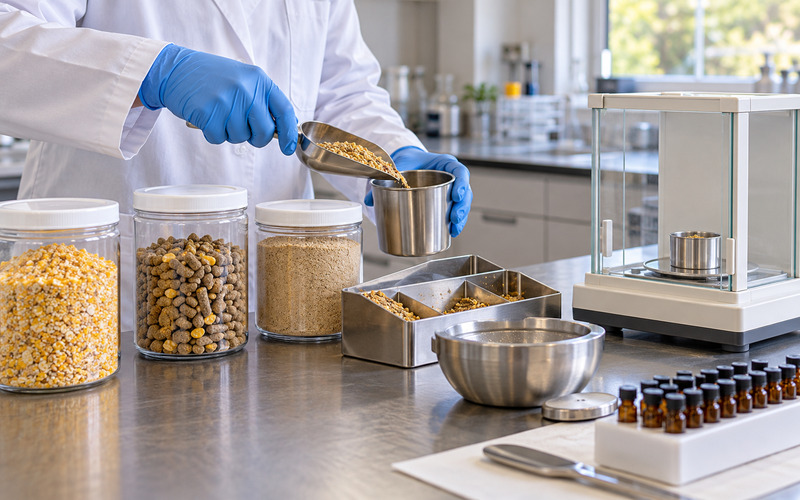
Animal feed testing rarely fails because a laboratory lacks an instrument. More often, the difficulty begins earlier: a truckload, bin, or production lot is heterogeneous, the target analyte is unevenly distributed, and the laboratory must turn a relatively small portion into a result that supports a real operational decision.
That decision might be release of a finished feed, acceptance of an ingredient, investigation of a mycotoxin concern, verification of a nutrient guarantee, or assessment of possible drug carryover. Each question points to a different combination of sampling, preparation, screening, confirmation, and quality control. The most efficient workflow is therefore the one that is fit for the decision, not simply the fastest method on the bench.
Start With a Five-Part Decision Framework
- Define the decision and consequence. A routine process-control screen has a different evidentiary burden from a regulatory submission, customer dispute, recall assessment, or root-cause investigation. State who will use the result and what action it may trigger.
- Describe the matrix and the lot. Record whether the material is whole grain, meal, pellet, premix, mineral supplement, medicated feed, pet food, or another form. Particle size, fat content, moisture, ingredient segregation, and analyte distribution affect both sampling and extraction.
- Identify the applicable source requirement. Check product specifications, contracts, state or federal requirements, validated laboratory procedures, and current consensus methods. FDA guidance for preventive controls in animal food addresses hazard analysis and verification, while ISO and AOAC documents provide method-specific frameworks. A guidance document, standard, customer method, and laboratory recommendation do not carry the same authority.
- Match performance to the reporting need. The analytical range, selectivity, detection capability, precision, recovery, uncertainty, and turnaround time should suit the decision. A screen near a decision limit may need a confirmation pathway planned before testing begins.
- Design quality control before the batch starts. Select blanks, laboratory control samples, matrix spikes, duplicates, reference materials, calibration checks, and carryover checks according to the method and risk. Define acceptance rules and escalation steps in advance.
Treat Sampling and Preparation as Part of the Method
Feed is often physically heterogeneous. Fine mineral particles can separate from larger particles, pellets can break, moisture can migrate, and fungal growth can create localized mycotoxin pockets. A precise instrument result from an unrepresentative portion is still the wrong answer for the lot.
ISO 6497:2002, reviewed and confirmed in 2026, specifies sampling methods for animal feeding stuffs used for commercial, technical, and legal quality control. Its scope excludes pet foods and microbiological sampling, which is a useful reminder that a single sampling plan does not fit every purpose. ISO 6498:2012 addresses preparation of laboratory samples and states that special instructions in a specific analytical method or regulation take priority over its general guidance.
A practical chain of custody should identify the lot, sampling location, increment pattern, composite formation, sample mass, container, seal, preservation, transport conditions, receipt time, and any visible segregation or damage. At the laboratory, the preparation record should capture mixing, splitting, grinding, moisture control, storage, and the portion used for each test.
Compare Methods by the Decision They Support
| Testing Need | Common Approaches | Operational Strength | Primary Tradeoff or Control Point |
|---|---|---|---|
| Nutrients and proximate composition | Reference wet-chemistry, gravimetric, combustion, or instrumental methods selected from an applicable AOAC, ISO, contract, or regulatory source | Defensible quantitative results when the method scope matches the matrix | Preparation and moisture changes can bias results; methods may be slower and more labor-intensive than rapid screens |
| Routine nutrient screening | Near-infrared spectroscopy, or NIR, with a matrix-appropriate calibration | Rapid, low-consumable screening of many samples | Performance depends on calibration population, reference data, instrument standardization, and drift monitoring; out-of-model samples need a reference pathway |
| Mycotoxins | Immunoassay or other rapid screen; chromatographic confirmation; single- or multi-analyte LC-MS/MS where validated for the feed matrix | Screens support quick segregation, while confirmation provides greater analyte specificity | Heterogeneous distribution, extraction efficiency, cross-reactivity, and matrix effects can dominate uncertainty |
| Minerals and toxic elements | ICP-OES or ICP-MS after suitable digestion, depending on required range and analytes | Multi-element capability and broad quantitative range | Contamination, incomplete digestion, spectral interference, and carryover require method-specific controls |
| Veterinary-drug carryover | Targeted LC-MS/MS or another validated confirmatory method | Selective analysis at concentrations relevant to the defined investigation | Complex feed matrices, recovery, ion suppression, and cross-contamination during grinding or extraction require careful control |
| Salmonella and other microbiological hazards | Culture with validated rapid or molecular screening and required confirmation | Rapid screens can shorten time to a presumptive result | Enrichment, stressed organisms, matrix inhibition, and confirmation rules affect interpretation; microbiological sampling requires its own plan |
AOAC INTERNATIONAL’s Official Methods program evaluates methods through expert review, and Final Action status requires evidence of reproducibility. FDA’s Foods Program Compendium of Analytical Laboratory Methods lists agency methods by analyte and matrix, including an LC-MS/MS method for certain antibiotic residues in distillers grains. The method scope matters: a method validated for one feed type or analyte set should not be assumed to cover every formulation without verification.
For microbiology, FDA’s Bacteriological Analytical Manual Chapter 5 includes animal-food applications and validated rapid options within a culture-based workflow. The chapter’s matrix and confirmation instructions should govern when that FDA method is selected.
Watch the Failure Modes That Instruments Cannot Fix
Unrepresentative Lot Sampling
A composite built from too few locations, easy-to-reach surfaces, or a segregated stream can miss hot spots and exaggerate uniformity. The laboratory should not infer lot representativeness when it did not control or document collection.
Preparation That Changes the Analyte
Grinding can generate heat, expose material to moisture, or contaminate subsequent samples. Inadequate homogenization can leave replicate portions with different particle compositions. Cleanout, temperature control, preparation order, and suitable splitters are operational controls, not housekeeping details.
Extraction and Matrix Mismatch
A solvent, cleanup, or dilution that works for grain may perform differently in a high-fat feed, mineral premix, or heavily pigmented matrix. Matrix spikes and representative control materials can reveal recovery or suppression problems, but they do not repair a method outside its validated scope.
Calibration or Screen Drift
Rapid methods can be reliable within a defined operating envelope. Drift checks, reference comparisons, calibration updates, and rules for novel samples are needed to keep a screen from becoming an unsupported release method.
Reporting Without Decision Context
A numeric result without the method, units, reporting limit, sample basis, uncertainty context, and relevant specification can be misread. Mycotoxin guidance, for example, may vary by toxin, species, animal class, ingredient, and proportion of the diet. FDA’s animal-food chemical-contaminant resource links current guidance and explains the hazard-analysis context.
Illustrative Example: Investigating Variable Results in a Pellet Feed
This example is illustrative and does not set a regulatory sampling plan or acceptance limit. A feed mill receives conflicting nutrient-screen and mycotoxin-screen results from different portions of the same pellet lot. The goal is to decide whether the discrepancy reflects the lot, sample collection, preparation, or the analytical method.
- The QA team records the decision: hold the lot while evaluating representativeness and confirmatory needs.
- Collection records are reviewed against the applicable lot-sampling procedure. New increments are taken across defined locations and combined using documented equipment and handling.
- The laboratory inspects the composite, reduces it with a suitable sample divider, and prepares separate retained portions under controlled grinding and moisture conditions.
- The nutrient screen is checked against qualified reference results for the matrix. Samples outside the calibration population move to the reference method rather than being forced into the screen.
- The mycotoxin screen is run with its required controls. Portions near the laboratory’s predefined decision zone proceed to a validated confirmatory method with matrix-appropriate recovery checks.
- QA reviews field duplicates, preparation duplicates, control performance, and result patterns together. The final report states whether the evidence supports lot heterogeneity, sampling error, preparation variability, analytical interference, or an unresolved combination.
This layered approach avoids treating one repeat measurement as proof that the first result was wrong. It also creates a defensible record of where variability entered the process.
Connect Hazard Analysis to the Testing Plan
FDA’s Guidance for Industry No. 245 explains hazard analysis and risk-based preventive controls for animal food, including verification and recordkeeping. Testing should connect to the facility’s identified hazards and preventive controls rather than operate as an isolated certificate-generating step.
Drug carryover deserves its own path. FDA’s Guidance for Industry No. 272 addresses practices to prevent unsafe contamination from carryover. Laboratory analysis can support an investigation, but production sequencing, cleanout, equipment design, and manufacturing records remain part of the evidence.
For a deeper look at confirmatory analysis, see LabPress’s veterinary-drug residue LC-MS/MS workflow guide. Readers new to this sector can also review What Is Agricultural and Animal Health Testing?, while laboratories comparing preparation choices may find the parallel soil-testing workflow guide useful.
Animal Feed Testing Workflow Checklist
- State the decision, user, and consequence before selecting the method.
- Identify the lot, matrix, analyte, species or use context, and applicable specification.
- Confirm whether a regulation, guidance, consensus standard, contract, or validated internal procedure governs the work.
- Document the sampling plan, increment locations, composite formation, custody, preservation, and receipt condition.
- Verify that splitting, grinding, moisture control, storage, and cleanout suit the analyte and matrix.
- Confirm method scope, analytical range, reporting limit, selectivity, and confirmation pathway.
- Define blanks, spikes, duplicates, reference materials, calibration checks, and carryover checks before analysis.
- Set rules for screen-positive, screen-negative, near-decision, and out-of-model results.
- Review field, preparation, and analytical variability together.
- Report the method, sample basis, units, limitations, and interpretation without overstating lot representativeness.
Primary Sources
- FDA CVM Guidance for Industry No. 245: Hazard Analysis and Risk-Based Preventive Controls for Food for Animals
- FDA CVM Guidance for Industry No. 272: Practices to Prevent Unsafe Contamination of Animal Feed from Drug Carryover
- FDA Foods Program Compendium of Analytical Laboratory Methods
- FDA Bacteriological Analytical Manual, Chapter 5: Salmonella
- ISO 6497:2002, Animal Feeding Stuffs, Sampling
- ISO 6498:2012, Animal Feeding Stuffs, Guidelines for Sample Preparation
- AOAC INTERNATIONAL Official Methods Program
Reader Question: Which part of your feed-testing workflow creates the most uncertainty today: lot sampling, sample preparation, rapid-screen calibration, or confirmatory analysis?
Keep Exploring
Related Reading
Evaluating Soil Testing Methods and Workflow Tradeoffs
A practical framework for choosing soil sampling, preparation, extraction, digestion, and analytical methods while balancing representativeness, reporting limits, throughput,…Read Article
Best LC-MS Systems for Quantitative and High-Resolution Analysis
A method-led comparison of LC-MS systems for targeted quantitation, high-resolution discovery, routine mass detection, software, service, and total cost…Read Article




Leave a Reply