
Evidence Review • Pharma And Biopharma Scope
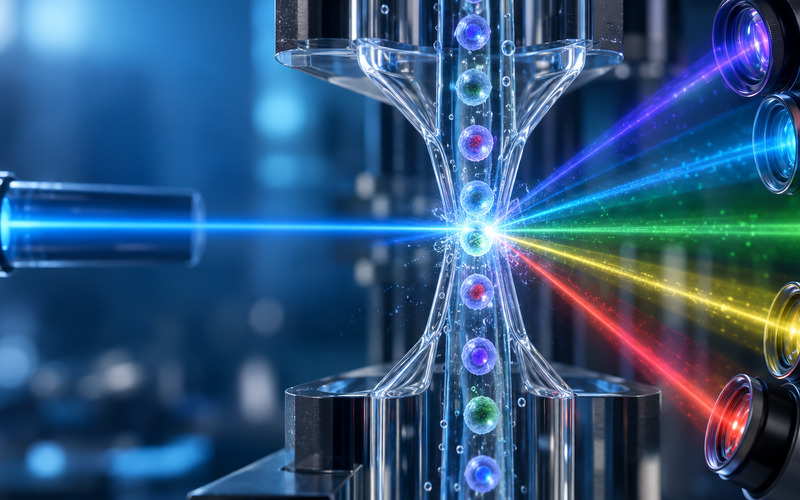
The most capable flow cytometer is not automatically the best instrument for a pharmaceutical or biopharmaceutical laboratory. Discovery teams may value spectral flexibility and very high parameter counts, while manufacturing quality control may place greater weight on assay transfer, daily standardization, electronic records, service coverage, and change control.
Key Points
Contents
Purchasing Scope And Editorial Methodology
This guide focuses on benchtop analyzers used for immunophenotyping, cell-therapy characterization, potency-supporting work, process development, translational studies, and related pharmaceutical or biopharmaceutical applications. Cell sorters are discussed only where they affect platform strategy. Laboratories buying a primary sorter should run a separate biosafety, aerosol management, recovery, purity, viability, and operator-training evaluation.
We ranked manufacturers across five evidence groups: fit for controlled and transferable assays, optical and panel flexibility, sample and automation workflow, software and data governance, and service and lifecycle support. We weighted routine reproducibility and regulated-workflow readiness ahead of maximum parameter count. The result is an editorial shortlist rather than a measured performance score.
Define The Intended Use First
A research-use-only configuration does not become an in vitro diagnostic device because it is used in a regulated laboratory. Product labeling, software edition, assay claims, validation, and jurisdiction all matter. Teams should document intended use and the applicable quality system before comparing configurations.
Quick Comparison
| Rank | Manufacturer And Platform | Best Fit In This Scope | Evidence-Based Strength | Primary Tradeoff To Examine |
|---|---|---|---|---|
| 1 | BD Biosciences FACSLyric FACSymphony A5 SE for higher-parameter research | Regulated QC, clinical development, assay transfer, and multisite standardization | Universal Setup, FACSuite controls, qualification options, reagents, and broad biopharma support | FACSLyric prioritizes controlled transfer over the highest research parameter counts |
| 2 | Beckman Coulter CytoFLEX LX | Flexible advanced analysis with regulated-environment software tools | Up to six lasers and 21 color parameters, scalable platform, and CytExpert Electronic Records Management option | Confirm the precise software installation, validation package, and configuration needed for each site |
| 3 | Cytek Aurora Evo | High-parameter spectral discovery and automated screening | Full-spectrum profiling, faster throughput, automated startup and shutdown, and data harmonization | Spectral controls, unmixing, panel governance, and data review demand disciplined procedures |
| 4 | Sony ID7000 | Expandable spectral immunophenotyping and core-lab standardization | Up to seven lasers, extensive spectral detection, plate and tube workflows, and Standardization Mode | High-dimensional flexibility can increase panel-development, analysis, storage, and training burden |
| 5 | Thermo Fisher Attune Xenith | High-throughput spectral work with challenging or clog-prone samples | Acoustic focusing, tube-to-plate conversion, sample recovery, and spectral or conventional workflows | Buyers should verify electronic-record controls, software governance, and qualification support for the intended regulated use |
A Decision Framework For Flow Cytometry
| Question | Why It Matters | Evidence To Request |
|---|---|---|
| Can the instrument resolve the populations that drive the assay decision? | Parameter count alone does not demonstrate biological discrimination or fit for purpose. | Representative panel data, sensitivity and resolution evidence, and a vendor-assisted feasibility plan |
| Can the assay transfer across instruments and sites? | Clinical development and manufacturing networks require controlled comparability. | Standardization workflow, target-setting approach, cross-instrument study, and change-control documentation |
| Can reviewers reconstruct acquisition and analysis? | Gating, compensation, unmixing, and reanalysis can materially affect reported results. | User-role model, audit-trail demonstration, raw-data retention, version control, and approval workflow |
| What happens when a sample clogs, a QC check fails, or service is delayed? | Recovery steps and local support determine operational resilience. | Failure-recovery demonstration, service terms, parts availability, escalation path, and contingency plan |
Overall Manufacturer Rankings
1BD Biosciences
The BD FACSLyric is the strongest overall fit for laboratories that need standardized assays, electronic-record controls, and transfer across instruments or sites. BD documents Universal Setup for transferring user-defined assays, FACSuite functions including password protection, audit trails, electronic signatures, and IQ/OQ procedures, plus field-service qualification support. For research groups needing higher-dimensional panels, the FACSymphony A5 SE adds spectral and conventional workflows and automation-ready options.
Strengths: Regulated-workflow emphasis, standardization tools, reagent ecosystem, service reach, and a portfolio spanning routine QC through high-parameter discovery.
Tradeoffs: The routine FACSLyric and research FACSymphony families solve different problems. A buyer may need a platform strategy instead of one instrument model, and the precise RUO or IVD labeling must match intended use.
2Beckman Coulter Life Sciences
The CytoFLEX LX combines a scalable conventional cytometry platform with high-parameter configurations reaching up to six lasers and 21 color parameters. CytExpert provides a common acquisition environment across the CytoFLEX family, while the optional Electronic Records Management installation adds tools intended to facilitate Part 11 compliance.
Strengths: Platform scalability, optical configuration breadth, consistent software across the family, and explicit regulated-environment software tools.
Tradeoffs: “Part 11 tools” describe enabling functions. The laboratory must verify the exact installation mode, permissions, audit trails, electronic signatures, infrastructure, validation documentation, and procedures.
3Cytek Biosciences
The Aurora Evo builds on Cytek’s full-spectrum platform with higher-throughput and automation capabilities. Cytek documents automated startup and shutdown, data harmonization, and workflows for drug discovery and high-parameter immunoprofiling. The spectral approach can help teams design panels around complete emission profiles and manage autofluorescence as a distinct signal.
Strengths: Mature full-spectrum ecosystem, panel flexibility, automation direction, and strong application depth in immune profiling.
Tradeoffs: High-dimensional spectral assays require rigorous reference controls, unmixing governance, standardized analysis, computing capacity, and training. Data harmonization claims should be tested with the laboratory’s own panels.
4Sony Biotechnology
Sony’s ID7000 is configurable with up to seven lasers and 186 detectors for tube and multiwell-plate acquisition. The system is built for high-dimensional spectral analysis, while Standardization Mode is intended to support stable performance over time and consistent setup. Sony also provides resources for transferring spectral panels and designing high-color assays.
Strengths: Extensive spectral detection, panel expansion capacity, plate workflow, and explicit standardization tools.
Tradeoffs: Maximum dimensionality increases data volume and analysis complexity. Teams should establish practical panel limits, reference-control policy, storage architecture, and reviewer training before scaling.
5Thermo Fisher Scientific
The Attune Xenith pairs acoustic focusing with spectral or conventional analysis, tube and plate workflows, sample recovery, and bubble detection. Manufacturer specifications describe live unmixing, concentration measurement without counting beads under defined conditions, and rapid conversion between tubes and plates. These features make it attractive for throughput-heavy development work and difficult samples.
Strengths: Acoustic focusing, flexible sample handling, high-throughput options, sample recovery, and spectral or conventional acquisition.
Tradeoffs: The purchasing team should assess regulated electronic-record controls and qualification support in the proposed software environment rather than infer readiness from analytical specifications.
Specialist Category Rankings
Regulated QC And Multisite Assay Transfer
- BD FACSLyric: Leads for Universal Setup, FACSuite controls, qualification support, and a clearly documented biopharma QC pathway.
- Beckman Coulter CytoFLEX LX: Strong flexible option when the Electronic Records Management installation and local validation support fit the quality system.
- Thermo Fisher Attune Xenith: Worth evaluating where sample handling and throughput dominate, subject to a satisfactory software and validation assessment.
High-Parameter Spectral Discovery
- Cytek Aurora Evo: Leads for an established full-spectrum ecosystem, panel flexibility, and automation-oriented evolution.
- Sony ID7000: Strong for very high-dimensional expansion and standardization across sophisticated core workflows.
- BD FACSymphony A5 SE: Compelling when teams want spectral and familiar compensation-based workflows within the BD ecosystem.
High-Throughput And Challenging Samples
- Thermo Fisher Attune Xenith: Moves to first place when acoustic focusing, tube-to-plate conversion, sample recovery, and clog resistance shape the decision.
- Cytek Aurora Evo: Strong for spectral plate workflows, automated operation, and discovery screening.
- BD FACSymphony A5 SE: Relevant for robotics-ready, high-parameter biopharma research.
These category changes show why the purchasing scope must be explicit. An instrument ranked first for manufacturing QC may rank lower for 40-color discovery, and a spectral research leader may require additional governance before use in a controlled release assay.
Validation, Standardization, And Data Governance
ICH Q2(R2) says an analytical procedure’s objective, performance characteristics, criteria, and validation tests should be documented and justified. FDA guidance for cellular and gene therapy products emphasizes that potency methods are product specific, while its comparability guidance illustrates why method precision must be adequate for the quality difference a laboratory needs to detect. Those principles make intended use, biological relevance, and fit-for-purpose performance more important than a generic specification comparison.
A validation or qualification plan may need to address specificity, precision, range, robustness, carryover, sample stability, minimum events, gating, compensation or unmixing, controls, and inter-instrument transfer. The exact characteristics and criteria depend on the assay and development phase. LabPress editorial recommendations are not universal acceptance limits.
Data governance should cover raw FCS files, acquisition templates, detector settings, compensation or unmixing matrices, gates, analysis versions, audit trails, user roles, approvals, exports, backup, retention, and reanalysis. If an assay result feeds a release or clinical decision, the review workflow should make every material analytical decision reconstructable.
Software Features Support Compliance
Password controls, audit trails, electronic signatures, and IQ/OQ services can support a compliant implementation. They do not certify the laboratory’s configured workflow. Include IT, quality, validation, cybersecurity, and records-management owners in the evaluation.
Illustrative Procurement Example
Hypothetical scenario: A biopharmaceutical company needs an eight-color identity and purity assay for a cell-therapy product at two manufacturing sites. Its discovery group also wants 30-color immune profiling for process-development studies. The manufacturing result may support batch disposition, while the discovery data remain exploratory.
The team avoids forcing both jobs onto one configuration. It evaluates a standardized routine platform for the controlled manufacturing assay and a spectral platform for high-dimensional research. The user requirements specification defines assay transfer, daily QC, audit-trail review, reagent-lot handling, backup, service response, and instrument replacement. The evaluation includes the same representative samples on both manufacturing instruments, multiple operators, and a planned software-update scenario.
This example does not prescribe a vendor or acceptance threshold. It shows how one company can use different systems within a governed platform strategy. Teams managing cell-culture quality can also consult LabPress’s mycoplasma detection strategy guide, while broader procurement teams may find the laboratory instrumentation buyer’s guide useful.
Flow Cytometer Buying Checklist
- Approve a user requirements specification tied to assay purpose and development phase.
- List sample types, available cell counts, biosafety conditions, and expected autofluorescence.
- Define required markers, controls, rare-event needs, throughput, and turnaround time.
- Choose conventional or spectral workflows based on panel evidence and staff capability.
- Test representative samples, including fragile, viscous, debris-rich, and low-abundance cases.
- Demonstrate compensation or unmixing, gating, reanalysis, audit-trail review, and approval.
- Assess inter-instrument, interday, interoperator, reagent-lot, and site-to-site performance.
- Confirm software versions, licenses, identity management, backup, retention, and cybersecurity.
- Put qualification, training, preventive maintenance, service response, and escalation in writing.
- Plan software updates, optical changes, reagent substitutions, assay transfer, and decommissioning.
For adjacent cell-based purchasing decisions, see the LabPress guide to microplate readers for multimode and cell-based assays.
Frequently Asked Questions
Is Spectral Cytometry Always Better For Biopharma?
Spectral acquisition can expand panel flexibility and separate autofluorescence, but it also increases control, unmixing, analysis, storage, and training demands. A stable lower-parameter release assay may benefit more from standardization and simplicity.
Does Part 11 Software Make An Assay Compliant?
No. Software functions can support required controls. Compliance depends on intended use, configuration, validation, procedures, access management, training, record review, infrastructure, and continued oversight.
Should Discovery And Manufacturing Use The Same Cytometer?
Sometimes. A common platform may simplify transfer and training, while separate platforms may better fit different scientific and quality needs. Evaluate the lifecycle of the assay, not only the current experiment.
What Should A Vendor Demonstration Include?
Use a representative panel and sample. Test setup, QC, acquisition, compensation or unmixing, a failed run, gate revision, reanalysis, audit-trail review, approval, export, and retrieval from backup.
Primary Sources
- BD FACSLyric Flow Cytometer, BD FACSymphony A5 SE, and BD GMP Manufacturing And Quality Control
- Beckman Coulter CytoFLEX LX and CytExpert Software
- Cytek Aurora Evo and Cytek Drug Discovery Workflows
- Sony ID7000 Spectral Cell Analyzer and ID7000 Standardization Mode
- Thermo Fisher Attune Xenith Flow Cytometer
- ICH Q2(R2), Validation of Analytical Procedures
- FDA Guidance on Potency Tests for Cellular and Gene Therapy Products and FDA Guidance on Manufacturing Changes and Comparability
Reader question: Which factor creates the greatest flow-cytometry purchasing risk for your team: panel transfer, data governance, sample handling, service coverage, or staff training?
Keep Exploring
Related Reading
Best Microplate Readers for Multimode and Cell-Based Assays
An evidence-based guide to microplate readers for multimode detection and cell-based assays, with ranked vendors, category shortlists, practical comparisons,…Read Article





Leave a Reply