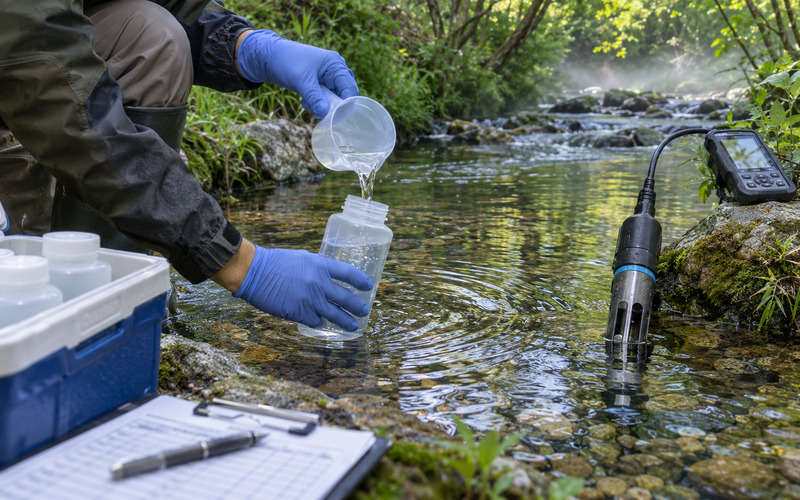
Water quality testing turns a broad question, “Is this water suitable for its intended use?”, into a defined sampling and measurement plan. The most important beginner lesson is that a trustworthy result starts before a bottle reaches the laboratory.
Key Points
- Start with the decision the data must support, then choose locations, timing, analytes, methods, and quality controls.
- Field measurements and laboratory analyses answer different questions. Many programs need both.
- Containers, preservatives, holding times, chain of custody, and transport conditions can affect whether a result represents the original water.
- A clear sample is not necessarily safe, and one test does not screen for every possible contaminant.
- Compliance decisions require the applicable approved method and, for U.S. public drinking water systems, an appropriately certified laboratory.
What Water Quality Testing Means
Water quality testing is the planned collection and measurement of physical, chemical, and biological characteristics of water. “Quality” is not a universal score. It is a judgment tied to use: drinking, recreation, irrigation, industrial processing, wastewater discharge, habitat assessment, or another defined purpose.
That distinction matters. A stream-monitoring program may focus on temperature, dissolved oxygen, turbidity, nutrients, and indicator bacteria. A public drinking water compliance program follows a different set of regulated analytes, approved methods, schedules, and reporting rules. A private-well investigation may begin with local risks, well construction, and recent events such as flooding. The useful question is not “What can we test?” but “What decision must this result support?”
The U.S. Geological Survey’s National Field Manual separates water-quality work into sampling, sample processing, field measurements, and specialized procedures. That structure is a practical reminder that testing is a workflow, not a single instrument reading.
Common Groups of Water Quality Measurements
| Measurement Group | Examples | What It Can Help Show |
|---|---|---|
| Physical | Temperature, color, odor, turbidity, and suspended solids | Changes in appearance, sediment, mixing, runoff, and conditions that can affect treatment or aquatic life |
| General chemistry | pH, conductivity, alkalinity, hardness, and dissolved oxygen | Basic water chemistry, mineral content, buffering capacity, oxygen conditions, and changes between sites or over time |
| Nutrients and inorganics | Nitrate, nitrite, ammonia, phosphorus, metals, and major ions | Nutrient loading, geologic influences, corrosion concerns, or potential contamination |
| Organic compounds | Pesticides, solvents, fuels, pharmaceuticals, and per- and polyfluoroalkyl substances | The presence and concentration of compounds included in a defined analytical panel |
| Microbiology | Total coliforms, E. coli, and other indicator organisms or targeted pathogens | Possible fecal influence or the presence of a specifically targeted microorganism |
No row in this table is a complete safety screen. A result is limited to the analytes, organisms, or properties that the chosen method can measure at its stated performance level.
A Beginner’s Water Quality Testing Workflow
1. Define the Use and the Decision
Write down why the water is being tested and what action could follow. The answer might determine whether a treatment step is working, whether storm runoff changed a stream, whether a production rinse meets an internal specification, or whether a public water system complies with a requirement. This first step sets the required accuracy, detection limits, turnaround time, and oversight.
2. Build the Sampling Plan
Select representative locations and times. Decide whether the program needs a grab sample collected at one moment, a composite sample assembled across time or flow, continuous sensor data, or a combination. Record site identifiers, coordinates when relevant, weather, flow or operating conditions, and anything unusual that could affect interpretation.
Sampling design is a major source of uncertainty. Water can change across a river channel, down a well, within a distribution system, or during a production cycle. A sample from the wrong tap, depth, time, or operating state can be analyzed perfectly and still answer the wrong question.
3. Prepare Clean, Method-Compatible Equipment
The laboratory or method should specify bottle material, sample volume, preservatives, temperature controls, and maximum holding time. Some analytes require glass rather than plastic. Some samples are filtered in the field; others must remain unfiltered. Microbiology samples, metals samples, and volatile-organic samples can have very different handling requirements.
Use clean equipment and avoid touching bottle interiors, caps, or contact surfaces. Calibrate field meters according to the method and document the standard, time, result, and operator. A meter display without calibration and context is not a defensible record.
4. Measure Field Parameters and Collect Samples
Temperature, dissolved oxygen, pH, conductivity, and turbidity are often measured at the site because they can change during storage. Collect laboratory samples using the planned technique, fill them as the method requires, preserve them immediately when required, and label every container so it remains connected to the correct site and time.
Real-time sensors can add valuable context, but they do not eliminate laboratory testing. In previously published remarks about the Baltimore Village Blue monitoring project, EPA scientist and project lead Gary Norris said, “Our goal is to work together with the Baltimore community to use real-time water sensors to raise awareness of the importance of water quality.” The project used sensor measurements including pH, dissolved oxygen, nitrate, temperature, and turbidity. Those continuous readings show patterns and changes, while targeted laboratory methods can identify and quantify other constituents.
5. Preserve, Document, and Transport
Place samples under the required temperature and light conditions, start the holding-time clock, and complete chain-of-custody documentation. Chain of custody is the traceable record of who collected, transferred, received, and analyzed each sample. It also carries the requested analyses and relevant field information to the laboratory.
Record departures from the plan. A broken bottle, missed preservative, delayed shipment, high cooler temperature, or sample collected after an unexpected operating change may require qualification, recollection, or a different interpretation. Hiding the deviation does not repair the sample.
6. Analyze With Fit-for-Purpose Methods and Controls
The laboratory prepares and analyzes the sample using a documented method. Quality-control samples help reveal contamination, bias, imprecision, or instrument problems. Depending on the program, these can include field blanks, equipment blanks, trip blanks, duplicates, laboratory control samples, matrix spikes, calibration checks, and certified reference materials.
For U.S. public drinking water compliance samples, the Environmental Protection Agency says laboratories must be certified by EPA or the state, use approved methods, successfully analyze proficiency-testing samples, and pass periodic audits. A research or screening result can be useful, but it should not be represented as a compliance result if it did not follow the required regulatory pathway.
7. Review the Result in Context
Before acting, check units, detection and reporting limits, qualifiers, blanks, duplicate agreement, sample condition, and method scope. Compare the result with the correct regulatory limit, project criterion, baseline, or internal specification. A number without its unit, method, sample identity, and quality-control context is incomplete.
Targeted panels illustrate this limitation. In previously published remarks about a national tap-water study, USGS research hydrologist and study lead Kelly Smalling said, “USGS scientists tested water collected directly from people’s kitchen sinks across the nation.” The sample location helped define what the study measured at the point of use. The analysis still applied to the specific PFAS compounds and methods in the study, not every possible substance in tap water.
Illustrative Example: A Stream After Heavy Rain
Scenario: An environmental laboratory is asked whether a storm changed conditions downstream of an urban drainage area.
The team defines upstream and downstream locations and collects samples before the storm when possible, during the runoff period, and after flow begins to recede. At each visit, it records weather, water level, temperature, pH, conductivity, dissolved oxygen, and turbidity. It collects method-compatible grab samples for nutrients, suspended solids, and E. coli, plus a field duplicate and an appropriate blank.
The samples are labeled, preserved, cooled, and transferred under chain of custody. The laboratory reviews blank results, duplicate precision, calibration performance, and any data qualifiers before comparing sites and times. Higher downstream turbidity accompanied by increased suspended solids may support a runoff interpretation. A single elevated result, however, does not by itself identify the source. Follow-up sampling, land-use information, flow data, or source-specific analyses may be needed.
Laboratories planning more complex environmental work can also review LabPress guidance on wastewater testing workflow tradeoffs, PFAS testing methods, and sample preparation for environmental LC-MS.
Four Common Misconceptions
“Clear Water Is Safe Water”
Appearance can reveal sediment, color, or visible growth, but many microorganisms and dissolved chemicals are not visible. Clear water can still require testing, and cloudy water is not automatically proof of a particular contaminant.
“One Test Checks Everything”
Every method has a defined scope. A bacteria test does not measure lead. A pH reading does not identify solvents. A broad screening method still has an analyte list, detection limits, and potential interferences.
“A Home Kit Is the Same as a Compliance Test”
Screening kits can help identify a need for follow-up, but collection technique, method validation, quality controls, instrument performance, and laboratory certification determine whether a result is suitable for regulatory or high-consequence decisions.
“The Laboratory Result Explains the Source”
A concentration establishes what was measured in that sample. Source attribution usually needs spatial and temporal patterns, site history, hydrology, process data, or additional chemical and biological evidence.
Limitations Beginners Should Expect
A sample is usually a snapshot. Concentrations can vary with rain, flow, pumping, temperature, treatment cycles, and human activity. Methods also have detection limits, and the sample matrix can suppress or enhance an analytical response. Storage and holding time can change the substance or organism being measured. These limitations do not make testing unreliable. They define what the result can reasonably support.
Good reports state those boundaries. They identify the method, units, reporting limit, sample condition, quality-control findings, and qualifiers. If an important decision depends on a borderline or unexpected result, confirmatory sampling is often more informative than treating one number as final.
Actionable Checklist
- Define the water’s intended use and the decision the data will support.
- Identify applicable regulatory, project, or internal requirements.
- Select representative sites, timing, sample type, and analytes.
- Confirm bottles, preservatives, volumes, holding times, and shipping conditions with the laboratory.
- Calibrate field instruments and record the checks.
- Include fit-for-purpose blanks, duplicates, and other quality controls.
- Maintain labels and chain-of-custody records from collection through analysis.
- Review units, reporting limits, qualifiers, and quality-control results before interpretation.
- Recollect or investigate when sample integrity or method suitability is uncertain.
Frequently Asked Questions
How Often Should Water Be Tested?
Frequency depends on the water source, intended use, applicable rules, local risks, and how quickly conditions can change. Public systems follow required monitoring schedules. Private-well owners should use state or local health guidance and add testing after flooding, repairs, a change in taste or odor, or a nearby contamination event.
Can pH Tell Me Whether Water Is Safe?
No. pH is a valuable measure of acidity or basicity and can affect treatment, corrosion, and chemical behavior, but it does not reveal every microorganism or chemical contaminant.
What Should I Do With an Unexpected Result?
Check the sample identity, method, unit, reporting limit, qualifiers, and quality-control data. Discuss the result with the laboratory, confirm whether the sample met collection and holding requirements, and determine whether prompt recollection or a regulatory notification is required.
Does a Nondetect Mean Nothing Is Present?
Not necessarily. It means the analyte was not detected under the method’s conditions at or above the applicable detection or reporting threshold. The method and threshold belong in the interpretation.
The Question to Ask Before the First Bottle
What decision will this result support, and does the sampling and analytical plan match that decision? Answering that question early prevents the most expensive beginner mistake: producing a precise result from the wrong sample or method.
Featured image: LabPress editorial illustration generated for this article.
Keep Exploring
Related Reading
Protein Analysis Explained for Beginners
A beginner-friendly guide to protein analysis, from sample preparation and total-protein assays to Western blotting, immunoassays, chromatography, mass spectrometry,…Read Article
Research Reproducibility Explained for Beginners
A beginner’s guide to research reproducibility, from study design and data lineage to independent analysis replay, failure modes, and…Read Article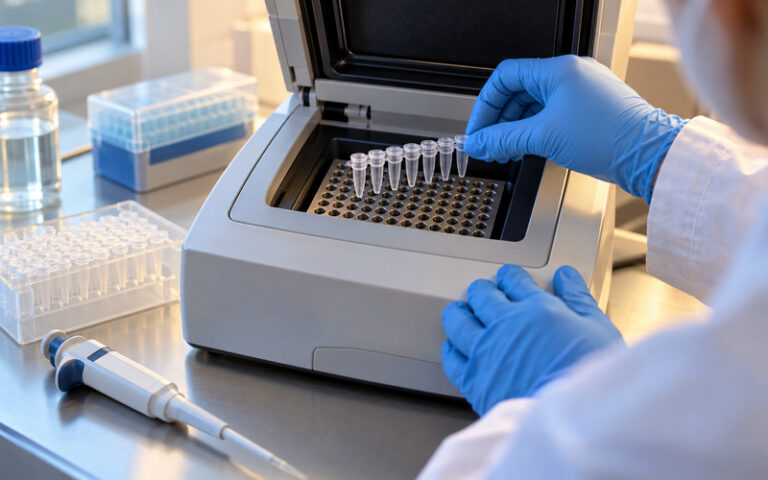



Leave a Reply