
Key Points
- Clinisys previewed configurable workflows and governed AI tools, while MiraVista selected AI-assisted requisition intake.
- Parallel Fluidics and Opentrons brought microfluidic lipid-nanoparticle formulation onto the Flex automation platform.
- Medicinal Genomics announced AOAC certification for a multiplex Listeria assay covering specified foods and environmental surfaces.
- Pattern expanded investigational pneumonia testing into five U.S. laboratories, and Thermo Fisher introduced a medium for adenovirus production.
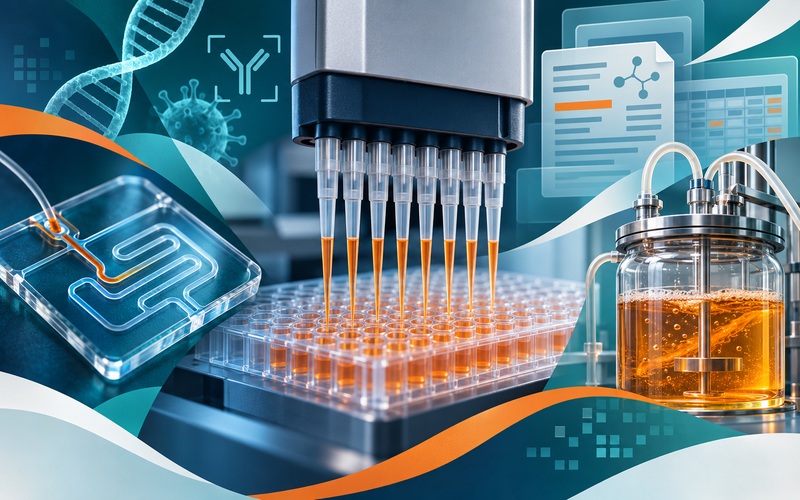
Laboratory automation reached beyond the pipetting deck this week, extending into test-request intake, configurable informatics, and formulation development. This edition covers announcements published from Saturday, Nov. 14, through Friday, Nov. 20, 2026, with research checked Friday afternoon Eastern time. Six developments stand out for the practical questions they raise about implementation, method performance, and the work between an initial sample and a usable result.

Clinisys Previews Configurable Workflows and Governed AI
Announced Nov. 17: Clinisys outlined version 2025.4 of Clinisys Laboratory Solution, with general availability planned for Nov. 24. The release expands reusable workflow content, including food-safety and public-health packages, alongside APIs and low-code or no-code configuration. Its AI-assisted functions include an Analytics Agent for authorized laboratory information, guidance grounded in approved documentation, and tools for working with equipment information and unstructured documents.
The development gives laboratory informatics teams a concrete upgrade to assess as they look for alternatives to maintaining extensive custom code. Reusable configuration could reduce implementation work, but laboratories still need to establish whether it fits their own procedures and validation requirements. Clinisys says individual capabilities can depend on licensing, region, configuration, and deployment prerequisites. Buyers should confirm the functions included in their proposed implementation and how access controls, source records, and human review carry through each AI-assisted task.
MiraVista Targets the Requisition Intake Bottleneck
Announced Nov. 18: MiraVista Diagnostics selected Hyperscience to classify incoming laboratory requisitions, extract information, and send structured data into its laboratory information management system. The specialty fungal diagnostics laboratory said increasing demand prompted the modernization effort. The companies evaluated representative requisitions, defined success criteria, and developed a proof of concept before moving toward implementation.
This is an important preanalytic application of AI because even a capable analytical laboratory can lose time to incomplete requests, inconsistent forms, and repetitive transcription. The announcement describes an intended workflow rather than published production results: it does not disclose a go-live date, measured field-level accuracy, or a turnaround-time improvement. For laboratories considering a similar project, the useful next questions concern handling uncertain fields, matching patient and specimen identifiers, routing exceptions to staff, and monitoring performance when referring organizations change their forms.
Opentrons and Parallel Fluidics Put LNP Formulation on the Robot
Announced Nov. 19: Parallel Fluidics and Opentrons introduced a Flow Processing Unit that runs on the Opentrons Flex deck to automate lipid-nanoparticle formulation. Lipid nanoparticles help deliver mRNA and other genetic medicines. The collaboration combines routine liquid handling with microfluidic mixing on one programmable platform, supported by protocols in the Opentrons Protocol Library and application training.
For discovery laboratories, the appeal is a more direct route from an experimental design to a larger set of formulations for characterization. The companies report throughput up to 50 times that of common benchtop instruments, a supplier claim that laboratories should test against the actual comparison workflow. Useful evaluation measures include particle-size distribution, encapsulation efficiency, carryover, reproducibility, and the time needed for cleaning and analysis. Parallel Fluidics says further units for buffer exchange and antibody purification are planned for 2027; those additions are future plans.
Medicinal Genomics Adds Certified Multiplex Listeria Testing
Announced Nov. 19: Medicinal Genomics announced AOAC Research Institute Performance Tested Methods certification No. 112601 for its PathoSEEK Listeria mono & spp. Multiplex Detection Assay with MaGiC Lysis. The qPCR assay detects Listeria species and Listeria monocytogenes in the same reaction. The certified matrices include whey powder, bagged spinach, deli turkey, and hot dogs, plus specified stainless-steel, ceramic, plastic, and sealed-concrete sampling surfaces.
The combination matters to food and supplement laboratories that monitor both product safety and processing environments. A multiplex assay can consolidate analytical work, while an independently reviewed validation package gives quality teams a defined performance scope to examine. That scope remains the key purchasing and implementation detail. A certification covering whey powder does not automatically cover every supplement formulation, and laboratories must confirm the applicable enrichment, sampling, instrument, and control conditions. Medicinal Genomics says matrices outside the certificate require additional verification work.
Original Medicinal Genomics announcement | Manufacturer validation scope | LabPress coverage
Pattern Brings Investigational Pneumonia Testing Into Five Laboratories
Announced Nov. 17: Pattern Bioscience said five U.S. clinical microbiology laboratories are evaluating its Pneumonia ID/AST Panel through an Early Evaluation Program. The platform is designed to detect and identify bacteria and assess antimicrobial susceptibility directly from lower respiratory tract specimens using single-cell microbiology. Participating laboratories are assessing how the system fits routine workflows and providing usability and integration feedback.
The distinction between an evaluation and a clinical launch is essential here. Pattern says its products are for investigational use only, have not received FDA clearance, and are not being used for patient-management decisions in the program. The panel has Breakthrough Device Designation, which does not constitute clearance or approval. The operational questions are nevertheless relevant to microbiology leaders: specimen preparation, mixed samples, result interpretation, staffing, LIS integration, and the evidence needed to connect a faster analytical process with clinical utility.
Original Pattern Bioscience announcement | LabPress coverage
Thermo Fisher Introduces a Medium for Suspension Adenovirus Workflows
Announced Nov. 18: Thermo Fisher Scientific launched Gibco VaxEvo CD 293 Medium for suspension HEK293 cell growth and adenovirus production. The chemically defined, animal-origin-free formulation is offered in liquid and Advanced Granulation Technology formats. Thermo Fisher positions it for vaccine and viral-vector development as teams move from process development toward larger-scale production.
Media choice can affect cell growth, yield, process complexity, and the evidence required when a laboratory changes an established workflow. Thermo Fisher reports favorable adenovirus-titer results against selected benchmark media, but its product information notes that performance varies with cell line, virus, and process conditions. Teams evaluating the formulation should therefore compare it in representative small-scale runs, including growth, product quality, reproducibility, and material preparation requirements. The practical value will depend on whether improvements persist in the specific process being transferred or scaled.
Original Thermo Fisher announcement | Manufacturer product information | LabPress coverage
Which of these developments would make the biggest difference in your laboratory, and what evidence would you need before adopting it?
Keep Exploring
Related Reading

Lab Lowdown for November 13, 2026
Seven laboratory developments from Nov. 7–13, covering duplex sequencing, hematologic tumor profiling, microbial ID/AST, emergency IVD validation, animal-health surveillance,…Read Article
Lab Lowdown for October 30, 2026
This week’s Lab Lowdown tracks six verified developments across laboratory automation, IVD sequencing, energy materials, laboratory informatics, chromatography software,…Read Article





Leave a Reply