
Key Points
- A reagent lot change deserves a defined release decision, with acceptance criteria agreed before the comparison begins.
- Patient specimens and quality-control materials answer different questions; agreement in one does not guarantee agreement in the other.
- Study size, concentrations, and allowable differences should reflect the assay and its clinical use. A single percentage or sample count cannot cover every method.
- Keep enough of the current lot to investigate discrepancies, document the decision, and monitor performance after the transition.
Build a defensible lot-change decision with the right specimens, comparison criteria, and investigation plan.
A new reagent shipment can arrive with acceptable paperwork while still presenting a difficult analytical question. Will the replacement lot produce results sufficiently consistent with the current lot for the decisions clinicians make? A routine control run provides useful evidence, but a laboratory needs a plan for evaluating the transition and resolving conflicting findings.
This guide focuses on quantitative clinical chemistry and immunoassay workflows. It offers an editorial decision framework for laboratory managers, analysts, and quality teams, alongside explicitly identified U.S. regulatory requirements and professional guidance. The laboratory’s approved procedures, assay instructions, applicable accreditation standards, and local requirements determine the final protocol.
Define What Is Changing Before Choosing the Study
Start the review with a change record that names the assay, instrument, current reagent lot, proposed lot, calibrator lot, and control lot. Then ask whether the transition also includes a formulation change, new specimen type, software revision, or changed preparation step. Bundling several changes into one comparison makes an unexpected result harder to explain.
| Change | Main Question | Planning Implication |
|---|---|---|
| New lot of the same reagent | Are patient results consistent enough across the transition? | Use the approved lot-comparison procedure and assess calibration obligations separately. |
| New control-material lot | What are the new control’s acceptable values and variation? | Establish or verify its acceptance criteria; avoid assuming the old control’s target transfers. |
| Calibration or calibration verification | Is the measurement response appropriately related to concentration across the reportable range? | Follow the test-system instructions and applicable calibration requirements. |
| Changed method or intended use | Does the altered test system perform adequately for its intended application? | Evaluate the required verification or validation scope before treating it as a routine lot change. |
Under 42 CFR 493.1255, applicable nonwaived systems require documented calibration verification at least every six months and at specified triggering events. A complete reagent change is one trigger, with an exception when the laboratory demonstrates that lot changes do not affect the reportable range or adversely affect control values. The section also addresses major maintenance and unresolved control shifts. A passing lot comparison should therefore be reviewed against the actual calibration requirements for that system.
42 CFR 493.1256 separately requires control procedures that monitor the complete analytic process, defines control-material acceptance responsibilities, and requires control testing before patient testing resumes after a complete reagent change. For an unmodified, FDA-cleared or approved nonwaived system being introduced into a laboratory, consult the CMS performance-specification verification guidance. That brochure excludes modified systems, whose performance-establishment obligations require a separate review. These are related quality activities with distinct purposes.
Design the Comparison Around the Decision
The Clinical and Laboratory Standards Institute’s EP26 guideline describes evaluation of reagent lot changes using patient samples to detect clinically important differences. Its public description supports a central planning principle: choose the study to detect the change that matters. It does not establish a universal acceptable bias or a single sample count for every assay.
Specify the Acceptance Rule
Write down the clinical concentration regions to examine, the allowable difference at each region, the units of that difference, and how uncertain or conflicting findings will be handled. Record the scientific rationale and reviewer before results are available. Treat a laboratory’s chosen limit as a local analytical decision, unless a cited requirement explicitly establishes it.
Reserve Operational Capacity
Set an internal start date that leaves time for testing, review, and investigation while the accepted lot remains usable. Assign an owner for procurement coordination and a separate release reviewer where staffing permits. A delivery deadline should trigger contingency planning, with a validated backup method or referral pathway considered when appropriate.
The Association of Public Health Laboratories’ 2024 verification and validation toolkit recommends clinical specimens together with QC materials for most new reagent-lot evaluations. It emphasizes relevant concentrations, suitable specimen handling, and close-in-time testing on both lots. Processed controls may behave differently from patient specimens, so a control shift and a patient-sample shift can tell different stories.
| Material | Useful Evidence | Operational Tradeoff |
|---|---|---|
| Individual residual patient specimens | Paired results across clinically relevant concentrations and specimen variation | Availability, volume, stability, and authorized handling can constrain the plan. |
| Patient pools | A practical way to obtain enough material at selected concentrations | Pooling can conceal specimen-specific effects. Document how pools were prepared and what they represent. |
| Commercial controls | Evidence about control performance and the ongoing monitoring system | Processing and matrix differences can limit how closely they reflect patient specimens. |
| Calibrators or other characterized materials | Evidence for their intended calibration or verification purpose | Assign each material a clear role and check its suitability before using it to support another claim. |
Sample count needs a rationale. A 2017 clinical laboratory study applying the earlier EP26-A protocol found that calculated sample needs and some acceptance decisions differed from its existing fixed-size procedure across six immunoassays. That result supports assay-specific planning; it does not supply a sample-count rule for another laboratory. Replicates help characterize measurement variation, while additional independent specimens explore a different dimension of the comparison.
Review Differences, Patterns, and Competing Explanations
A high correlation can coexist with a systematic shift. If every new-lot result equals the old-lot result multiplied by 1.1, the two sets retain a perfect linear relationship even though each nonzero result is 10% higher. This mathematical illustration explains why a correlation coefficient alone cannot establish acceptable agreement.
For each paired result, calculate the difference in the assay’s units and, where appropriate, the percentage difference relative to the current-lot result. Examine the pattern across concentration, then evaluate it against the prespecified criteria and statistical plan. Percentage differences become unstable when the denominator approaches zero, so the protocol should explain how the low end will be assessed. Neither lot should automatically be treated as an independent reference for trueness.
A disputed comparison should produce an investigation record. Keep the original results, identify the suspected cause, specify any repeat work, and explain what new evidence resolves the discrepancy. Repeating until a passing set appears produces a weak release record.
The Association for Diagnostics & Laboratory Medicine’s discussion of lot verification describes how QC and patient-sample responses can diverge and cautions against relying exclusively on controls. Translate that concern into explicit branches in the review:
- Controls and patient comparisons are acceptable. Complete the remaining calibration, documentation, and authorization checks before release.
- Controls pass but patient differences exceed the plan. Hold routine release of the candidate lot and investigate the patient-sample finding, including concentration dependence and specimen integrity.
- Controls shift but patient results appear consistent. Investigate the control matrix, assigned values, preparation, and handling. Any revision to QC targets needs a documented technical basis and authorization under the laboratory’s rules.
- Both show an unexpected shift. Review calibration, reagent preparation, storage, instrument condition, and the sequence of changes before assigning the problem solely to manufacturing variability.
An Illustrative Immunoassay Lot-Change Review
A hospital laboratory is evaluating a replacement reagent lot for a quantitative thyroid-stimulating hormone assay. The approved plan includes residual specimens in clinically important low, middle, and high concentration regions, together with the laboratory’s established controls. The old lot remains within its usable period, and both lots are evaluated under their required calibration conditions.
One specimen measures 4.00 mIU/L with the current lot and 4.40 mIU/L with the candidate lot. The absolute difference is +0.40 mIU/L and the relative difference is +10%. These invented numbers demonstrate the calculation only; they establish neither a clinical decision threshold nor an acceptable limit.
The controls remain within their existing limits, but several specimens in the same concentration region show differences outside the laboratory’s prespecified criterion. The reviewer holds the new lot, confirms the sample handling and instrument records, and arranges additional work under an approved investigation. The conclusion must explain whether the finding reflects a lot effect, another analytical cause, or insufficient evidence to decide.
The management question in this example is whether the laboratory can defend continuity of results. A spreadsheet that labels the overall average acceptable could obscure a problem concentrated in a clinically important region. The release summary should preserve that regional interpretation, the uncertainty, and the scope of any limitations.
Common Failure Modes to Catch Early
Comparison With Yesterday’s Result
Using a historical value as the only old-lot comparator can entangle lot differences with specimen aging or a changed analytical run. State the permitted comparison timing and stability evidence in the protocol, and flag departures for review.
Several Changes at Once
A reagent, calibrator, and control transition on the same day complicates attribution. When simultaneous changes are unavoidable, document them explicitly and plan how each possible explanation will be assessed.
Acceptance Criteria Chosen Afterward
Moving a limit after seeing an inconvenient result undermines the original decision. Any scientifically justified protocol revision should retain the first analysis, its rationale, and the new approval trail.
No Record of the Actual Switch
A signed study and an instrument changeover can occur on different shifts. Record the effective lot-change time, communicate it to operators, and ensure the information system can trace relevant results to the lot in use.
A Practical Release Checklist
- Identify the scope. Confirm assay, instruments, reagent and calibrator lots, specimen types, and any accompanying changes.
- Approve the plan. Record concentration coverage, sample and replicate strategy, acceptance criteria, analysis method, and escalation route.
- Protect the comparison. Verify usable inventory, specimen handling, required calibration, control performance, and traceability of each result.
- Resolve discrepancies. Retain the original data, explain repeat testing, document corrective actions, and obtain the required technical review.
- Authorize implementation. Record the release decision, reviewer, effective time, and any limitations or remaining monitoring commitments.
- Review the transition. Check the agreed post-change QC and investigation records, and confirm that operators know how to escalate a new signal.
For laboratories automating comparison work, map specimen identity, result transfer, exception handling, and approval responsibilities before selecting equipment. LabPress’s laboratory automation planning guide provides broader workflow context. The automated liquid handling buyer’s guide can support equipment evaluation, while assay-specific suitability still requires its own assessment.
Where Does Your Lot-Change Process Stall?
Is the hardest step finding suitable patient specimens, agreeing on acceptance criteria, or resolving a control-and-patient mismatch? Share the workflow problem and what improved it in the comments, without including patient-identifiable information.
Sources and Scope
Sources checked Oct. 9, 2026. Regulatory statements above refer to the identified U.S. CLIA provisions. Professional guidance and the editorial workflow suggestions are distinguished from those requirements; the hypothetical example is not a validated protocol.
- 42 CFR 493.1255, calibration and calibration verification.
- 42 CFR 493.1256, control procedures.
- CMS, verification of performance specifications.
- CLSI EP26, User Evaluation of Acceptability of a Reagent Lot Change, public guideline description.
- APHL, Laboratory Test Verification and Validation Toolkit, March 2024, especially pages 22-24.
- ADLM, Tackling Reagent Lot-to-Lot Verification in the Clinical Laboratory, July 2014.
- Evaluation of the CLSI EP26-A protocol for detection of reagent lot-to-lot differences, Clinical Biochemistry, 2017.
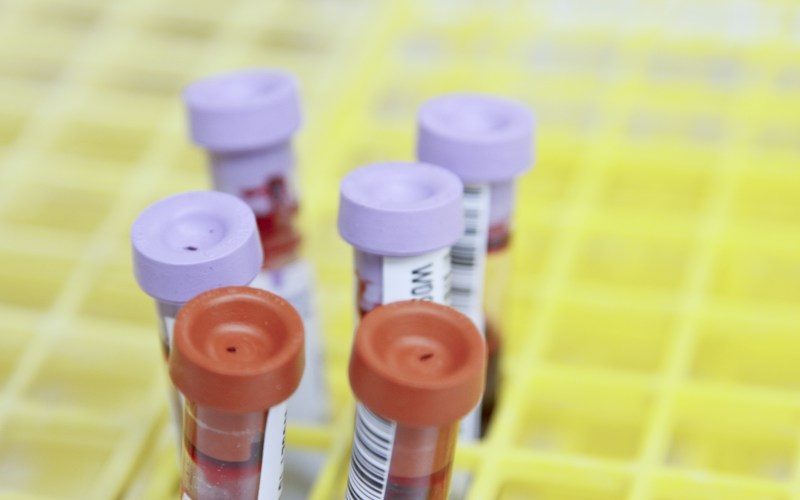
Featured photograph: National Cancer Institute via Unsplash. Illustrative blood-sample photograph; it does not depict the hypothetical comparison described here.
Keep Exploring
Related Reading

Lab Lowdown for November 13, 2026
Seven laboratory developments from Nov. 7–13, covering duplex sequencing, hematologic tumor profiling, microbial ID/AST, emergency IVD validation, animal-health surveillance,…Read Article
Lab Lowdown for November 6, 2026
Six laboratory developments from Oct. 31 through Nov. 6, including hemorrhagic-fever PCR, rare-disease genomics, lab informatics, ion mobility, and…Read Article





Leave a Reply