
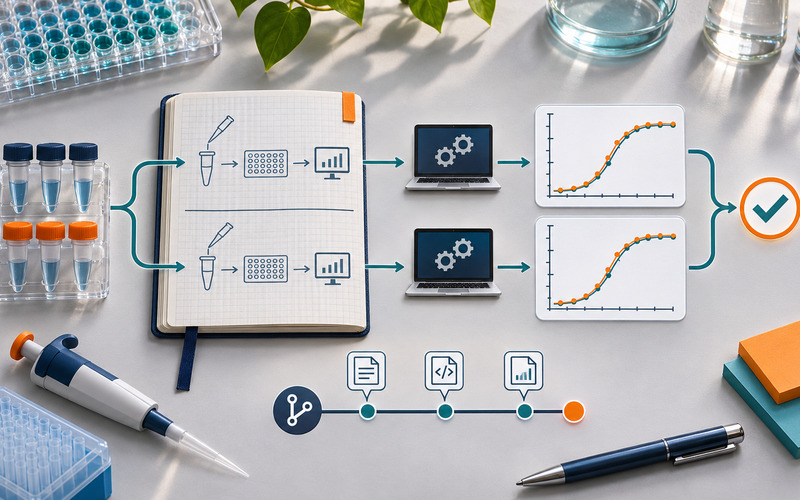
Key Points
- Reproducibility means that another researcher can use the same data, methods, and analysis steps to obtain a consistent result. Replicability asks whether a new study using new data reaches a consistent conclusion.
- A reproducible project begins before the first sample is run. The team must define the question, controls, sample unit, inclusion rules, data structure, and analysis plan.
- Good records connect each result to its sample, reagent lot, instrument settings, raw file, processing steps, software version, and decision history.
- Reproducibility does not prove that a scientific claim is true. It makes the work easier to inspect, repeat, challenge, and extend.
Research reproducibility is the ability to follow a documented path from evidence to result and obtain a consistent outcome. In a modern laboratory, that path includes more than the written method. It may also include sample identities, reagent lots, instrument settings, raw files, data-cleaning rules, statistical code, software versions, and records of every exclusion or correction.
This matters because laboratory findings rarely stand alone. A student may inherit a project, a core facility may rerun an assay, a collaborator may analyze the same data, or another group may test the conclusion in a different setting. The clearer the evidence trail, the easier it is to find mistakes, understand differences, and build on the work responsibly.
What Research Reproducibility Means
Scientific fields do not always use the words reproducibility and replicability in the same way. The National Academies of Sciences, Engineering, and Medicine separates them by the source of the data. Under that framework, reproducibility uses the same input data and analysis steps, while replicability uses new data collected to answer the same scientific question.
| Term | Plain-Language Question | Example |
|---|---|---|
| Reproducibility | Can someone rerun the documented analysis on the same data and obtain a consistent result? | A colleague runs the archived script on the original microscopy measurements and recreates the reported plot. |
| Replicability | Does a new study with new data produce a result consistent with the original conclusion? | A second laboratory repeats the experiment with a new cell batch and independently collected images. |
| Generalizability | Does the conclusion hold in another population, model, material, or setting? | The same relationship appears in a different cell line or disease model. |
A laboratory should state how it uses these terms. Clear definitions prevent a team from treating a successful rerun of computer code as if it were an independent experimental confirmation.
Why Reproducibility Starts With Study Design
Reproducibility cannot be added at the end of a project by cleaning up a notebook or uploading a spreadsheet. It begins when the team decides what it will measure, what counts as an independent sample, which controls are needed, and how results will be analyzed.
The National Institutes of Health guidance on rigor and reproducibility emphasizes experimental design, relevant biological variables, authentication of key resources, and transparent reporting. NIH reporting principles also call for clear descriptions of randomization, blinding, sample-size decisions, exclusion criteria, replicates, and statistical methods where those elements apply.
For a beginner, the practical lesson is simple: every result should be traceable to a planned decision or a documented change. If an exclusion rule, data transformation, or endpoint appears only after the results are known, readers cannot tell whether it was scientifically justified or selected because it produced a preferred answer.
A Beginner-Friendly Reproducibility Workflow
- Define the question and experimental unit. State the primary question, outcome, comparison, and the unit that is independently sampled. A well, image, technical repeat, animal, patient, or batch may represent a different level of independence.
- Plan controls and decision rules. Record positive and negative controls, randomization or allocation steps, blinding where feasible, acceptance criteria, exclusions, and the intended analysis before examining the final pattern.
- Identify materials and methods precisely. Capture reagent source and lot, cell-line identity, sample history, instrument model, acquisition settings, calibration state, and method version. Field-specific reporting standards can help. For animal research, the ARRIVE 2.0 framework organizes essential reporting items for evaluating the reliability of a study.
- Preserve raw data and metadata. Store the original instrument output without overwriting it. Link the file to the sample, operator, run, method, and quality-control record. NIH describes data management as the work of validating, organizing, protecting, maintaining, and processing scientific data so they remain reliable and usable.
- Make transformations visible. Keep scripts, formulas, thresholds, and manual corrections under version control. A final spreadsheet without its calculation history is difficult to audit, even when every value looks reasonable.
- Run an independent replay. Ask someone who did not write the analysis to start with the archived files and instructions. Record where the replay fails, then improve the documentation or code until the result can be reconstructed.
- Report limits and share responsibly. Distinguish exploratory work from confirmatory testing, report uncertainty, disclose exclusions and deviations, and share data, code, and materials when ethical, legal, contractual, and privacy requirements allow.
These practices fit naturally into the responsibilities described in What Is Academic Laboratory Research?. Teams that use a shared instrument or specialist service should also agree on handoffs, file formats, and acknowledgment at the planning stage, as explained in Core Research Facilities Explained for Beginners.
Illustrative Example: A Cell-Migration Study
Scenario: An academic cell-biology laboratory is testing whether a candidate compound changes the migration of cultured cells in a scratch assay. The team plans three independent experiments on different days. Each experiment uses a separately prepared cell batch, vehicle controls, a fixed imaging schedule, and predefined image-quality criteria.
The raw microscope files are saved unchanged. A sample table connects every image to the cell batch, treatment, plate location, acquisition time, and operator. A versioned analysis script measures the open area at each time point, applies the same quality checks to every group, and creates the summary plot. The repository records the script version, required software packages, and a machine-readable copy of the analysis-ready data.
Before submission, another laboratory member downloads the archived files into a clean environment and recreates the main figure. That replay tests reproducibility. If a collaborator later repeats the experiment with a new cell batch and independently collected images, that is a test of replicability. Neither result alone proves that the compound will behave the same way in another cell line, an animal model, or a patient.
Common Failure Modes
- Confusing technical and biological replicates: Repeated measurements of one sample can estimate measurement variation, but they do not automatically create independent biological observations.
- Missing identifiers: A reagent name without a lot, catalog number, validation record, or preparation history may leave the next researcher using a materially different input.
- Overwritten raw files: Saving processed data over the original output removes the baseline needed to investigate an error.
- Undocumented exclusions: Dropping an outlier, failed run, or low-quality image without a recorded rule makes the analysis hard to evaluate.
- Manual spreadsheet edits: Copying, sorting, and correcting by hand can separate data from its provenance. A visible, repeatable transformation is easier to check.
- Uncaptured software environments: The same script may behave differently after a package, dependency, or default setting changes.
- Selective reporting: Reporting only favorable measures or successful repeats hides information needed to judge robustness.
Electronic systems can help link context and results, but software alone does not make a study reproducible. The record structure, naming rules, review process, and staff habits still matter. LabPress’s coverage of an integrated electronic lab notebook illustrates how experimental context and structured data can be connected. For laboratories evaluating automation, the buyer’s guide to automated liquid handling systems explains why real methods, consumables, software, validation burden, and error recovery matter more than headline speed.
What Reproducibility Does Not Guarantee
A reproducible analysis can still begin with a biased design, an unsuitable model, a mislabeled sample, or an invalid measurement. It demonstrates that the documented steps can be followed consistently, not that every scientific assumption is correct.
Likewise, one failed replication does not automatically disprove the original study. Differences in populations, materials, environments, methods, or statistical uncertainty may explain the disagreement. A useful response is to compare the evidence trails and identify which conditions changed.
Actionable Checklist
- Write the primary question, outcome, comparison, and experimental unit.
- Define controls, acceptance criteria, exclusions, and planned analyses.
- Record sample provenance, material identifiers, instrument settings, and method versions.
- Keep immutable raw data and link it to complete metadata.
- Use scripts or auditable workflows for transformations where practical.
- Record software versions, dependencies, and configuration settings.
- Separate technical repeats from independent biological samples.
- Ask a colleague to replay the analysis from the archived package.
- Report deviations, exclusions, negative results, uncertainty, and limitations.
- Share data, code, protocols, and materials within applicable ethical and legal limits.
A Focused Question for Your Laboratory
If a new team member had only your archived files and written instructions, which step in your current workflow would be hardest for that person to reconstruct without asking the original analyst?
Frequently Asked Questions
Is repeating an experiment in the same laboratory enough?
It can reveal whether a workflow is stable under local conditions, but it does not answer every question. Reanalyzing the same data tests reproducibility, while collecting new data tests replicability under the conditions of the new study.
Does reproducibility require publishing every file openly?
No. Human-subject privacy, animal-welfare obligations, intellectual property, security, contracts, and repository rules may limit access. The goal is to manage and document materials so that authorized reviewers can understand the evidence and so that sharing is as open as the constraints allow.
Can a laboratory notebook make a study reproducible?
A notebook is an important part of the record, but it is rarely sufficient by itself. Modern studies may also require raw instrument files, metadata, code, software environments, quality-control records, and material identifiers.
Where should a beginner start?
Choose one active workflow and map the path from sample receipt to final figure. Identify every point where information is copied, transformed, excluded, or interpreted. Then make the highest-risk step traceable and repeatable before expanding the system.
Authoritative Sources
- National Academies: Reproducibility and Replicability in Science
- NIH: Guidance on Rigor and Reproducibility in Grant Applications
- NIH: Principles and Guidelines for Reporting Preclinical Research
- NIH: Data Management
- NC3Rs: ARRIVE 2.0 Guidelines
Keep Exploring
Related Reading
Teaching Laboratories Explained for Beginners
A beginner-friendly guide to teaching laboratories, including the people, equipment, safety controls, workflows, limitations, and practical habits that turn…Read Article
What Is Life Science Research?
A beginner’s guide to life science research, from testable questions and biological models to controls, reproducibility, data stewardship, and…Read Article




Leave a Reply