
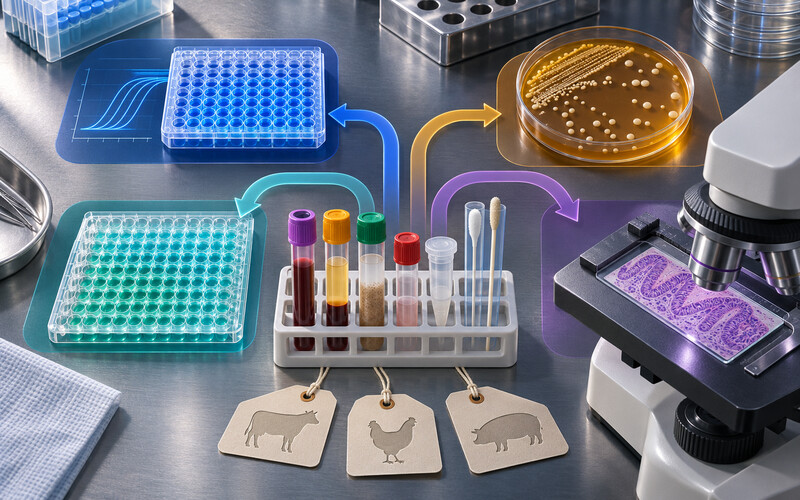
- Veterinary diagnostics method selection should begin with the decision the result must support: acute case management, herd or flock surveillance, movement or trade, outbreak response, or agent characterization.
- PCR, antigen testing, culture, serology, pathology, and sequencing produce different kinds of evidence. A rapid result may be useful without proving viability, exposure timing, or disease causation.
- Specimen type, collection timing, transport, host species, disease stage, treatment history, and the need for later confirmation can matter more than the nominal speed of the analytical platform.
- Reflex, referral, reporting, and specimen-retention rules should be designed before testing begins, especially when a foreign or reportable animal disease is possible.
Veterinary diagnostic laboratories rarely face a simple choice between a fast method and an accurate one. They face a sequence of decisions. A veterinarian may need an actionable result for one animal, a production manager may need to understand whether a problem is moving through a herd or flock, and an animal-health authority may need confirmatory evidence suitable for surveillance or regulatory action.
The same specimen cannot always answer every question. A targeted nucleic acid amplification test can detect a defined sequence quickly, but it may not preserve a viable isolate for culture or antimicrobial susceptibility testing. Serology can support exposure assessment, but its interpretation depends on timing, vaccination, host response, and the validated purpose of the assay. Sequencing can characterize an agent in detail, but only when specimen quality, contamination control, bioinformatics, and reference data are adequate.
This guide provides an operational framework for choosing and linking veterinary diagnostic methods. It is not a disease-specific testing protocol. Laboratories must follow the current collection, testing, referral, reporting, biosafety, and authority requirements that apply to the species, disease, jurisdiction, and intended use.
Start With the Decision, Not the Platform
The World Organisation for Animal Health, or WOAH, begins assay validation with the intended purpose because that purpose shapes the required performance evidence. A laboratory evaluating a test for individual diagnosis is solving a different problem from a laboratory using a test to demonstrate population freedom from infection, support surveillance, or authorize movement.
- Name the decision. State whether the result will guide individual case management, cohort control, surveillance, movement, trade, outbreak response, or another action.
- Define the target evidence. Decide whether the workflow needs nucleic acid, antigen, viable organism, antibody response, tissue-associated lesions, sequence information, or a combination.
- Map the biological window. Consider the likely stage of disease, shedding pattern, immune response, prior vaccination, treatment, and the tissues or fluids in which the target is expected.
- Protect downstream options. Reserve enough appropriate material for culture, pathology, repeat testing, referral, sequencing, or archiving when those steps may become necessary.
- Predefine the action path. Document which findings trigger repeat testing, recollection, a second method, referral, notification, or an amended report.
Put the diagnostic decision and the evidence that must survive at the top of the test plan. This exposes workflows that produce a rapid answer while accidentally eliminating the specimen needed for confirmation or characterization.
Compare Methods by the Evidence They Produce
| Method | Best Operational Fit | Evidence Produced | Tradeoff to Control |
|---|---|---|---|
| Targeted PCR or other NAAT | Rapid testing when a defined pathogen, gene, or small target set is suspected | Presence of the selected nucleic-acid target within the validated specimen and method scope | Can detect nonviable material; inhibition, contamination, target variation, and specimen timing can affect interpretation |
| Antigen detection | Rapid screening or testing where a validated antigen assay fits the species, specimen, and disease stage | Detection of a selected pathogen-associated antigen | Analytical sensitivity and the useful biological window may differ from molecular methods; confirmatory needs are disease-specific |
| Culture or agent isolation | Viability assessment, phenotypic characterization, susceptibility testing, confirmation, or isolate retention | A viable organism or agent that can support downstream work | May be slower and vulnerable to transport, prior treatment, overgrowth, organism requirements, and biosafety constraints |
| Serology | Exposure assessment, immune-response monitoring, surveillance, or paired-sample interpretation | Antibody response within the validated assay and population context | Vaccination, maternal antibody, cross-reactivity, and collection timing can complicate interpretation; it may not establish active infection |
| Histopathology and immunohistochemistry | Disease processes in tissue, lesion distribution, and localization of a selected antigen | Morphologic evidence, sometimes linked to antigen localization | Sampling site, fixation, tissue quality, lesion stage, and interpretive expertise are critical; a negative section may not exclude focal disease |
| Sequencing | Characterization, strain comparison, novel-agent investigation, outbreak analysis, or resistance-marker assessment | Sequence data interpreted through a controlled bioinformatics and reference-data workflow | Cost, turnaround, mixed specimens, coverage, contamination, database quality, and change control can limit operational value |
These methods are often complementary. For example, PCR can prioritize an immediate response, culture can preserve a viable isolate, and sequencing can support comparison among isolates. The correct order depends on the specimen, urgency, biosafety, and authority requirements. For a broader introduction, see What Is Agricultural and Animal Health Testing? and PCR Explained for Beginners.
Design the Workflow Around the Specimen
Coordinate Before Collection
WOAH guidance emphasizes specimen identification, case history, suspected agents, tests requested, animal information, collection dates, transport media, clinical findings, and epidemiological context. The receiving laboratory should be contacted when special handling, regulated shipping, limited stability, unusual matrices, or after-hours delivery may affect acceptance.
That coordination is operationally important because the best analytical method cannot correct an unsuitable specimen. Sampling the wrong site, collecting outside the relevant biological window, allowing temperature excursions, or omitting disease history can produce an inconclusive workflow even when every instrument control passes.
Preserve Multiple Evidence Paths
When specimen volume permits, separate aliquots or parallel collections can protect different evidence paths. Molecular testing, culture, pathology, and referral may require different containers, media, storage conditions, or handling. A single container that is optimal for one method may compromise another.
The plan should state who may divide material, how identities are maintained, which aliquot is tested first, what is retained, and how freeze-thaw cycles are controlled. If destructive extraction or fixation will eliminate later options, that decision should be visible and authorized.
Build Controls Around the Complete Process
A passing amplification control does not demonstrate that the correct animal was sampled, that the specimen remained stable, or that the result reached the right case record. Veterinary diagnostic quality controls should cover accessioning, specimen suitability, extraction, analytical controls, contamination prevention, equipment status, interpretation, reporting, and any data transfer.
USDA’s National Animal Health Laboratory Network uses standardized protocols, reference materials, proficiency testing, personnel competency, secure reporting, and appropriate biosafety as network principles. FDA’s Veterinary Laboratory Investigation and Response Network likewise uses proficiency tests and interlaboratory comparison exercises to evaluate method performance across participating laboratories.
Separate General Practice From Regulatory Requirements
Similarly, NAHLN testing for high-consequence diseases is performed through approved laboratories using controlled methods, training, proficiency testing, and program requirements. A commercial assay or locally validated method is not automatically interchangeable with an authorized network procedure.
Outside a regulatory program, the laboratory still needs a documented quality system, validated or verified methods appropriate to the intended use, trained staff, controlled equipment, records, nonconforming-work procedures, and participation in suitable proficiency or comparison activities. AAVLD accreditation requirements and WOAH quality-management guidance align veterinary testing laboratories with ISO/IEC 17025 principles, but the exact accreditation and program obligations depend on the laboratory’s scope.
Use Reflex Rules to Link Speed With Confirmation
Reflex rules should be written before the first result. A positive molecular result may trigger culture, sequencing, referral, or notification. A negative result may trigger a specimen-quality review, an inhibition check, recollection, paired serology, pathology, or a method aimed at another differential diagnosis. The trigger should depend on the decision and validated method scope, not on a universal cycle threshold or a generic repeat count.
Useful reflex documentation includes:
- The result pattern or case condition that activates the next step.
- The specimen or retained material used for that step.
- The personnel authorized to approve or stop the reflex.
- The required communication with the submitting veterinarian or authority.
- How preliminary, confirmed, amended, and inconclusive results are labeled.
- How discordant results are investigated without selectively repeating until an expected answer appears.
The same discipline appears in public-health testing. LabPress’s public-health microbiology workflow guide explains why rapid detection and surveillance evidence often require linked methods rather than a single-method contest.
Common Failure Modes
The Specimen Does Not Match the Disease Window
The assay is suitable, but the collected material does not contain the target at the relevant stage. Review pathogenesis, collection site, timing, treatment, and validated matrices before blaming the platform.
A Molecular Detection Is Treated as Proof of Infectiousness
Nucleic-acid detection establishes that the selected target was detected within the assay’s scope. It does not, by itself, prove viability, transmissibility, or causation. Interpretation should integrate clinical, epidemiological, and other laboratory evidence.
Serology Is Used Without Timing Context
A single antibody result may be affected by vaccination, prior exposure, maternal antibody, cross-reactivity, or collection timing. The report and test algorithm should reflect the validated interpretation and whether paired samples or another method are required.
The Last Usable Material Is Consumed
Extraction, fixation, or a screening workflow uses all available specimen before culture, referral, or confirmation is considered. Accessioning rules should flag limited-volume and high-consequence cases before material is committed.
Metadata and Results Separate
A result without species, animal identity, specimen type, collection date, location, clinical history, vaccination status, treatment, or epidemiological context may be analytically valid but operationally weak. Required metadata should travel with every aliquot, referral, and result.
A Local Method Is Assumed to Satisfy a Program Requirement
A technically capable laboratory may still lack program authorization, approved instrumentation, current SOP revisions, required proficiency status, or the correct reporting route. Confirm the applicable program before testing regulated or high-consequence submissions.
Illustrative Example: Respiratory Disease in a Production Group
This scenario demonstrates a decision process. It does not prescribe collection, testing, reporting, or treatment for a specific species or disease.
A production group develops an acute respiratory syndrome. The veterinarian needs information for immediate management, while the laboratory must preserve evidence for bacterial characterization and investigate whether the pattern is spreading.
- The veterinarian contacts the laboratory before collection to review the differential diagnosis, disease stage, appropriate animals, specimen types, transport, and any reportable-disease concerns.
- The submission includes affected and relevant comparison animals, complete histories, treatment information, vaccination context, dates, and location metadata.
- Where the specimen and validated methods permit, the laboratory divides material so targeted molecular testing can proceed without eliminating culture, pathology, or referral options.
- A rapid PCR result is reported within its validated scope. The report does not equate target detection with viable agent or complete causation.
- Culture and susceptibility testing proceed when they answer the stated bacterial and treatment questions. Pathology is used when tissue-associated lesions and agent localization are important.
- Sequencing is added only if characterization or comparison will change the operational decision and the specimen or isolate meets the controlled workflow’s requirements.
- Discordant findings trigger review of specimen identity, timing, controls, target coverage, treatment history, and case definition before further testing is authorized.
This layered approach produces an early result while retaining the evidence needed to test alternative explanations. It also creates clear stopping points, so the laboratory does not add expensive characterization that will not change a decision.
Implementation Checklist
- Define the animal-health decision, intended use, and person or authority acting on the result.
- Identify current disease-specific collection, reporting, referral, movement, and biosafety requirements.
- Confirm species, specimen, matrix, disease stage, vaccination, and treatment are within the test plan.
- Contact the receiving or reference laboratory before collecting unusual, regulated, hazardous, or time-sensitive material.
- Map containers, media, temperatures, transport times, accessioning, aliquoting, retention, and disposal.
- Reserve the evidence required for culture, pathology, paired serology, sequencing, referral, or repeat testing.
- Document each method’s validated purpose, limitations, interpretation rules, and authorized users.
- Use process controls appropriate to collection, extraction, analysis, contamination, identity, and reporting.
- Predefine reflex, recollection, confirmation, referral, notification, and amended-report triggers.
- Verify personnel competency, equipment status, reference materials, proficiency testing, and current SOP revisions.
- Exercise the complete workflow with limited-volume, inhibited, discordant, after-hours, and referral scenarios.
- Review whether the final report distinguishes detection, exposure, viability, pathology, characterization, and interpretation.
Authoritative Sources
- WOAH Standards and Codes and Manuals
- WOAH Validation of Diagnostic Assays for Infectious Diseases of Terrestrial Animals
- WOAH Collection, Submission and Storage of Diagnostic Specimens
- WOAH Biotechnology Advances in the Diagnosis of Infectious Diseases
- USDA APHIS National Animal Health Laboratory Network Activities
- USDA APHIS Diagnostic Testing at NVSL
- FDA Veterinary Laboratory Investigation and Response Network
- AAVLD Accreditation Program
Editorial scope: The decision framework and checklist are LabPress editorial recommendations derived from the cited standards and guidance. They do not replace a validated method, a veterinarian’s judgment, an accreditation requirement, or the instructions of the responsible animal-health authority.
Keep Exploring
Related Reading
Evaluating Public Health Microbiology Methods and Workflow Tradeoffs
A decision-first framework for choosing culture, targeted PCR, multiplex panels, and whole-genome sequencing in public health microbiology workflows.Read Article
Evaluating Soil Testing Methods and Workflow Tradeoffs
A practical framework for choosing soil sampling, preparation, extraction, digestion, and analytical methods while balancing representativeness, reporting limits, throughput,…Read Article




Leave a Reply