
Key Points
- Opentrons raised $40 million to expand its laboratory robotics, software, and data infrastructure.
- Element Biosciences began a 10-country European launch of its first CE-marked IVD sequencer.
- New laboratory initiatives span battery materials, integrated R&D records, AI-assisted chromatography review, and whole-genome residual disease testing.
The final week of October brought investment in connected laboratory automation, a regulated sequencing launch in Europe, and new approaches to keeping experimental and analytical data traceable. This edition covers verified developments first published from Oct. 24 through the Friday morning research cutoff on Oct. 30, 2026. Product performance figures and future availability dates are identified as company statements where independent validation is not yet available.

Opentrons Raises $40 Million for Connected Automation
Opentrons announced a $40 million Series E round led by Avego, with participation from BroadOak Capital Partners. The company said it will direct the financing toward robotics and software development, AI-assisted protocol creation and execution, manufacturing scale, geographic expansion, and data infrastructure intended to make automated workflows easier to reproduce. This is a financing announcement, not an independent demonstration of AI performance.
For laboratory leaders, the practical test will be whether that investment improves interoperability, method transfer, deployment support, and reproducibility across instruments, teams, and sites. Read the Oct. 29 Opentrons announcement and LabPress coverage.
Element Brings AVITI Dx Sequencing to Europe
Element Biosciences began the commercial launch of AVITI Dx, its first CE-marked in vitro diagnostic sequencing platform under the European Union’s In Vitro Diagnostic Regulation. Initial availability covers 10 European countries. Element classifies the system as a Class A IVD and says its dual-boot design separates diagnostic and research-use-only modes through distinct software and reagents.
A shared instrument could help laboratories manage capacity, but regulated and exploratory workflows still require clear procedural boundaries, validation, change control, and traceability. See Element’s Oct. 29 release and LabPress coverage.
Agilent and UChicago Build an Energy Materials Research Center
Agilent Technologies and the University of Chicago established a Center of Excellence for Energy Materials Research at the Pritzker School of Molecular Engineering. Researchers plan to use mass spectrometry and atomic spectroscopy to study battery material composition, impurities, interfaces, and degradation pathways.
Battery performance and safety often turn on chemical changes that are difficult to see with a single technique. A shared center can give researchers broader access to instrumentation and applications expertise while supporting comparable analytical methods across academic and industry programs. The details are in Agilent’s Oct. 27 announcement and LabPress coverage.
Genedata Embeds an ELN in Its R&D Platform
Genedata launched an electronic lab notebook inside its biopharmaceutical research and development platform. The company says the ELN connects experimental context with structured records for molecules, samples, process parameters, assays, and analytical results, alongside LIMS, registration, sample management, and workflow execution capabilities.
A continuous data model can reduce manual transfers and preserve lineage as work moves from experimental design through analysis and process development. Its value will still depend on implementation, governance, and integration quality. Review Genedata’s Oct. 28 release and LabPress coverage.
Waters Plans AI-Assisted Peak Integration for Empower
Waters introduced AI-Powered Peak Integration as a premium subscription capability for Empower chromatography software. The company says the system trains on each laboratory’s data, keeps models version controlled, and preserves analyst review and audit traceability. In a Waters-reported pilot of 400 chromatograms, manual interventions fell from 90 to four. Separate company-reported user testing found faster review and less variation among analysts.
Those figures have not been independently validated. Early access is planned for December 2026, with validated, compliant deployment targeted for mid-2027. Regulated laboratories should evaluate model governance, validation, change control, and exception handling alongside efficiency claims. See Waters’ Oct. 28 release and LabPress coverage.
Abbott Launches a Whole-Genome Residual Disease Test
Abbott launched a whole-genome sequencing version of its tumor-informed Oncodetect molecular residual disease test for solid tumors. The test can track as many as 5,000 patient-specific variants, compared with up to 200 in the earlier whole-exome version. Abbott says its MAESTRO enrichment method can produce a limit of detection below one part per million under high-end sample inputs while maintaining analytical specificity above 99%.
These are company-reported analytical claims, and clinical studies are continuing. Oncodetect is a laboratory-developed test performed by Genomic Health in a CLIA-certified high-complexity laboratory; Abbott states that it has not been cleared or approved by the U.S. Food and Drug Administration. For laboratories, the shift raises workflow questions around tumor intake, serial blood collection, informatics, validation, and result integration. Read Abbott’s Oct. 26 release and LabPress coverage.
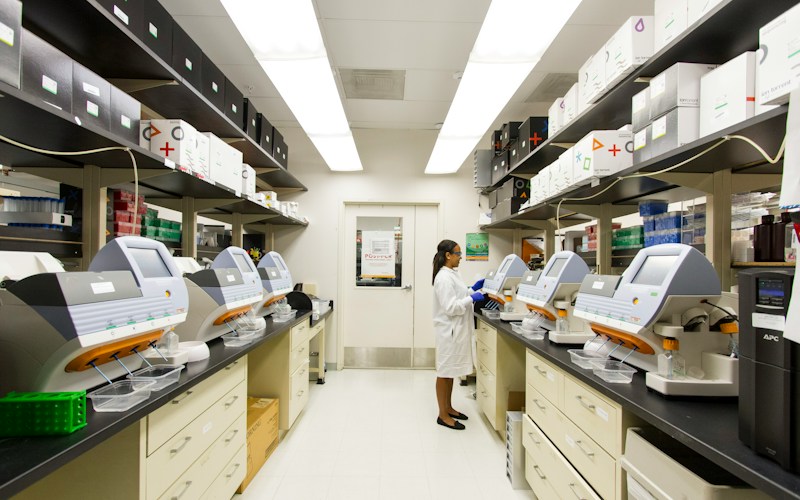
Featured image: National Cancer Institute via Unsplash.
Keep Exploring
Related Reading

Lab Lowdown for October 16, 2026
This week’s laboratory briefing covers AI-connected instruments, genomic analysis, mRNA-production enzymes, agricultural research capacity, and Labcorp’s proposed BioReference acquisition.Read Article



Leave a Reply