
Key Points
- Oil, gas, and mining laboratories turn fluids, gases, rocks, ores, water, waste, and workplace samples into evidence for exploration, production, processing, safety, and environmental decisions.
- The hardest part often comes before the instrument. A sample must represent a large, variable reservoir, orebody, stockpile, process stream, or exposure period.
- Common techniques include gas chromatography, X-ray fluorescence, X-ray diffraction, inductively coupled plasma spectrometry, gravimetric tests, and physical-property measurements.
- Results are defensible when the laboratory connects sample identity, preparation, validated methods, calibration, quality-control checks, units, uncertainty, and decision limits.
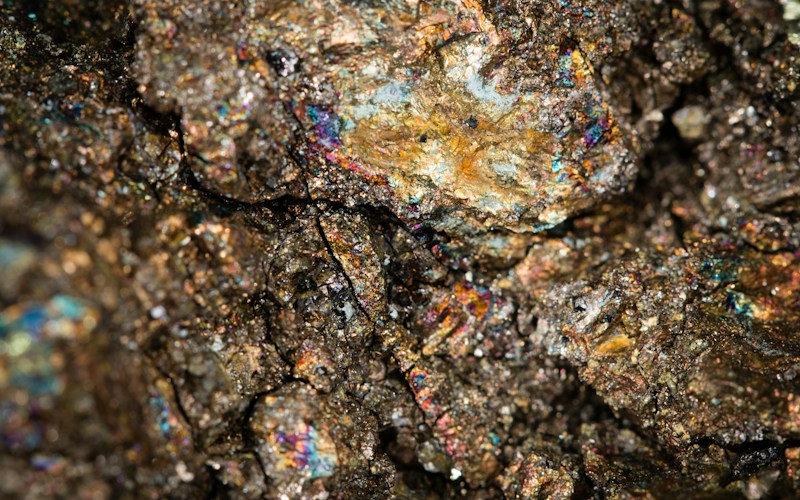
Oil, gas, and mining testing is the laboratory examination of materials and conditions associated with finding, extracting, processing, transporting, and managing natural resources. The work can begin with a drill core from an exploration program, continue with process-control samples from a mine or refinery, and extend to produced water, tailings, soil, air filters, and finished fuels.
The phrase covers several industries rather than one universal test menu. A petroleum laboratory may characterize a crude oil, verify a natural-gas composition, or investigate contaminants in water. A mining laboratory may determine elemental grade, identify minerals, or support a metallurgical recovery study. An industrial hygiene laboratory may measure material collected from workplace air to help assess worker exposure. Each result belongs to a specific sample, method, reporting basis, and decision.
What Oil, Gas, and Mining Testing Means
A laboratory test produces information about a defined property or analyte under a stated procedure. The property could be density, viscosity, flash point, moisture, particle size, mineral phase, elemental concentration, gas composition, sulfur content, acidity, or the amount of a substance collected from workplace air. An analyte is the component being measured. A matrix is everything else in the sample that surrounds that analyte.
The same chemical element can require different preparation and measurement strategies in brine, crude oil, crushed rock, soil, or an air-sampling filter. High salt can suppress or distort some instrumental responses. Hydrocarbon mixtures can contain compounds with overlapping signals. Rock must often be crushed, split, and pulverized before a small laboratory portion can represent a much larger interval or lot. Method selection therefore starts with the decision, the matrix, the expected concentration range, and the required reporting limit.
Testing supports commercial decisions, process control, resource estimation, worker protection, and environmental management. Its role should be stated precisely. An exploration assay estimates selected constituents in submitted material. It does not establish an entire deposit’s value by itself. A produced-water result describes the tested sample and method. It does not automatically prove that every part of a changing process stream has the same composition.
The Main Questions Resource Laboratories Answer
What Is Present?
How Much Is Present?
How Will the Material Behave?
Does It Meet a Requirement?
Different questions can require different tests on the same material. A crude-oil sample may be examined for physical properties, sulfur, water, salts, and a boiling-range profile. A rock sample may need elemental composition, mineral identification, and metallurgical testing because grade alone does not explain how efficiently a valuable mineral can be separated.
From Reservoirs and Orebodies to Laboratory Portions
Resource materials are heterogeneous, meaning their composition varies across space or time. A few grams analyzed in the laboratory may stand for tons of ore, a long drill interval, a storage tank, a pipeline batch, or hours of workplace exposure. The sampling plan must create a defensible connection between that small portion and the larger decision.
| Sample or Matrix | Typical Question | Common Approach | Important Boundary |
|---|---|---|---|
| Natural gas | Which components are present, and in what proportions? | Gas chromatography under a suitable method, with calibration standards and defined reporting basis | Sampling pressure, condensation, leaks, cylinder condition, and changing stream composition can affect representativeness. |
| Crude oil or refined petroleum | Does the material meet a property or composition requirement? | Physical-property tests, spectroscopy, chromatography, elemental analysis, or distillation-related methods | Water, sediment, volatility, stratification, and handling can make a poorly collected sample misleading. |
| Produced water or brine | What dissolved constituents, organics, solids, or other pollutants are present? | Ion chromatography, ICP-OES or ICP-MS, organic analysis, gravimetric methods, and field measurements | High salinity creates matrix challenges. Filtration, preservation, dissolved versus total definitions, and holding time matter. |
| Drill core, chips, or ore | What is the grade, mineralogy, or spatial pattern? | XRF, XRD, ICP-based analysis, microscopy, fire assay, or other commodity-specific methods after controlled preparation | Geologic logging, interval selection, crushing, splitting, particle size, contamination, and coarse particles can dominate error. |
| Process stream, concentrate, or tailings | Is recovery, separation, or waste control performing as intended? | Elemental assay, mineralogy, particle-size analysis, moisture, and mass-balance measurements | Slurries segregate, process conditions change, and dry-basis versus wet-basis reporting can alter interpretation. |
| Air filter or surface sample | What workplace exposure indicator was collected over a defined task or period? | Validated industrial hygiene sampling followed by gravimetric, spectroscopic, or chemical analysis | Sampler selection, flow, location, duration, blank correction, and the exposure assessment plan determine meaning. |
Sample identity should remain traceable from collection through disposal or storage. Labels, custody records, interval depths, coordinates, date and time, sampler, preservation, container, requested methods, and unusual observations can all become essential metadata. A laboratory information management system, or LIMS, can help control these records, although software cannot repair a nonrepresentative sample.
Common Laboratory Methods and What They Reveal
Chromatography
Chromatography separates components before detection. Gas chromatography, or GC, is widely used for compounds that can enter the gas phase under the method’s conditions. It can characterize natural-gas components and analyze many volatile or semivolatile organic compounds. Coupling GC with mass spectrometry, or GC-MS, adds mass-spectral information that supports identification and quantitation. LabPress’s GC-MS systems guide explains why inlet choice, analyzer type, libraries, calibration, and the sample matrix belong in the same method discussion.
Elemental Analysis
X-ray fluorescence, or XRF, measures characteristic X-rays emitted from a material and can support rapid multi-element analysis. Inductively coupled plasma optical emission spectrometry, or ICP-OES, measures light emitted by excited atoms and ions. Inductively coupled plasma mass spectrometry, or ICP-MS, separates ions by mass-to-charge ratio and can support lower concentration measurements for many elements. Preparation, calibration, spectral interference, contamination, dilution, and total dissolved solids affect the result.
The U.S. Geological Survey’s analytical chemistry program describes sample preparation, quality assurance and quality control, X-ray diffraction, and ICP-based work for mineral-resource research. Its BRInE Laboratory lists ion chromatography and ICP-OES capabilities designed for high-salinity produced-water samples. These examples show why a method must be adapted and verified for its actual matrix.
Mineralogy and Imaging
X-ray diffraction, or XRD, helps identify crystalline mineral phases. Optical microscopy, scanning electron microscopy, and microanalytical tools can reveal texture, grain relationships, liberation, inclusions, and mineral hosts for selected elements. Elemental concentration and mineral identity answer related questions. They are not interchangeable measurements.
Classical and Physical Tests
Gravimetric, titrimetric, combustion, distillation, density, viscosity, flash-point, moisture, particle-size, and sieve methods remain important. An instrument with a sophisticated detector is not automatically more suitable than a well-established physical or wet-chemistry method. Fitness depends on the measurand, matrix, range, performance requirements, and decision.
Environmental and Occupational Methods
The Environmental Protection Agency’s SW-846 Compendium contains more than 200 sampling and analytical methods for waste and other matrices. Its sections include digestion and extraction, ICP and XRF methods, chromatography, petroleum-hydrocarbon screening, and leaching procedures. EPA explains that most SW-846 methods are guidance, while specified method-defined parameters can be required by regulation.
The National Institute for Occupational Safety and Health Manual of Analytical Methods, known as NMAM, collects methods for workplace air, surfaces, blood, and urine. NIOSH advises users to choose the best method for the measurement and to verify performance when applying a method in another laboratory or after modification. The method and sampling protocol are parts of one exposure-measurement system.
A Core Testing Workflow
A Concrete Example: Testing a Copper-Bearing Drill Interval
Consider a hypothetical exploration program evaluating a copper-bearing rock interval. The details below illustrate workflow logic and are not a universal assay procedure, sampling frequency, or resource-reporting standard.
A geologist logs the core, records recovery and visible features, marks the interval, and assigns a unique sample identifier. The program defines how the core is cut, which half is submitted, how the retained half is stored, and how equipment is cleaned. Those steps protect the connection between the laboratory sample and its location in the drill hole.
At the preparation laboratory, the submitted interval is dried when appropriate, crushed, and split under the project’s procedure. One split is pulverized to a defined particle-size criterion. The preparation sequence includes controls suited to the risk, such as cleaning material, duplicates, blanks, and certified reference materials. Coarse native metal or unevenly distributed sulfide grains can create sampling error, so the project may need a larger mass or a specialized protocol.
The analytical laboratory weighs a test portion and applies a digestion or fusion selected for the expected minerals and reporting needs. An ICP-OES or ICP-MS method can measure copper and other elements after suitable preparation. The word total needs care because an acid digestion may leave resistant minerals incompletely dissolved. A fusion or another preparation may be needed when the decision requires a more complete decomposition.
The batch includes blanks to reveal contamination, reference materials to challenge accuracy within a relevant range, and duplicate measurements or sample splits to assess selected sources of precision. The laboratory reviews calibration checks, control recoveries, dilution factors, detection limits, and results that exceed the calibrated range. It reports units, method, preparation, qualifiers, and the sample identifiers.
The exploration team then compares analytical results with geology, core recovery, density measurements, spatial continuity, and the quality-control record. Metallurgical tests may examine whether copper-bearing minerals can be liberated and recovered under a proposed process. A concentration result is an important input to resource evaluation. The result gains meaning through the surrounding geologic, sampling, and quality evidence.
Quality Control, Uncertainty, and Practical Limitations
Blanks
Blanks can reveal contamination from containers, reagents, preparation equipment, transport, or the analytical sequence. Different blank types challenge different parts of the workflow. A clean instrument blank cannot rule out contamination introduced during crushing or digestion.
Reference Materials and Calibration
Calibration standards establish the relationship between response and known values. Certified reference materials provide property values with documented uncertainty and traceability for a defined material. A reference material should resemble the sample and concentration range closely enough to challenge the method. A successful check outside the relevant matrix may provide limited assurance.
Duplicates and Replicates
Repeated instrument readings evaluate only part of the process. Duplicate digestions include more preparation variation. Field duplicates or independent splits can include sampling and heterogeneity. The duplicate design should match the source of variation the laboratory or project needs to understand.
Detection and Reporting Limits
A detection limit concerns the ability to distinguish a signal under defined conditions. A reporting limit is the laboratory’s threshold for routinely reporting a quantitative value under its procedure. Neither limit guarantees that a method can support every regulatory, commercial, or scientific decision. Matrix interference, dilution, sample mass, blank contamination, and uncertainty remain relevant.
Screening and Confirmatory Results
Portable XRF, field kits, rapid sensors, and other screening tools can guide sampling or identify areas for follow-up. Their results should be used within a defined performance envelope. Confirmatory laboratory analysis may be required when the decision carries legal, environmental, health, or high-value commercial consequences.
- What exact material, location, depth, time, or exposure period does the sample represent?
- Were collection, container, preservation, holding time, and chain of custody suitable?
- Does the preparation recover or measure the form of the analyte relevant to the decision?
- Did blanks, reference materials, duplicates, spikes, and calibration checks meet their criteria?
- Are the units and reporting basis clear, including wet, dry, dissolved, total, volume, mass, or standard conditions?
- Do any qualifiers, interferences, detection limits, or uncertainty affect the planned decision?
Standards, Permits, and Regulatory Context
Oil, gas, and mining laboratories work within overlapping systems. Commercial contracts and consensus standards can define product tests. Environmental permits can specify monitoring locations, analytes, methods, frequency, and limits. Occupational programs connect air sampling and analysis with worker tasks, duration, and exposure criteria. Resource-estimation and public-reporting frameworks can impose additional expectations for qualified oversight and quality evidence.
For U.S. oil and gas extraction, EPA’s effluent guidelines at 40 CFR Part 435 cover wastewater discharges associated with exploration, drilling, production, well treatment, and well completion. EPA identifies produced water, produced sand, drilling fluids, drill cuttings, and completion-related fluids among the relevant waste streams. Applicability varies by facility category and discharge pathway, so the governing permit and current rule should guide the monitoring plan.
Worker-exposure testing also requires a defined protocol. NMAM notes that an industrial hygienist should determine the sampling approach while considering analytical accuracy, cost, and the optimum number of samples. A laboratory result is one part of the exposure assessment. Task selection, sampler placement, flow, duration, controls, and interpretation remain essential.
Laboratories planning an analytical method or instrument should begin with the measurand, matrix, range, and reporting requirement. LabPress’s guide to choosing analytical instruments by method, matrix, and detection limit provides a practical framework. The complete laboratory instrumentation buyer’s guide offers broader category comparisons. Vendor specifications should be verified against representative samples, complete workflows, service requirements, and the laboratory’s quality system.
Practical Takeaways for Beginners
Start With the Decision
Respect the Sample
Read the Whole Report
Escalate Method Questions
New laboratory professionals can build practical fluency by tracing one sample from collection through reporting, then identifying every place its identity or composition could change. LabPress’s introduction to chemical and materials testing provides additional context on composition, physical properties, destructive testing, and method boundaries.
Frequently Asked Questions
What does an assay mean in mining?
An assay is an analytical determination of one or more constituents in a submitted sample, often reported as a mass fraction or concentration. The method, preparation, units, and quality controls define what the number represents. Resource or reserve conclusions require additional geologic, spatial, technical, economic, and governance work.
What is produced water?
EPA defines produced water as fluid brought up from hydrocarbon-bearing strata during oil and gas extraction. It can include formation water, injected water, and chemicals introduced downhole or during separation. Its composition can be highly saline and can vary by formation and process.
What is the difference between XRF and XRD?
XRF is primarily used for elemental analysis. XRD identifies crystalline phases from their diffraction patterns. A rock can contain the same elements in different minerals, so the two techniques often provide complementary information.
Why are rock samples crushed and pulverized?
Reducing particle size and mixing can make a smaller test portion more representative of the submitted material and can prepare it for digestion, fusion, XRF, XRD, or another method. The procedure must also control contamination, material loss, segregation, and coarse particles.
Can a portable instrument replace a laboratory?
A portable instrument can be valuable for screening and field decisions when its performance is understood. Confirmatory laboratory analysis may still be required for lower reporting limits, difficult matrices, legally consequential decisions, or methods that need controlled preparation and extensive quality checks.
Why can two laboratories report different results?
Differences can arise from sample heterogeneity, splitting, preparation, digestion or extraction, calibration, interferences, moisture basis, units, reporting rules, and random measurement variation. A useful comparison sends well-homogenized material, aligns methods and reporting bases, and evaluates each laboratory’s quality-control evidence.
Authoritative Sources and Further Reading
- U.S. Environmental Protection Agency: The SW-846 Compendium
- U.S. Environmental Protection Agency: Oil and Gas Extraction Effluent Guidelines
- National Institute for Occupational Safety and Health: Manual of Analytical Methods
- U.S. Geological Survey: BRInE Laboratory Capabilities
- U.S. Geological Survey: Analytical Chemistry for Mineral Resources
- U.S. Geological Survey: Research Mineralogy and X-Ray Diffraction
Keep Exploring
Related Reading

Protein Analysis Explained for Beginners
A beginner-friendly guide to protein analysis, from sample preparation and total-protein assays to Western blotting, immunoassays, chromatography, mass spectrometry,…Read Article
Research Reproducibility Explained for Beginners
A beginner’s guide to research reproducibility, from study design and data lineage to independent analysis replay, failure modes, and…Read Article



Leave a Reply